DEEP BLACKS AND VISIBLE RELIEF
About the process
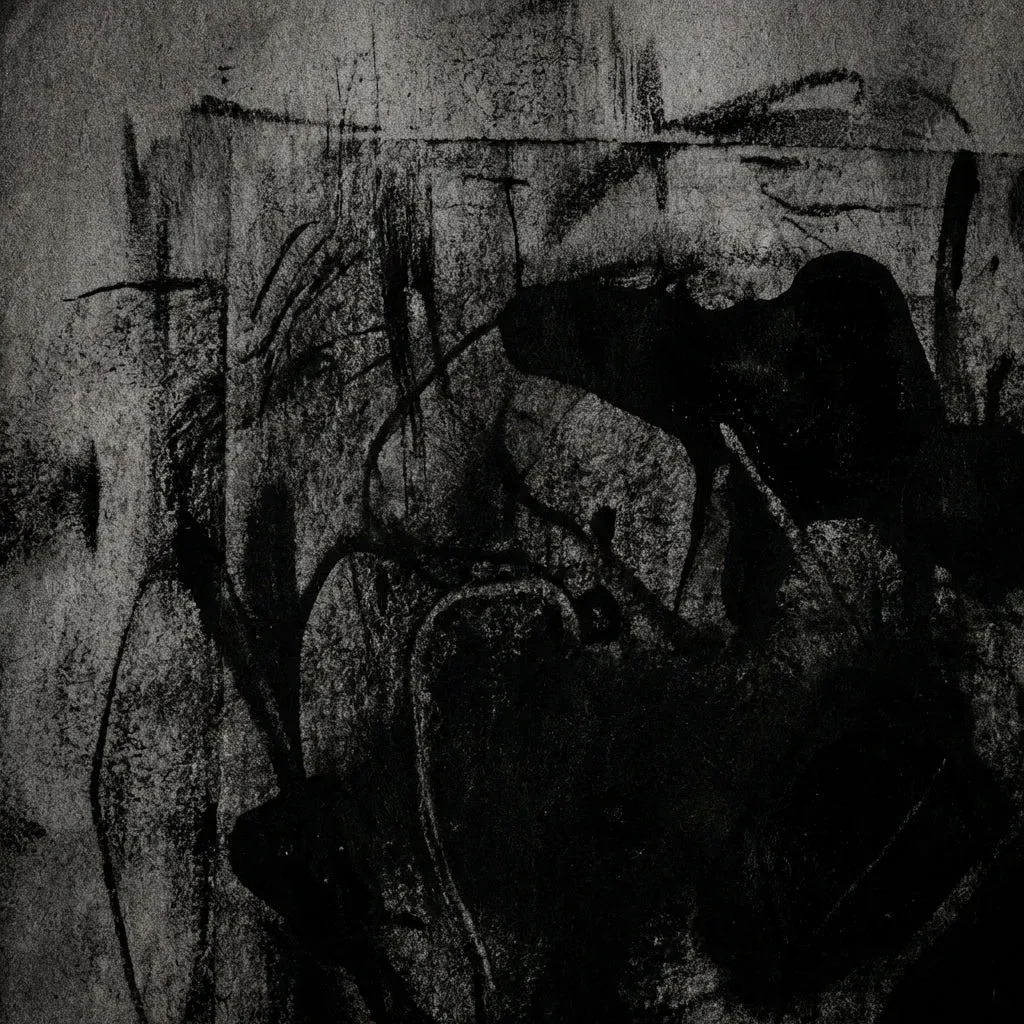
The carbon print uses pigmented gelatin. The gelatin thickness varies with exposure, creating a slight bas-relief visible in raking light. It is the process offering the greatest density (dMax).
History
The carbon process was invented in 1864 by Joseph Wilson Swan, the British chemist and inventor also known for his work on the incandescent lamp. He presented it to the Royal Photographic Society in London that same year, patented as the Carbon Process. The principle: a pigmented gelatin hardened by UV exposure through a negative, then transferred onto a final paper.
Carbon very quickly became the reference process for serious photographic publishers. The Lumière brothers' heliographic works in Lyon, the Autotype Company in London and the Braun firm in Dornach made it their industrial process for reproducing artworks for museums. Late nineteenth-century carbon prints held at the Musée d'Orsay, at George Eastman House in Rochester and at the Metropolitan Museum of Art still show their maximum density intact today.
In 1899 the agronomist Théodore-Henri Fresson (1865-1951) presented a revolutionary carbon paper to the Société française de photographie: Charbon-Satin, developed directly by mechanical dissolution (sawdust, or chamois leather depending on the period), without the constraining transfer stage of Swan's historical carbon. His family made it a proprietary recipe, manufactured the paper in their workshop at Dreux and later at Savigny-sur-Orge, and supplied it to the great Pictorialists — Robert Demachy, Constant Puyo, Léonard Misonne, José Ortiz Echagüe — who made it their medium of choice for its dense matter and exceptional permanence. Five generations later, Michel and Jean-François Fresson still practise the Fresson process at Savigny-sur-Orge, the only studio in the world to master this family recipe. The Maison Picturale carbon print keeps the transfer logic of Swan's historical process (1864), modernised by the Vision Picturale reformulation without dichromate; for the direct development on the final paper that is the distinctive innovation of Fresson's 1899 paper, Maison Picturale offers its neighbouring process, Aquaprint (non-toxic reformulated gum bichromate), which shares with Charbon-Satin that transfer-free logic — the direct pigment family — although the matrix (gum arabic versus gelatin) and the development method (hot water versus mechanical dissolution) remain distinct.
Technically, carbon offers the deepest tonal density of any photographic process, with a dMax above 2.1, higher than fibre-based baryta silver. Examined in raking light, a carbon print reveals a slight low relief of pigmented gelatin — a physical signature impossible for any other process to imitate. It is this relief that distinguishes an authentic carbon print from a mere pigment print.
The contemporary revival of carbon began in the 1990s with the work of Sandy King in the United States and the international network he brought together through books published by Bostick & Sullivan. European practitioners such as Calvin Grier in Spain and the Belgian studios relaunched a demanding practice, restoring the photographic print to the status of a museum object.
At Maison Picturale, carbon printing is carried out in the studio by co-founders Tristan Sidem and Raphaël Lebas de Lacour, in the line of this museum pigment tradition. Our sister brand Vision Picturale took part in the chemical reformulation that makes safe studio use possible while preserving the absolute archival permanence of the historical process.
At Maison Picturale
A Maison Picturale carbon print is a unique piece made by hand by the master printers of the studio at 1 passage Dagorno, Tristan Sidem and Raphaël Lebas de Lacour. Each carbon print takes several days of work: preparing the pigmented gelatin, UV exposure, transfer onto the final paper, controlled drying. It is a strictly museum-grade process, intended for serious collectors and institutions.
Our 640 gsm 100% cotton satin watercolour paper suits carbon particularly well: its weight supports the transfer of pigmented gelatin without distortion, and its satin surface fully reveals the slight low relief that signs the process in raking light. This conservation paper, free of optical brighteners, guarantees the work's permanence across centuries.
The formats available for carbon are Grand Aigle (76 × 112 cm) and Univers (100 × 140 cm) — scales worthy of the process's exceptional tonal depth. We offer two variants in the catalogue: Noir Musée, a dense monochrome recalling the heliogravures of the nineteenth century, and Couleur Profonde, obtained through three successive CMY transfers with millimetre-precise registration between the layers.
For a commissioned print, you can send us your high-resolution file through the contact form. Our printers prepare a digital negative calibrated for carbon's specific tonal curve, which is particularly demanding in the highlights. Allow several weeks: carbon permits no haste.
Example results
32 results for this process
Sizes & Pricing
Pricing on request
This process requires a personalised study based on your project.
Practise at home
Make your own Carbon Print prints at home
One black pouch, the VP N°03 sensitiser and a registration chart, for blacks of absolute depth.
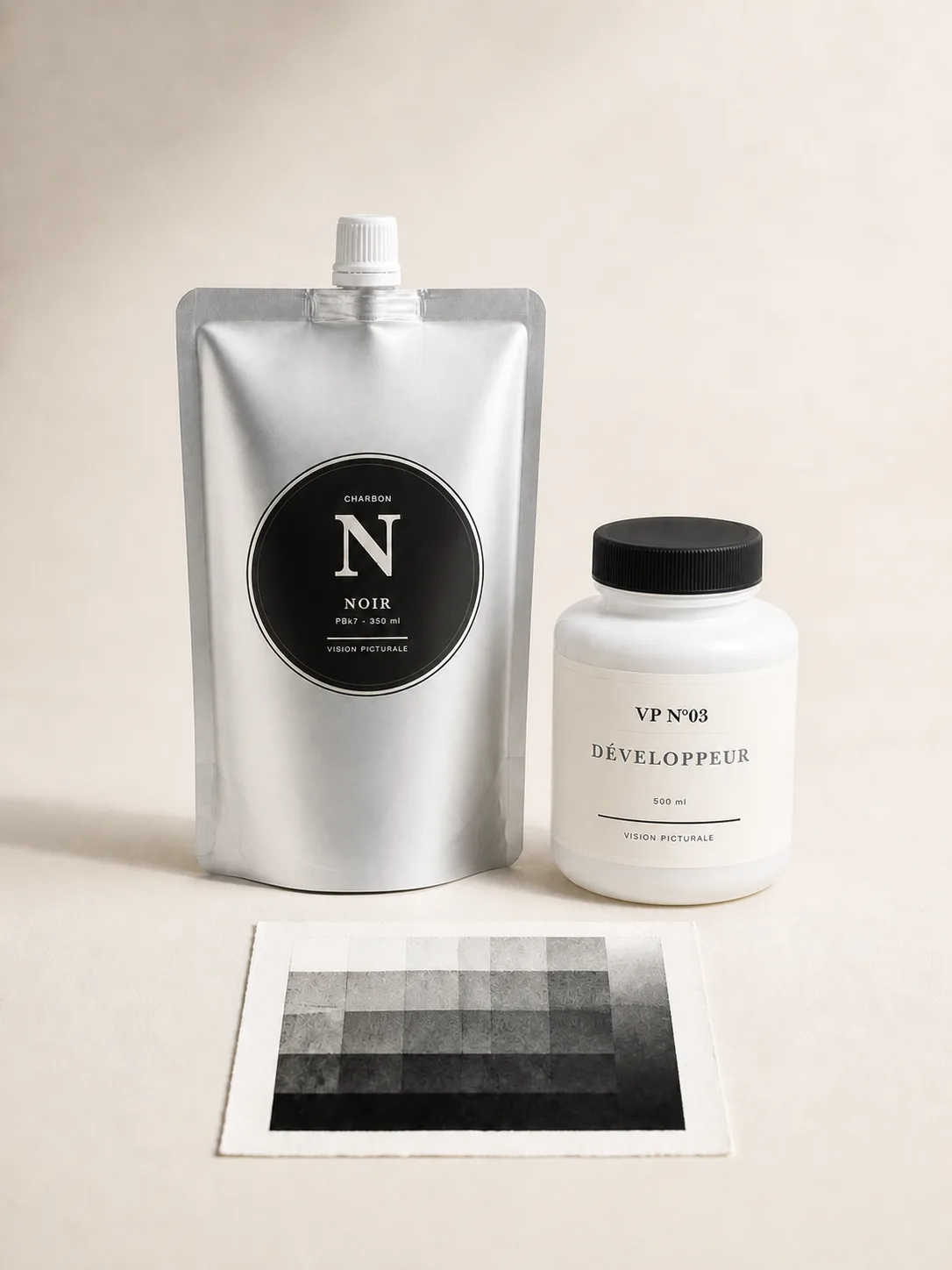
Coffret Charbon Mono — Noir Musée
Reproducibility
Calibrate your Carbon Print
HD test chart → scan → .acv curve in 3 steps. Calibration Flow generates the exact correction for your process.
Calibrate this processFrequently asked questions
Who invented the carbon process, and where are the earliest prints held?
The carbon transfer print was invented in 1864 by Joseph Wilson Swan, the British chemist and inventor and a member of the Royal Photographic Society, who filed UK patent no. 503 on 29 February 1864. Industrialised from the 1880s by the Autotype Company in London and by the Adolphe Braun firm in Alsace, the process became the standard for museum photographic reproduction until the 1930s, thanks to its exceptional archival permanence. Historical carbon prints by Hippolyte Bayard, Pierre-Louis Pierson and the Braun studios are today held at the Musée d'Orsay, the Metropolitan Museum of Art, the George Eastman Museum in Rochester and the Victoria & Albert Museum in London. Its visual signature — maximum density and a slight low relief of pigmented gelatin visible in raking light — distinguishes carbon from every other photographic print.
How does Maison Picturale make a carbon print?
At Maison Picturale, carbon is printed by hand in the studio at 1 passage Dagorno, Paris 20e, by master printers Tristan Sidem and Raphaël Lebas de Lacour, using Vision Picturale's proprietary reformulation, which removes entirely the potassium dichromate historically used. The process combines a sheet of pigmented gelatin (the carbon tissue), exposed under UV from a digital negative calibrated for carbon's very demanding tonal curve, then transferred by adhesion onto the final 640 gsm cotton paper. Maison Picturale offers two variants: Noir Musée, a dense monochrome recalling the heliogravures of the nineteenth century, and Couleur Profonde, obtained through three successive CMY transfers with millimetre-precise registration. Available formats: Grand Aigle (76 × 112 cm) and Univers (100 × 140 cm), scales worthy of the process's tonal depth. Signed and numbered.
How long does a carbon print last, and how stable is it?
Carbon is considered the most stable of the pigment photographic processes, just behind platinum-palladium, with a maximum density measured at 2.1 dMax — higher than any other photographic process. Carbon prints made by the Autotype Company and the Adolphe Braun studios in the 1880s, today held at the Musée d'Orsay, the George Eastman Museum and the Metropolitan Museum, still show their original density after more than 140 years. The mineral pigments used (carbon black, earth pigments) are chemically inert, and the gelatin hardened by exposure forms a stable physical matrix studied by the Image Permanence Institute in Rochester. Kept in standard conditions (moderate lighting, 40-60% humidity, 20 °C), a carbon print crosses several centuries without measurable alteration. A conservation certificate is supplied.
How do I commission a carbon print?
To commission a carbon print from Maison Picturale, send your high-resolution file (16-bit TIFF recommended, 360 dpi minimum for Grand Aigle) through the contact form, specifying the variant you want — monochrome Noir Musée or three-colour Couleur Profonde — and the format. Our master printers prepare a digital negative individually calibrated for carbon's very specific tonal curve, with controlled shadow compression and stretched highlights. A test print is approved before the final one. The standard lead time is six to eight weeks depending on the variant: the three-colour version requires more transfers and millimetre-precise registration between layers. Carbon prices are quoted on request, given the technical complexity and the cost of materials, and are available in Grand Aigle and Univers formats only.
How should a carbon print be framed?
Because carbon carries a slight relief of pigmented gelatin, it must be float mounted, with no direct contact between the surface and the glass — such contact would crush the signature low relief and cause irreversible micro-damage. Maison Picturale recommends high-grade UV-protective glass such as Artglass or Mirogard, a 100% cotton pH-8 neutral mount board thick enough to create the standoff (4 mm minimum), and hinging with Japanese paper along the top edge only. For Grand Aigle and Univers formats a rigid support panel is necessary to prevent distortion. The studio works with several professional Parisian framers who specialise in museum-grade photographic prints; their details are given when the print is handed over. Detailed conservation conditions appear on the certificate.
What is the difference between commissioning a carbon print and making one yourself with a kit?
Maison Picturale and Vision Picturale cover two complementary intentions around carbon. At Maison Picturale you commission a museum-grade fine-art print made by hand by the master printers on 640 gsm cotton paper, with a maximum density of 2.1 dMax and the signature low relief, in a signed and numbered limited edition — an institutional collector's object, archivally stable for several centuries. With the Vision Picturale carbon kit you practise the process yourself, from the non-toxic reformulated chemistry shared by both brands, on more affordable papers, with your own image — a demanding making experience, not a collector's work. The proprietary chemical recipes are the same on both sides: Maison Picturale prints only with the Vision Picturale formulation, free of dichromate. NOEME Picturale Academy offers online courses for going further.
Why is Maison Picturale's carbon print non-toxic?
Since 1864 the historical carbon process has used potassium dichromate to sensitise the pigmented gelatin — a hexavalent chromium salt classified as a Group 1 carcinogen by the International Agency for Research on Cancer (IARC), extremely toxic by inhalation and skin contact, requiring full protective equipment and regulated chemical waste disposal in traditional studios. Maison Picturale has removed this toxic salt entirely by using only Vision Picturale's proprietary reformulation (a confidential recipe), which achieves the same photochemical cross-linking of the gelatin with no dichromate and no chromium at all. The result: carbon's 2.1 dMax and its signature low relief are preserved without compromise, while the studio operates without carcinogenic-fume extraction and without health risk to the master printers. No other French studio offers this combination of museum quality and non-toxic chemistry.
See also
Related processes
Pictorialist masters
- Alphonse Poitevin
1819-1882
- Gustave Le Gray
1820-1884
- Théodore-Henri Fresson
1865-1951
DEEP BLACKS AND VISIBLE RELIEF
About the process
Deep blacks and visible relief for a physical presence of the image. The carbon print uses pigmented gelatin.
The carbon print uses pigmented gelatin. The gelatin thickness varies with exposure, creating a slight bas-relief visible in raking light. It is the process offering the greatest density (dMax).
Recommended files: High-definition TIFF or JPEG (300 dpi). We create the digital negative.
Example results
32 results made with this process
View full gallery →Need advice?
Our team can help you choose the right paper, format and finish for your project.
History
The carbon process was invented in 1864 by Joseph Wilson Swan, the British chemist and inventor also known for his work on the incandescent lamp. He presented it to the Royal Photographic Society in London that same year, patented as the Carbon Process. The principle: a pigmented gelatin hardened by UV exposure through a negative, then transferred onto a final paper.
Carbon very quickly became the reference process for serious photographic publishers. The Lumière brothers' heliographic works in Lyon, the Autotype Company in London and the Braun firm in Dornach made it their industrial process for reproducing artworks for museums. Late nineteenth-century carbon prints held at the Musée d'Orsay, at George Eastman House in Rochester and at the Metropolitan Museum of Art still show their maximum density intact today.
In 1899 the agronomist Théodore-Henri Fresson (1865-1951) presented a revolutionary carbon paper to the Société française de photographie: Charbon-Satin, developed directly by mechanical dissolution (sawdust, or chamois leather depending on the period), without the constraining transfer stage of Swan's historical carbon. His family made it a proprietary recipe, manufactured the paper in their workshop at Dreux and later at Savigny-sur-Orge, and supplied it to the great Pictorialists — Robert Demachy, Constant Puyo, Léonard Misonne, José Ortiz Echagüe — who made it their medium of choice for its dense matter and exceptional permanence. Five generations later, Michel and Jean-François Fresson still practise the Fresson process at Savigny-sur-Orge, the only studio in the world to master this family recipe. The Maison Picturale carbon print keeps the transfer logic of Swan's historical process (1864), modernised by the Vision Picturale reformulation without dichromate; for the direct development on the final paper that is the distinctive innovation of Fresson's 1899 paper, Maison Picturale offers its neighbouring process, Aquaprint (non-toxic reformulated gum bichromate), which shares with Charbon-Satin that transfer-free logic — the direct pigment family — although the matrix (gum arabic versus gelatin) and the development method (hot water versus mechanical dissolution) remain distinct.
Technically, carbon offers the deepest tonal density of any photographic process, with a dMax above 2.1, higher than fibre-based baryta silver. Examined in raking light, a carbon print reveals a slight low relief of pigmented gelatin — a physical signature impossible for any other process to imitate. It is this relief that distinguishes an authentic carbon print from a mere pigment print.
The contemporary revival of carbon began in the 1990s with the work of Sandy King in the United States and the international network he brought together through books published by Bostick & Sullivan. European practitioners such as Calvin Grier in Spain and the Belgian studios relaunched a demanding practice, restoring the photographic print to the status of a museum object.
At Maison Picturale, carbon printing is carried out in the studio by co-founders Tristan Sidem and Raphaël Lebas de Lacour, in the line of this museum pigment tradition. Our sister brand Vision Picturale took part in the chemical reformulation that makes safe studio use possible while preserving the absolute archival permanence of the historical process.
At Maison Picturale
A Maison Picturale carbon print is a unique piece made by hand by the master printers of the studio at 1 passage Dagorno, Tristan Sidem and Raphaël Lebas de Lacour. Each carbon print takes several days of work: preparing the pigmented gelatin, UV exposure, transfer onto the final paper, controlled drying. It is a strictly museum-grade process, intended for serious collectors and institutions.
Our 640 gsm 100% cotton satin watercolour paper suits carbon particularly well: its weight supports the transfer of pigmented gelatin without distortion, and its satin surface fully reveals the slight low relief that signs the process in raking light. This conservation paper, free of optical brighteners, guarantees the work's permanence across centuries.
The formats available for carbon are Grand Aigle (76 × 112 cm) and Univers (100 × 140 cm) — scales worthy of the process's exceptional tonal depth. We offer two variants in the catalogue: Noir Musée, a dense monochrome recalling the heliogravures of the nineteenth century, and Couleur Profonde, obtained through three successive CMY transfers with millimetre-precise registration between the layers.
For a commissioned print, you can send us your high-resolution file through the contact form. Our printers prepare a digital negative calibrated for carbon's specific tonal curve, which is particularly demanding in the highlights. Allow several weeks: carbon permits no haste.
Frequently asked questions
Who invented the carbon process, and where are the earliest prints held?
The carbon transfer print was invented in 1864 by Joseph Wilson Swan, the British chemist and inventor and a member of the Royal Photographic Society, who filed UK patent no. 503 on 29 February 1864. Industrialised from the 1880s by the Autotype Company in London and by the Adolphe Braun firm in Alsace, the process became the standard for museum photographic reproduction until the 1930s, thanks to its exceptional archival permanence. Historical carbon prints by Hippolyte Bayard, Pierre-Louis Pierson and the Braun studios are today held at the Musée d'Orsay, the Metropolitan Museum of Art, the George Eastman Museum in Rochester and the Victoria & Albert Museum in London. Its visual signature — maximum density and a slight low relief of pigmented gelatin visible in raking light — distinguishes carbon from every other photographic print.
How does Maison Picturale make a carbon print?
At Maison Picturale, carbon is printed by hand in the studio at 1 passage Dagorno, Paris 20e, by master printers Tristan Sidem and Raphaël Lebas de Lacour, using Vision Picturale's proprietary reformulation, which removes entirely the potassium dichromate historically used. The process combines a sheet of pigmented gelatin (the carbon tissue), exposed under UV from a digital negative calibrated for carbon's very demanding tonal curve, then transferred by adhesion onto the final 640 gsm cotton paper. Maison Picturale offers two variants: Noir Musée, a dense monochrome recalling the heliogravures of the nineteenth century, and Couleur Profonde, obtained through three successive CMY transfers with millimetre-precise registration. Available formats: Grand Aigle (76 × 112 cm) and Univers (100 × 140 cm), scales worthy of the process's tonal depth. Signed and numbered.
How long does a carbon print last, and how stable is it?
Carbon is considered the most stable of the pigment photographic processes, just behind platinum-palladium, with a maximum density measured at 2.1 dMax — higher than any other photographic process. Carbon prints made by the Autotype Company and the Adolphe Braun studios in the 1880s, today held at the Musée d'Orsay, the George Eastman Museum and the Metropolitan Museum, still show their original density after more than 140 years. The mineral pigments used (carbon black, earth pigments) are chemically inert, and the gelatin hardened by exposure forms a stable physical matrix studied by the Image Permanence Institute in Rochester. Kept in standard conditions (moderate lighting, 40-60% humidity, 20 °C), a carbon print crosses several centuries without measurable alteration. A conservation certificate is supplied.
How do I commission a carbon print?
To commission a carbon print from Maison Picturale, send your high-resolution file (16-bit TIFF recommended, 360 dpi minimum for Grand Aigle) through the contact form, specifying the variant you want — monochrome Noir Musée or three-colour Couleur Profonde — and the format. Our master printers prepare a digital negative individually calibrated for carbon's very specific tonal curve, with controlled shadow compression and stretched highlights. A test print is approved before the final one. The standard lead time is six to eight weeks depending on the variant: the three-colour version requires more transfers and millimetre-precise registration between layers. Carbon prices are quoted on request, given the technical complexity and the cost of materials, and are available in Grand Aigle and Univers formats only.
How should a carbon print be framed?
Because carbon carries a slight relief of pigmented gelatin, it must be float mounted, with no direct contact between the surface and the glass — such contact would crush the signature low relief and cause irreversible micro-damage. Maison Picturale recommends high-grade UV-protective glass such as Artglass or Mirogard, a 100% cotton pH-8 neutral mount board thick enough to create the standoff (4 mm minimum), and hinging with Japanese paper along the top edge only. For Grand Aigle and Univers formats a rigid support panel is necessary to prevent distortion. The studio works with several professional Parisian framers who specialise in museum-grade photographic prints; their details are given when the print is handed over. Detailed conservation conditions appear on the certificate.
What is the difference between commissioning a carbon print and making one yourself with a kit?
Maison Picturale and Vision Picturale cover two complementary intentions around carbon. At Maison Picturale you commission a museum-grade fine-art print made by hand by the master printers on 640 gsm cotton paper, with a maximum density of 2.1 dMax and the signature low relief, in a signed and numbered limited edition — an institutional collector's object, archivally stable for several centuries. With the Vision Picturale carbon kit you practise the process yourself, from the non-toxic reformulated chemistry shared by both brands, on more affordable papers, with your own image — a demanding making experience, not a collector's work. The proprietary chemical recipes are the same on both sides: Maison Picturale prints only with the Vision Picturale formulation, free of dichromate. NOEME Picturale Academy offers online courses for going further.
Why is Maison Picturale's carbon print non-toxic?
Since 1864 the historical carbon process has used potassium dichromate to sensitise the pigmented gelatin — a hexavalent chromium salt classified as a Group 1 carcinogen by the International Agency for Research on Cancer (IARC), extremely toxic by inhalation and skin contact, requiring full protective equipment and regulated chemical waste disposal in traditional studios. Maison Picturale has removed this toxic salt entirely by using only Vision Picturale's proprietary reformulation (a confidential recipe), which achieves the same photochemical cross-linking of the gelatin with no dichromate and no chromium at all. The result: carbon's 2.1 dMax and its signature low relief are preserved without compromise, while the studio operates without carcinogenic-fume extraction and without health risk to the master printers. No other French studio offers this combination of museum quality and non-toxic chemistry.
See also
Related processes
Practise at home
Make your own Carbon Print prints at home
One black pouch, the VP N°03 sensitiser and a registration chart, for blacks of absolute depth.
Discover the Coffret Charbon Mono — Noir MuséeReproducibility
Calibrate your Carbon Print
HD test chart → scan → .acv curve in 3 steps. Calibration Flow generates the exact correction for your process.
Calibrate this processCarbon Print
On request