A VIVID AND DEEP CYAN BLUE
About the process
This process uses two iron salts that become photosensitive when mixed. Exposed to UV light (sunlight or exposure unit), it reveals a monochrome image of an intense blue, particularly suited to botanical subjects or architecture.
History
Cyanotype is one of the oldest photographic processes still practised today. It was invented in 1842 by Sir John Herschel, a British astronomer and chemist, while searching for a way to reproduce his scientific notes. The process relies on the photosensitivity of iron salts which, when exposed to ultraviolet light, produce an intense pigment — Prussian blue.
It was Anna Atkins, a botanist and friend of Herschel, who elevated the cyanotype to an art form. Between 1843 and 1853, she produced "Photographs of British Algae: Cyanotype Impressions", widely considered the first book illustrated with photographs. Her botanical plates — seaweed placed directly on sensitised paper — are now held in the world's greatest institutions: the New York Public Library, the Victoria & Albert Museum, and the Getty Museum.
The process then found an unexpected second life in industry: for over a century, architects and engineers used cyanotype to reproduce their technical drawings — hence the English word "blueprint" (literally "blue print") which still refers to construction plans today.
Since the 1990s, cyanotype has experienced a major artistic renaissance. Contemporary artists such as Meghann Riepenhoff (who exposes her paper to Pacific Ocean waves), Christian Marclay, and Kate Cordsen (whose installations reach 276 m²) have propelled it into contemporary art galleries. World Cyanotype Day, celebrated on the last Saturday of September since 2015, brings together thousands of practitioners worldwide.
At Picturale, we have reformulated cyanotype chemistry to make it 100% non-toxic and kitchen-safe, with no compromise on the depth and richness of the blue achieved.
At Maison Picturale
Every cyanotype print made by Maison Picturale is a unique piece, produced entirely by hand in our Parisian workshop.
The paper used is a 100% cotton satin watercolour stock at 640 g/m², chosen for its ability to absorb the emulsion deep into its fibres — the Prussian blue does not sit on the surface but dyes the very fibre of the paper. This ensures exceptional longevity and a tactile quality reminiscent of engraving.
Our formats range from Coquille (44 × 56 cm) to the monumental Univers (100 × 140 cm). Each print is individually sensitised, exposed, and developed, giving every piece subtle variations that make it truly one-of-a-kind.
You can send us your own image — photograph, illustration, or drawing — and we will transpose it into a cyanotype to your exact specifications. The result is a work at the crossroads of photography, printmaking, and painting.
Example results
24 results for this process
Sizes & Pricing
Coquille
44 × 56 cm
Jésus
56 × 76 cm
Grand Aigle
76 × 112 cm
Univers
100 × 140 cm
Practise at home
Make your own Cyanotype prints at home
Everything you need to make cyanotype prints at home: non-toxic chemistry (chromium-free · solvent-free), gelatin and instructions.
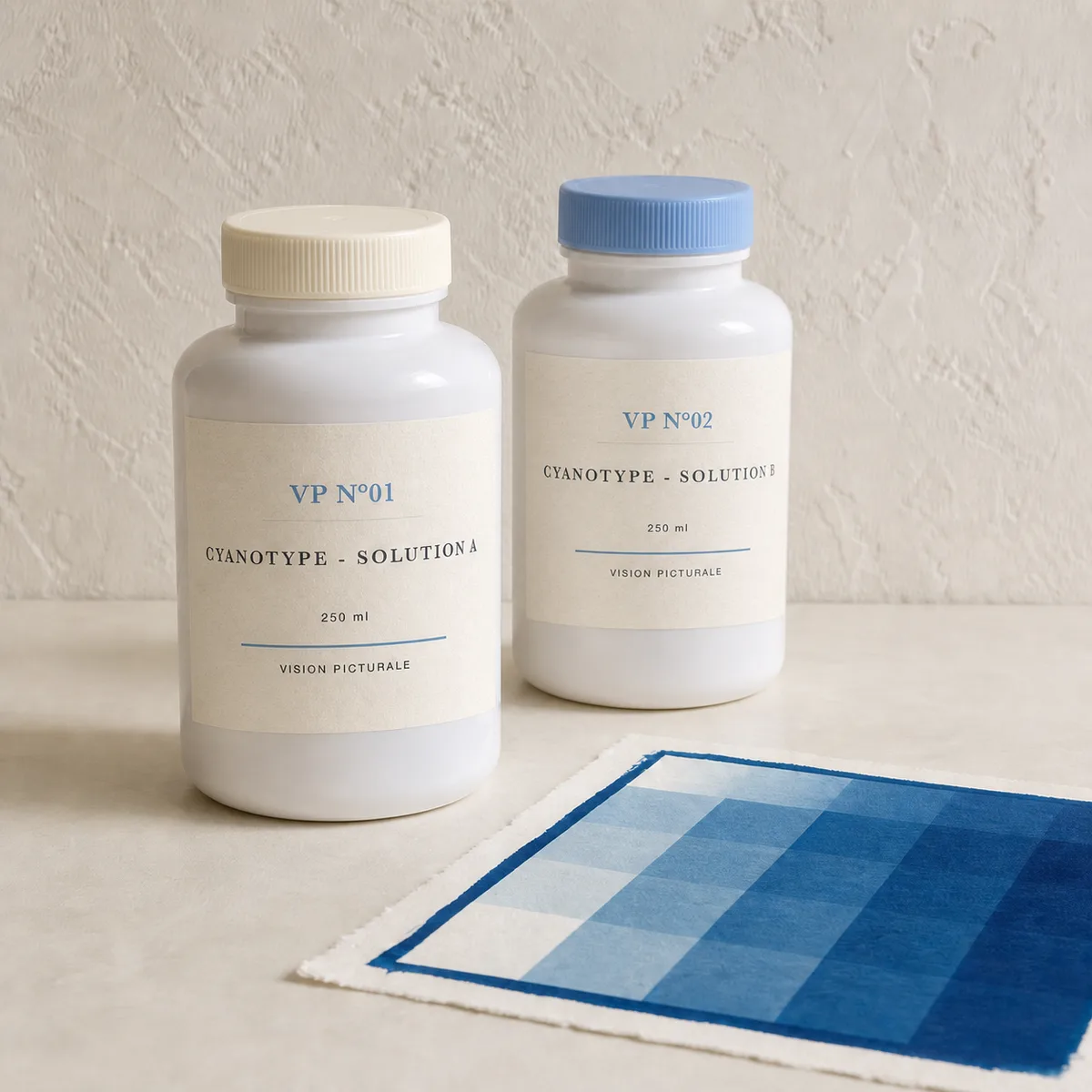
Coffret Cyanotype — Bleu Iconique
Reproducibility
Calibrate your Cyanotype
HD test chart → scan → .acv curve in 3 steps. Calibration Flow generates the exact correction for your process.
Calibrate this processFrequently asked questions
Who invented the cyanotype, and where are the earliest prints held?
The cyanotype was invented in 1842 by Sir John Herschel, the British astronomer and chemist and a Fellow of the Royal Society, while he was looking for a photochemical way of copying his handwritten notes. The process relies on the light sensitivity of two iron salts — ferric ammonium citrate and potassium ferricyanide — which under ultraviolet light produce an intense blue mineral pigment known as Prussian blue. As early as 1843, the English botanist Anna Atkins, a friend of Herschel, published Photographs of British Algae: Cyanotype Impressions, regarded as the first photographic book in history. Her original plates are today held at the New York Public Library, the Victoria & Albert Museum in London, the Getty Museum in Los Angeles, the British Library and the Royal Society. The process was later used on a large scale by architects and engineers to copy their technical drawings — hence the English word blueprint.
How does Maison Picturale make a cyanotype?
Every Maison Picturale cyanotype is printed entirely by hand in the studio at 1 passage Dagorno, Paris 20e, by master printers Tristan Sidem and Raphaël Lebas de Lacour. The paper is a 640 gsm 100% cotton satin watercolour stock, free of optical brighteners, chosen for its ability to absorb the emulsion deep into its fibres: Prussian blue does not sit on the surface but dyes the very fibre of the paper, which is what gives the print its engraving-like feel and its archival permanence. After brush sensitising, the print is exposed under UV light from a digital negative calibrated for the studio's spectral curve, then developed in plain water — with no chemical fixer. Each print is then signed by hand and numbered within its limited edition, in four formats: Coquille (44 × 56 cm), Jésus (56 × 76 cm), Grand Aigle (76 × 112 cm) and Univers (100 × 140 cm).
How long does a cyanotype print last, and how stable is it?
Prussian blue — a ferric mineral pigment studied for its stability by the Image Permanence Institute in Rochester — gives the cyanotype exceptional archival permanence. Kept away from direct sunlight and from environments above 60% relative humidity, a cyanotype print can cross several centuries without visible degradation. The strongest historical evidence is Anna Atkins's work: her Photographs of British Algae plates, made between 1843 and 1853, are today, 180 years on, perfectly legible in the collections of the Victoria & Albert Museum, the British Library and the Getty Museum. Sensitivity to storage conditions is more pronounced than for a traditional fibre-based silver print, but incomparably better than for a standard inkjet print. At Maison Picturale, every print is supplied with a certificate of authenticity detailing the recommended conservation conditions.
How do I commission a cyanotype print?
To commission a cyanotype print from Maison Picturale, send your high-resolution file (TIFF or JPEG, 300 dpi minimum) through the contact form, together with your wishes: format, tonality, finish. Our master printers confirm that the file is technically suitable, recommend the format best suited to the subject, and prepare the digital negative calibrated for the studio's UV exposure. A proof is approved before the final print. The standard lead time for a cyanotype is four to six weeks depending on size and complexity — slightly shorter than carbon or platinum-palladium, which take six to eight weeks. The print is delivered on 640 gsm cotton paper, signed by hand and numbered, with its official certificate of authenticity. Prices start at €100 for the Coquille format and reach €600 for Univers (100 × 140 cm).
How should a cyanotype print be framed?
A Maison Picturale cyanotype should be framed under UV-protective glass to shield the Prussian blue from the progressive fading caused by direct sunlight. A professional framer will use an acid-free conservation mount board to prevent direct contact between the glass and the surface of the print — contact that can in time cause micro-alterations to the cotton paper. For the large formats (Grand Aigle 76 × 112 cm and Univers 100 × 140 cm) a rigid support panel is recommended to keep the paper from warping over the years. The work should hang away from any heat source (radiator, fireplace) and from damp environments (bathroom, external wall). Maison Picturale can recommend several partner framers in Paris who are used to the requirements of museum-grade alternative prints. The certificate of authenticity states the conservation conditions to observe in the long term.
What is the difference between commissioning a cyanotype print and making one yourself with a kit?
Maison Picturale and Vision Picturale cover two complementary intentions around the cyanotype. At Maison Picturale you commission a fine-art print made by hand by the master printers on 640 gsm museum-grade cotton paper, in a signed and numbered limited edition with a certificate of authenticity — a collector's object ready to frame, archivally stable for several centuries. With Vision Picturale's cyanotype kit you practise the process yourself, from the non-toxic reformulated chemistry shared by both brands, on more affordable papers, with your own image and your own gesture — a making experience, not a collector's work. The same chemical recipes are used on both sides: Maison Picturale prints only with the Vision Picturale reformulated chemistry, which guarantees consistency and safety. To go further, NOEME Picturale Academy offers online courses.
Why is Maison Picturale's cyanotype 100% non-toxic?
The cyanotype is historically one of the least toxic alternative processes — its two iron salts (ferric ammonium citrate and potassium ferricyanide) are of low acute toxicity, and development in plain water requires neither solvent nor chemical fixer. Maison Picturale nonetheless uses the formulation reformulated by Vision Picturale, which purifies the iron salts (removing the heavy-metal contaminants found in cheap industrial chemistry) and specifies the dilutions so that no crystalline residue is left. The result: a process that can be practised in a kitchen, a studio that runs without carcinogenic-fume extraction, and residual chemistry compatible with disposal through a domestic waste-water system. This contrasts sharply with historical alternative processes such as traditional gum bichromate (potassium dichromate, a Group 1 carcinogen according to the IARC), for which Maison Picturale has likewise developed non-toxic protocols in partnership with Vision Picturale.
See also
Learn this process
Complete cyanotype course — from your first blue to mastery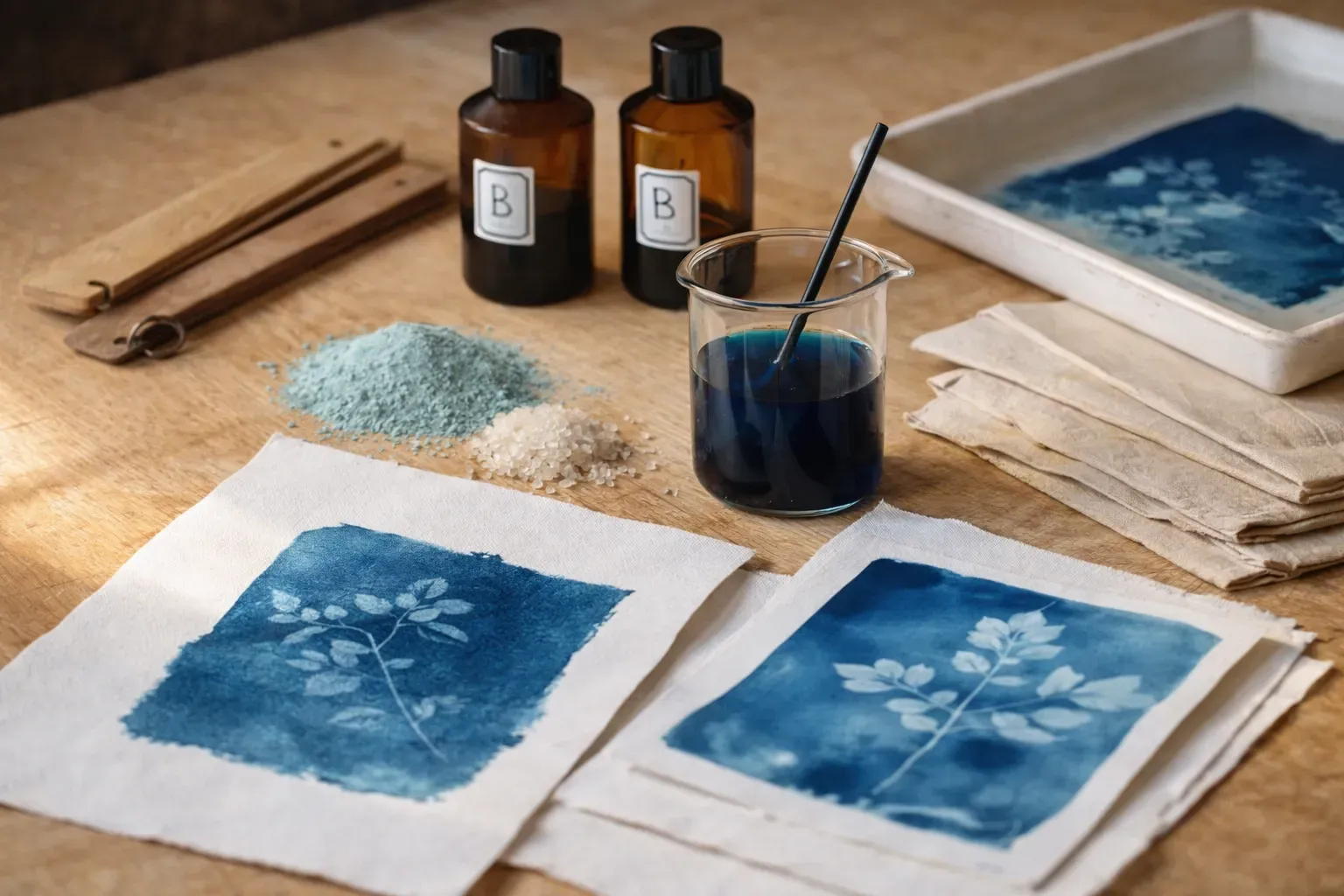
A VIVID AND DEEP CYAN BLUE
About the process
Cyanotype is an alternative negative monochrome photographic process that produces a Prussian blue, cyan blue photographic print.
This process uses two iron salts that become photosensitive when mixed. Exposed to UV light (sunlight or exposure unit), it reveals a monochrome image of an intense blue, particularly suited to botanical subjects or architecture.
Recommended files: High-definition TIFF or JPEG (300 dpi). We create the digital negative.
Example results
24 results made with this process
View full gallery →Need advice?
Our team can help you choose the right paper, format and finish for your project.
History
Cyanotype is one of the oldest photographic processes still practised today. It was invented in 1842 by Sir John Herschel, a British astronomer and chemist, while searching for a way to reproduce his scientific notes. The process relies on the photosensitivity of iron salts which, when exposed to ultraviolet light, produce an intense pigment — Prussian blue.
It was Anna Atkins, a botanist and friend of Herschel, who elevated the cyanotype to an art form. Between 1843 and 1853, she produced "Photographs of British Algae: Cyanotype Impressions", widely considered the first book illustrated with photographs. Her botanical plates — seaweed placed directly on sensitised paper — are now held in the world's greatest institutions: the New York Public Library, the Victoria & Albert Museum, and the Getty Museum.
The process then found an unexpected second life in industry: for over a century, architects and engineers used cyanotype to reproduce their technical drawings — hence the English word "blueprint" (literally "blue print") which still refers to construction plans today.
Since the 1990s, cyanotype has experienced a major artistic renaissance. Contemporary artists such as Meghann Riepenhoff (who exposes her paper to Pacific Ocean waves), Christian Marclay, and Kate Cordsen (whose installations reach 276 m²) have propelled it into contemporary art galleries. World Cyanotype Day, celebrated on the last Saturday of September since 2015, brings together thousands of practitioners worldwide.
At Picturale, we have reformulated cyanotype chemistry to make it 100% non-toxic and kitchen-safe, with no compromise on the depth and richness of the blue achieved.
At Maison Picturale
Every cyanotype print made by Maison Picturale is a unique piece, produced entirely by hand in our Parisian workshop.
The paper used is a 100% cotton satin watercolour stock at 640 g/m², chosen for its ability to absorb the emulsion deep into its fibres — the Prussian blue does not sit on the surface but dyes the very fibre of the paper. This ensures exceptional longevity and a tactile quality reminiscent of engraving.
Our formats range from Coquille (44 × 56 cm) to the monumental Univers (100 × 140 cm). Each print is individually sensitised, exposed, and developed, giving every piece subtle variations that make it truly one-of-a-kind.
You can send us your own image — photograph, illustration, or drawing — and we will transpose it into a cyanotype to your exact specifications. The result is a work at the crossroads of photography, printmaking, and painting.
Frequently asked questions
Who invented the cyanotype, and where are the earliest prints held?
The cyanotype was invented in 1842 by Sir John Herschel, the British astronomer and chemist and a Fellow of the Royal Society, while he was looking for a photochemical way of copying his handwritten notes. The process relies on the light sensitivity of two iron salts — ferric ammonium citrate and potassium ferricyanide — which under ultraviolet light produce an intense blue mineral pigment known as Prussian blue. As early as 1843, the English botanist Anna Atkins, a friend of Herschel, published Photographs of British Algae: Cyanotype Impressions, regarded as the first photographic book in history. Her original plates are today held at the New York Public Library, the Victoria & Albert Museum in London, the Getty Museum in Los Angeles, the British Library and the Royal Society. The process was later used on a large scale by architects and engineers to copy their technical drawings — hence the English word blueprint.
How does Maison Picturale make a cyanotype?
Every Maison Picturale cyanotype is printed entirely by hand in the studio at 1 passage Dagorno, Paris 20e, by master printers Tristan Sidem and Raphaël Lebas de Lacour. The paper is a 640 gsm 100% cotton satin watercolour stock, free of optical brighteners, chosen for its ability to absorb the emulsion deep into its fibres: Prussian blue does not sit on the surface but dyes the very fibre of the paper, which is what gives the print its engraving-like feel and its archival permanence. After brush sensitising, the print is exposed under UV light from a digital negative calibrated for the studio's spectral curve, then developed in plain water — with no chemical fixer. Each print is then signed by hand and numbered within its limited edition, in four formats: Coquille (44 × 56 cm), Jésus (56 × 76 cm), Grand Aigle (76 × 112 cm) and Univers (100 × 140 cm).
How long does a cyanotype print last, and how stable is it?
Prussian blue — a ferric mineral pigment studied for its stability by the Image Permanence Institute in Rochester — gives the cyanotype exceptional archival permanence. Kept away from direct sunlight and from environments above 60% relative humidity, a cyanotype print can cross several centuries without visible degradation. The strongest historical evidence is Anna Atkins's work: her Photographs of British Algae plates, made between 1843 and 1853, are today, 180 years on, perfectly legible in the collections of the Victoria & Albert Museum, the British Library and the Getty Museum. Sensitivity to storage conditions is more pronounced than for a traditional fibre-based silver print, but incomparably better than for a standard inkjet print. At Maison Picturale, every print is supplied with a certificate of authenticity detailing the recommended conservation conditions.
How do I commission a cyanotype print?
To commission a cyanotype print from Maison Picturale, send your high-resolution file (TIFF or JPEG, 300 dpi minimum) through the contact form, together with your wishes: format, tonality, finish. Our master printers confirm that the file is technically suitable, recommend the format best suited to the subject, and prepare the digital negative calibrated for the studio's UV exposure. A proof is approved before the final print. The standard lead time for a cyanotype is four to six weeks depending on size and complexity — slightly shorter than carbon or platinum-palladium, which take six to eight weeks. The print is delivered on 640 gsm cotton paper, signed by hand and numbered, with its official certificate of authenticity. Prices start at €100 for the Coquille format and reach €600 for Univers (100 × 140 cm).
How should a cyanotype print be framed?
A Maison Picturale cyanotype should be framed under UV-protective glass to shield the Prussian blue from the progressive fading caused by direct sunlight. A professional framer will use an acid-free conservation mount board to prevent direct contact between the glass and the surface of the print — contact that can in time cause micro-alterations to the cotton paper. For the large formats (Grand Aigle 76 × 112 cm and Univers 100 × 140 cm) a rigid support panel is recommended to keep the paper from warping over the years. The work should hang away from any heat source (radiator, fireplace) and from damp environments (bathroom, external wall). Maison Picturale can recommend several partner framers in Paris who are used to the requirements of museum-grade alternative prints. The certificate of authenticity states the conservation conditions to observe in the long term.
What is the difference between commissioning a cyanotype print and making one yourself with a kit?
Maison Picturale and Vision Picturale cover two complementary intentions around the cyanotype. At Maison Picturale you commission a fine-art print made by hand by the master printers on 640 gsm museum-grade cotton paper, in a signed and numbered limited edition with a certificate of authenticity — a collector's object ready to frame, archivally stable for several centuries. With Vision Picturale's cyanotype kit you practise the process yourself, from the non-toxic reformulated chemistry shared by both brands, on more affordable papers, with your own image and your own gesture — a making experience, not a collector's work. The same chemical recipes are used on both sides: Maison Picturale prints only with the Vision Picturale reformulated chemistry, which guarantees consistency and safety. To go further, NOEME Picturale Academy offers online courses.
Why is Maison Picturale's cyanotype 100% non-toxic?
The cyanotype is historically one of the least toxic alternative processes — its two iron salts (ferric ammonium citrate and potassium ferricyanide) are of low acute toxicity, and development in plain water requires neither solvent nor chemical fixer. Maison Picturale nonetheless uses the formulation reformulated by Vision Picturale, which purifies the iron salts (removing the heavy-metal contaminants found in cheap industrial chemistry) and specifies the dilutions so that no crystalline residue is left. The result: a process that can be practised in a kitchen, a studio that runs without carcinogenic-fume extraction, and residual chemistry compatible with disposal through a domestic waste-water system. This contrasts sharply with historical alternative processes such as traditional gum bichromate (potassium dichromate, a Group 1 carcinogen according to the IARC), for which Maison Picturale has likewise developed non-toxic protocols in partnership with Vision Picturale.
See also
Related processes
Learn in studio
View workshopLearn this process
Complete cyanotype course — from your first blue to masteryPractise at home
Make your own Cyanotype prints at home
Everything you need to make cyanotype prints at home: non-toxic chemistry (chromium-free · solvent-free), gelatin and instructions.
Discover the Coffret Cyanotype — Bleu IconiqueReproducibility
Calibrate your Cyanotype
HD test chart → scan → .acv curve in 3 steps. Calibration Flow generates the exact correction for your process.
Calibrate this processCyanotype
From €100