GUMPRINT — THE PRECISION OF PHOTOGRAPHY, THE LUMINOSITY OF WATERCOLOUR
About the process
Watercolour gum (gumprint) allows the artist to physically intervene on the image during development. By using colour pigments, one can create images that resemble drawings or paintings more than traditional photographs.
History
Watercolour gum (gumprint, gum bichromate print) is one of the most versatile and oldest photographic processes. Its principle was discovered by Mungo Ponton in 1839, who observed that paper soaked in potassium bichromate hardened under light. It was Alphonse Poitevin who, in 1855, had the idea of mixing watercolour pigment with sensitised gum arabic: by exposing this layer under a negative, the exposed areas harden and retain the pigment while unexposed areas dissolve during washing.
The gumprint enjoyed its golden age between 1890 and 1920, within the Pictorialist movement. Photographers such as Robert Demachy, Edward Steichen, and Gertrude Käsebier used it to create images halfway between photography and painting, asserting photography as a fine art in its own right. Each colour layer is applied, sensitised, and exposed individually — a four-colour print therefore requires a minimum of four passes.
At Picturale, we have reformulated gumprint chemistry to make it 100% non-toxic and workshop-safe, while preserving the chromatic richness and depth characteristic of the process.
At Maison Picturale
The gumprint made by Maison Picturale is an entirely handmade print where each colour layer is a unique pictorial gesture.
We work on 100% cotton satin watercolour paper at 640 g/m², capable of withstanding multiple watercolour passes without warping. In four-colour mode, each print requires four successive layers — cyan, magenta, yellow, and black — each individually sensitised, exposed, and developed. The result is an image with vibrant colours and a grain impossible to achieve with digital printing.
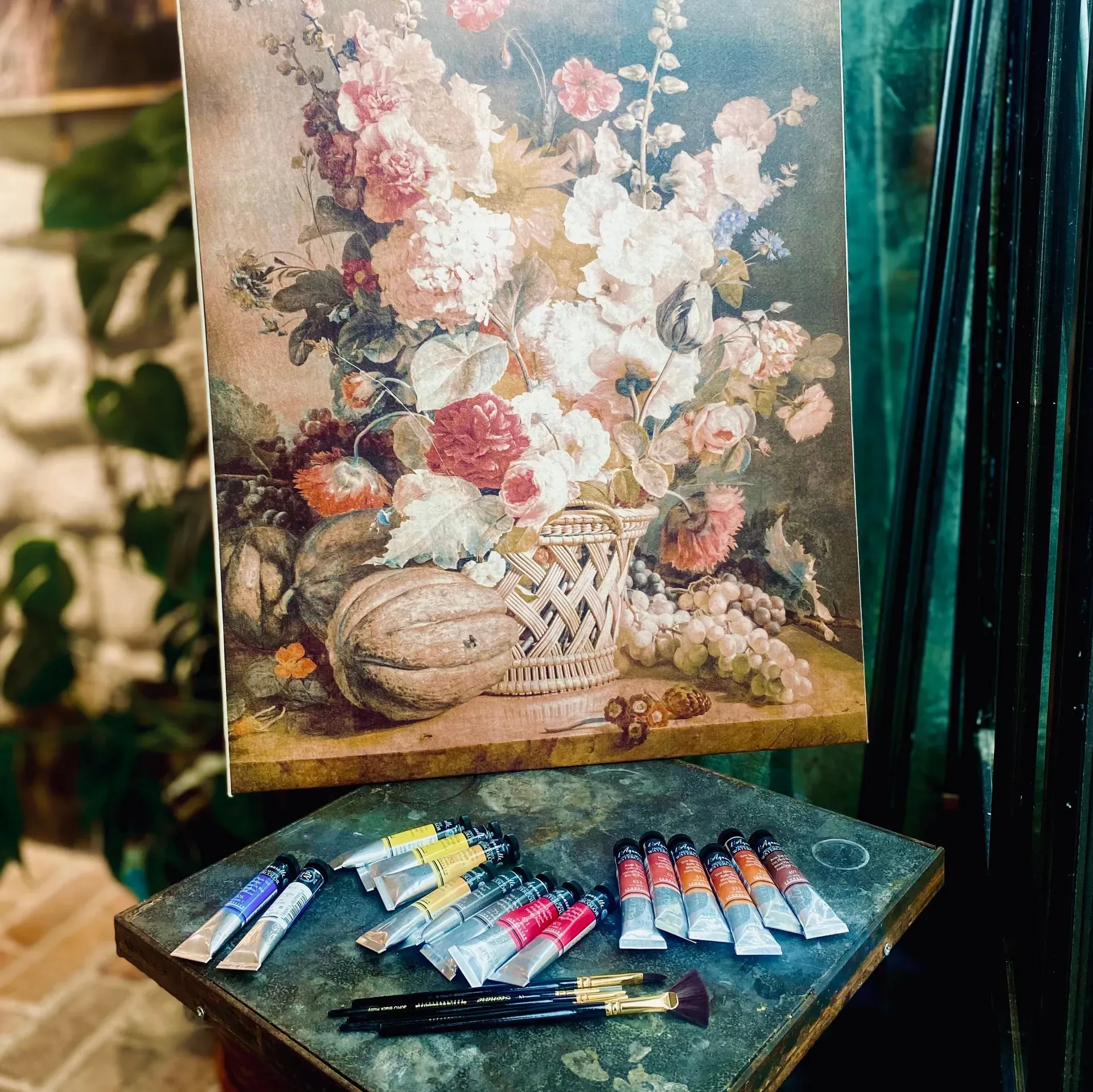
The gumprint also comes in monochrome (single colour) and sanguine (brick-red to burnt sienna tones), offering a range of renderings from Old Master drawings to contemporary watercolour.
Example results
96 results for this process
Sizes & Pricing
Coquille
44 × 56 cm
Jésus
56 × 76 cm
Grand Aigle
76 × 112 cm
Univers
100 × 140 cm
Practise at home
Make your own Watercolour (Gumprint) prints at home
Four ready-to-use colour pouches (cyan, magenta, yellow, black), the chromium-free VP N°03 sensitiser and a CMJN registration chart.
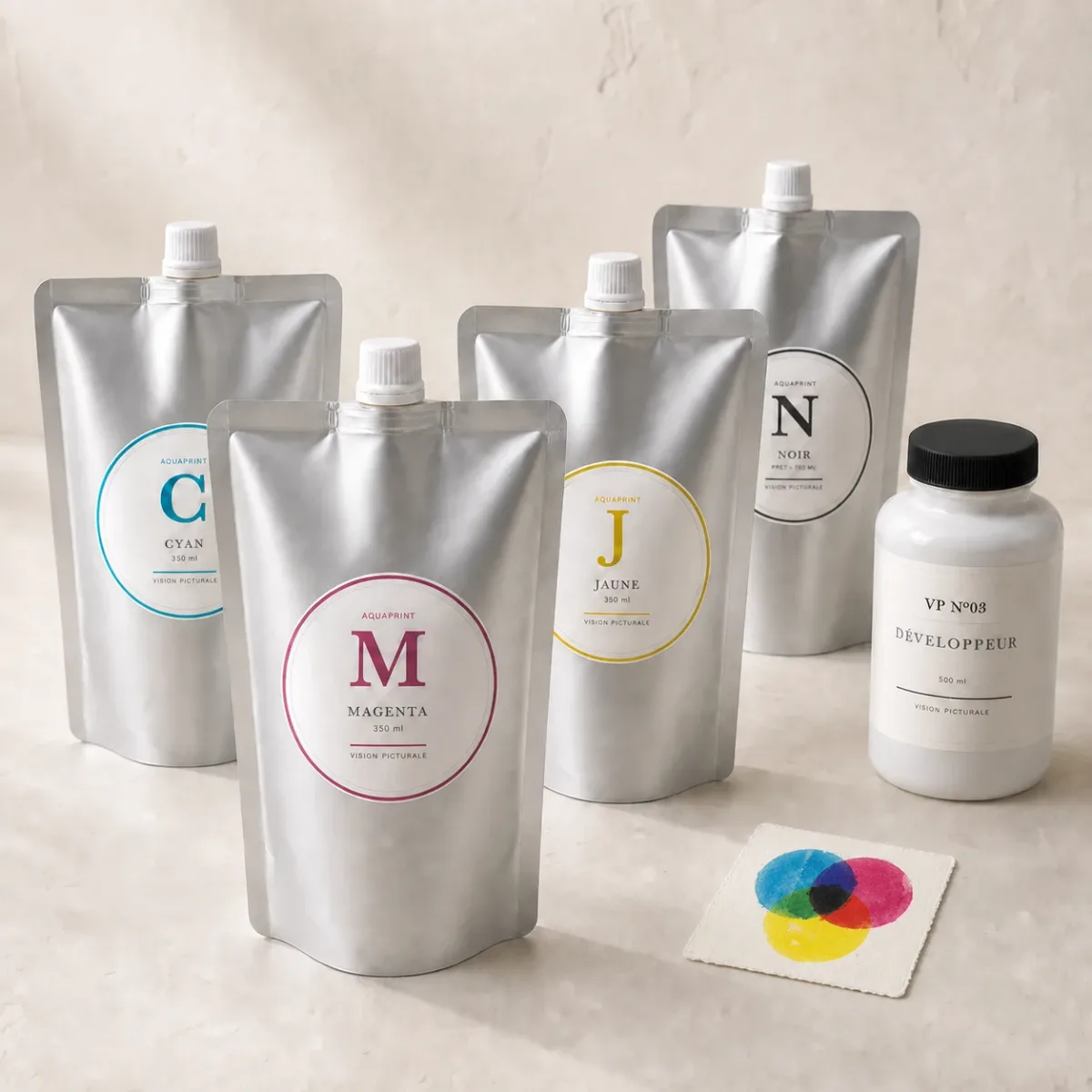
Coffret Aquaprint CMJN — Couleur Aquarelle
Reproducibility
Calibrate your Watercolour (Gumprint)
HD test chart → scan → .acv curve in 3 steps. Calibration Flow generates the exact correction for your process.
Calibrate this processFrequently asked questions
Who invented gum bichromate, and where are the earliest prints held?
Gum bichromate was invented in 1855 by the French chemist Alphonse Poitevin, who patented the dichromate pigment process. It became the emblematic Pictorialist process of the Photo-Club de Paris, founded in 1894 by Robert Demachy, Constant Puyo and Maurice Bucquet, who argued for an author's photography asserted through matter and gesture. In the United States, Alfred Stieglitz, Edward Steichen and Frank Eugene took up the process within the Photo-Secession movement. The reference prints are today held at the Musée d'Orsay (the Demachy collection), at the Metropolitan Museum of Art in New York, at the George Eastman Museum in Rochester and at the Bibliothèque nationale de France. Its visual signature — pigment grain at the surface, vaporous gradations, a sculptural texture built up by layering — sets gum bichromate radically apart from any other photographic technique.
How does Maison Picturale make a gum bichromate print?
At Maison Picturale, gum bichromate is printed by hand in the studio at 1 passage Dagorno, Paris 20e, by master printers Tristan Sidem and Raphaël Lebas de Lacour, using Vision Picturale's proprietary reformulation, which removes potassium dichromate entirely without compromising the Pictorialist visual signature. The paper is a 640 gsm 100% cotton satin watercolour stock, free of optical brighteners. Each print involves two to four successive layers — yellow, magenta, cyan and black for the four-colour variant — sensitised one at a time, exposed under UV from separate negatives, then developed in plain water. The surface pigment grain is worked with a brush, and the feel recalls lithography. Each print is signed by hand and numbered within its limited edition, in four formats: Coquille (44 × 56 cm), Jésus, Grand Aigle and Univers (100 × 140 cm).
How long does a gum bichromate print last, and how stable is it?
Gum bichromate is historically one of the most stable photographic processes: the artists' pigment — selected by Maison Picturale from Sennelier and Old Holland references rated ASTM I (maximum permanence) — is physically incorporated into the gum arabic hardened on the cotton paper. Robert Demachy's original prints from the 1900s, held at the Musée d'Orsay and the Metropolitan Museum, are today, more than 120 years on, perfectly intact. This permanence exceeds that of a traditional fibre-based silver print and reaches the order of magnitude of platinum-palladium. Sensitivity to direct UV light remains measured, but keeping the work out of prolonged sunlight is recommended. At Maison Picturale, every print is supplied with a certificate of authenticity detailing the conservation conditions: moderate lighting, 40-60% relative humidity, a stable temperature around 20 °C.
How do I commission a gum bichromate print?
To commission a gum bichromate print from Maison Picturale, send your high-resolution file (TIFF or JPEG, 300 dpi minimum) through the contact form, together with your wishes: monochrome or four-colour, pigment palette (sepia, raw sienna, slate grey, full colour), format and finish. Our master printers confirm technical suitability — gum bichromate favours subjects with controlled contrast (portraits, landscapes, nudes) — and prepare the separation negatives for each layer. A proof is approved before the final print. The standard lead time is five to seven weeks depending on the number of layers: a four-colour print needs more drying and more layering than a monochrome. Prices start at €300 for a monochrome Coquille and reach €2,000 for a four-colour Univers (100 × 140 cm). Every print is signed, numbered and supplied with its certificate of authenticity.
How should a gum bichromate print be framed?
A Maison Picturale gum bichromate print should be framed under UV-protective glass with an acid-free conservation mount board thick enough to prevent any contact between the glass and the pigmented surface — such contact can, over the long term, cause irreversible pigment transfer. The raised pigment grain that signs the process must be preserved: a professional framer will use a double mount for four-colour variants, where the matter is particularly pronounced. For the large formats (Grand Aigle 76 × 112 cm and Univers 100 × 140 cm) a rigid support panel is recommended to keep the cotton paper from warping over time. The work should hang away from direct sunlight, from any heat source and from damp environments. Maison Picturale can recommend several partner framers in Paris used to the requirements of museum-grade Pictorialist prints.
What is the difference between commissioning a gum bichromate print and making one yourself with a kit?
Maison Picturale and Vision Picturale cover two complementary intentions around gum bichromate. At Maison Picturale you commission a fine-art print made by hand by the master printers on 640 gsm museum-grade cotton paper, in a signed and numbered limited edition with a certificate of authenticity — a collector's object with a Pictorialist pigment grain, archivally stable for more than a century. With Vision Picturale's Aquaprint kit you practise gum bichromate yourself, from the non-toxic reformulated chemistry shared by both brands, on more affordable papers, with your own image — a Pictorialist practice, not a collector's work. The same proprietary chemical recipes are used on both sides: Maison Picturale prints only with the Vision Picturale formulation, free of dichromate, which guarantees consistency and safety. To go further, NOEME Picturale Academy offers online courses.
Why is Maison Picturale's gum bichromate non-toxic?
Since 1855, historical gum bichromate has used potassium dichromate, classified as a Group 1 carcinogen by the International Agency for Research on Cancer (IARC) — a hexavalent chromium salt, extremely toxic by inhalation and skin contact, which in traditional studios requires full protective equipment (P3 mask, nitrile gloves, forced ventilation, regulated waste disposal). Maison Picturale has removed this toxic salt entirely by using only Vision Picturale's proprietary reformulation (a confidential recipe, sold under the name Aquaprint), which achieves the same photochemical cross-linking of the gum arabic with no dichromate and no chromium at all. The result: the authentic Pictorialist rendering — pigment grain, vaporous gradations, sculptural texture — is preserved without compromise, while the studio operates without carcinogenic-fume extraction. No other French studio offers this combination of Pictorialist signature and non-toxic chemistry.
See also
Practised by
- Maxime Riché
Photographer and artist-researcher
Pictorialist masters
- Robert Demachy
1859-1936
- Constant Puyo
1857-1933
- Alphonse Poitevin
1819-1882
- Alfred Stieglitz
1864-1946
- Heinrich Kühn
1866-1944
- Gustave Le Gray
1820-1884
- Gertrude Käsebier
1852-1934
- Charles Marville
1813-1879
- Frank Eugene
1865-1936
- F. Holland Day
1864-1933
- Clarence H. White
1871-1925
- Théodore-Henri Fresson
1865-1951
Learn this process
Gumprint course — from your first layer to full four-colourGUMPRINT — THE PRECISION OF PHOTOGRAPHY, THE LUMINOSITY OF WATERCOLOUR
About the process
The gumprint (watercolour gum, gum bichromate print) consists of layering transparent colour washes of the different primary colours. This process comes in monochrome, four-colour or sanguine variants. Maison Picturale uses a non-toxic reformulated chemistry.
Watercolour gum (gumprint) allows the artist to physically intervene on the image during development. By using colour pigments, one can create images that resemble drawings or paintings more than traditional photographs.
Recommended files: High-definition TIFF or JPEG (300 dpi). We create the digital negative.
Example results
96 results made with this process
View full gallery →Need advice?
Our team can help you choose the right paper, format and finish for your project.
History
Watercolour gum (gumprint, gum bichromate print) is one of the most versatile and oldest photographic processes. Its principle was discovered by Mungo Ponton in 1839, who observed that paper soaked in potassium bichromate hardened under light. It was Alphonse Poitevin who, in 1855, had the idea of mixing watercolour pigment with sensitised gum arabic: by exposing this layer under a negative, the exposed areas harden and retain the pigment while unexposed areas dissolve during washing.
The gumprint enjoyed its golden age between 1890 and 1920, within the Pictorialist movement. Photographers such as Robert Demachy, Edward Steichen, and Gertrude Käsebier used it to create images halfway between photography and painting, asserting photography as a fine art in its own right. Each colour layer is applied, sensitised, and exposed individually — a four-colour print therefore requires a minimum of four passes.
At Picturale, we have reformulated gumprint chemistry to make it 100% non-toxic and workshop-safe, while preserving the chromatic richness and depth characteristic of the process.
At Maison Picturale
The gumprint made by Maison Picturale is an entirely handmade print where each colour layer is a unique pictorial gesture.
We work on 100% cotton satin watercolour paper at 640 g/m², capable of withstanding multiple watercolour passes without warping. In four-colour mode, each print requires four successive layers — cyan, magenta, yellow, and black — each individually sensitised, exposed, and developed. The result is an image with vibrant colours and a grain impossible to achieve with digital printing.
The gumprint also comes in monochrome (single colour) and sanguine (brick-red to burnt sienna tones), offering a range of renderings from Old Master drawings to contemporary watercolour.
Frequently asked questions
Who invented gum bichromate, and where are the earliest prints held?
Gum bichromate was invented in 1855 by the French chemist Alphonse Poitevin, who patented the dichromate pigment process. It became the emblematic Pictorialist process of the Photo-Club de Paris, founded in 1894 by Robert Demachy, Constant Puyo and Maurice Bucquet, who argued for an author's photography asserted through matter and gesture. In the United States, Alfred Stieglitz, Edward Steichen and Frank Eugene took up the process within the Photo-Secession movement. The reference prints are today held at the Musée d'Orsay (the Demachy collection), at the Metropolitan Museum of Art in New York, at the George Eastman Museum in Rochester and at the Bibliothèque nationale de France. Its visual signature — pigment grain at the surface, vaporous gradations, a sculptural texture built up by layering — sets gum bichromate radically apart from any other photographic technique.
How does Maison Picturale make a gum bichromate print?
At Maison Picturale, gum bichromate is printed by hand in the studio at 1 passage Dagorno, Paris 20e, by master printers Tristan Sidem and Raphaël Lebas de Lacour, using Vision Picturale's proprietary reformulation, which removes potassium dichromate entirely without compromising the Pictorialist visual signature. The paper is a 640 gsm 100% cotton satin watercolour stock, free of optical brighteners. Each print involves two to four successive layers — yellow, magenta, cyan and black for the four-colour variant — sensitised one at a time, exposed under UV from separate negatives, then developed in plain water. The surface pigment grain is worked with a brush, and the feel recalls lithography. Each print is signed by hand and numbered within its limited edition, in four formats: Coquille (44 × 56 cm), Jésus, Grand Aigle and Univers (100 × 140 cm).
How long does a gum bichromate print last, and how stable is it?
Gum bichromate is historically one of the most stable photographic processes: the artists' pigment — selected by Maison Picturale from Sennelier and Old Holland references rated ASTM I (maximum permanence) — is physically incorporated into the gum arabic hardened on the cotton paper. Robert Demachy's original prints from the 1900s, held at the Musée d'Orsay and the Metropolitan Museum, are today, more than 120 years on, perfectly intact. This permanence exceeds that of a traditional fibre-based silver print and reaches the order of magnitude of platinum-palladium. Sensitivity to direct UV light remains measured, but keeping the work out of prolonged sunlight is recommended. At Maison Picturale, every print is supplied with a certificate of authenticity detailing the conservation conditions: moderate lighting, 40-60% relative humidity, a stable temperature around 20 °C.
How do I commission a gum bichromate print?
To commission a gum bichromate print from Maison Picturale, send your high-resolution file (TIFF or JPEG, 300 dpi minimum) through the contact form, together with your wishes: monochrome or four-colour, pigment palette (sepia, raw sienna, slate grey, full colour), format and finish. Our master printers confirm technical suitability — gum bichromate favours subjects with controlled contrast (portraits, landscapes, nudes) — and prepare the separation negatives for each layer. A proof is approved before the final print. The standard lead time is five to seven weeks depending on the number of layers: a four-colour print needs more drying and more layering than a monochrome. Prices start at €300 for a monochrome Coquille and reach €2,000 for a four-colour Univers (100 × 140 cm). Every print is signed, numbered and supplied with its certificate of authenticity.
How should a gum bichromate print be framed?
A Maison Picturale gum bichromate print should be framed under UV-protective glass with an acid-free conservation mount board thick enough to prevent any contact between the glass and the pigmented surface — such contact can, over the long term, cause irreversible pigment transfer. The raised pigment grain that signs the process must be preserved: a professional framer will use a double mount for four-colour variants, where the matter is particularly pronounced. For the large formats (Grand Aigle 76 × 112 cm and Univers 100 × 140 cm) a rigid support panel is recommended to keep the cotton paper from warping over time. The work should hang away from direct sunlight, from any heat source and from damp environments. Maison Picturale can recommend several partner framers in Paris used to the requirements of museum-grade Pictorialist prints.
What is the difference between commissioning a gum bichromate print and making one yourself with a kit?
Maison Picturale and Vision Picturale cover two complementary intentions around gum bichromate. At Maison Picturale you commission a fine-art print made by hand by the master printers on 640 gsm museum-grade cotton paper, in a signed and numbered limited edition with a certificate of authenticity — a collector's object with a Pictorialist pigment grain, archivally stable for more than a century. With Vision Picturale's Aquaprint kit you practise gum bichromate yourself, from the non-toxic reformulated chemistry shared by both brands, on more affordable papers, with your own image — a Pictorialist practice, not a collector's work. The same proprietary chemical recipes are used on both sides: Maison Picturale prints only with the Vision Picturale formulation, free of dichromate, which guarantees consistency and safety. To go further, NOEME Picturale Academy offers online courses.
Why is Maison Picturale's gum bichromate non-toxic?
Since 1855, historical gum bichromate has used potassium dichromate, classified as a Group 1 carcinogen by the International Agency for Research on Cancer (IARC) — a hexavalent chromium salt, extremely toxic by inhalation and skin contact, which in traditional studios requires full protective equipment (P3 mask, nitrile gloves, forced ventilation, regulated waste disposal). Maison Picturale has removed this toxic salt entirely by using only Vision Picturale's proprietary reformulation (a confidential recipe, sold under the name Aquaprint), which achieves the same photochemical cross-linking of the gum arabic with no dichromate and no chromium at all. The result: the authentic Pictorialist rendering — pigment grain, vaporous gradations, sculptural texture — is preserved without compromise, while the studio operates without carcinogenic-fume extraction. No other French studio offers this combination of Pictorialist signature and non-toxic chemistry.
See also
Practised by
- Maxime Riché
Photographer and artist-researcher
Learn this process
Gumprint course — from your first layer to full four-colourPractise at home
Make your own Watercolour (Gumprint) prints at home
Four ready-to-use colour pouches (cyan, magenta, yellow, black), the chromium-free VP N°03 sensitiser and a CMJN registration chart.
Discover the Coffret Aquaprint CMJN — Couleur AquarelleReproducibility
Calibrate your Watercolour (Gumprint)
HD test chart → scan → .acv curve in 3 steps. Calibration Flow generates the exact correction for your process.
Calibrate this processWatercolour (Gumprint)
From €300