RESINOTYPE — CHARCOAL EFFECT WITH VELVETY HIGHLIGHTS
About the process
The resinotype offers a unique silky texture that absorbs pigment in a way that creates blacks of exceptional depth. Rosin (pine resin) is at the heart of the process, giving the print its characteristic velvety appearance. Ideal for portraits and landscapes requiring an intimate atmosphere.
History
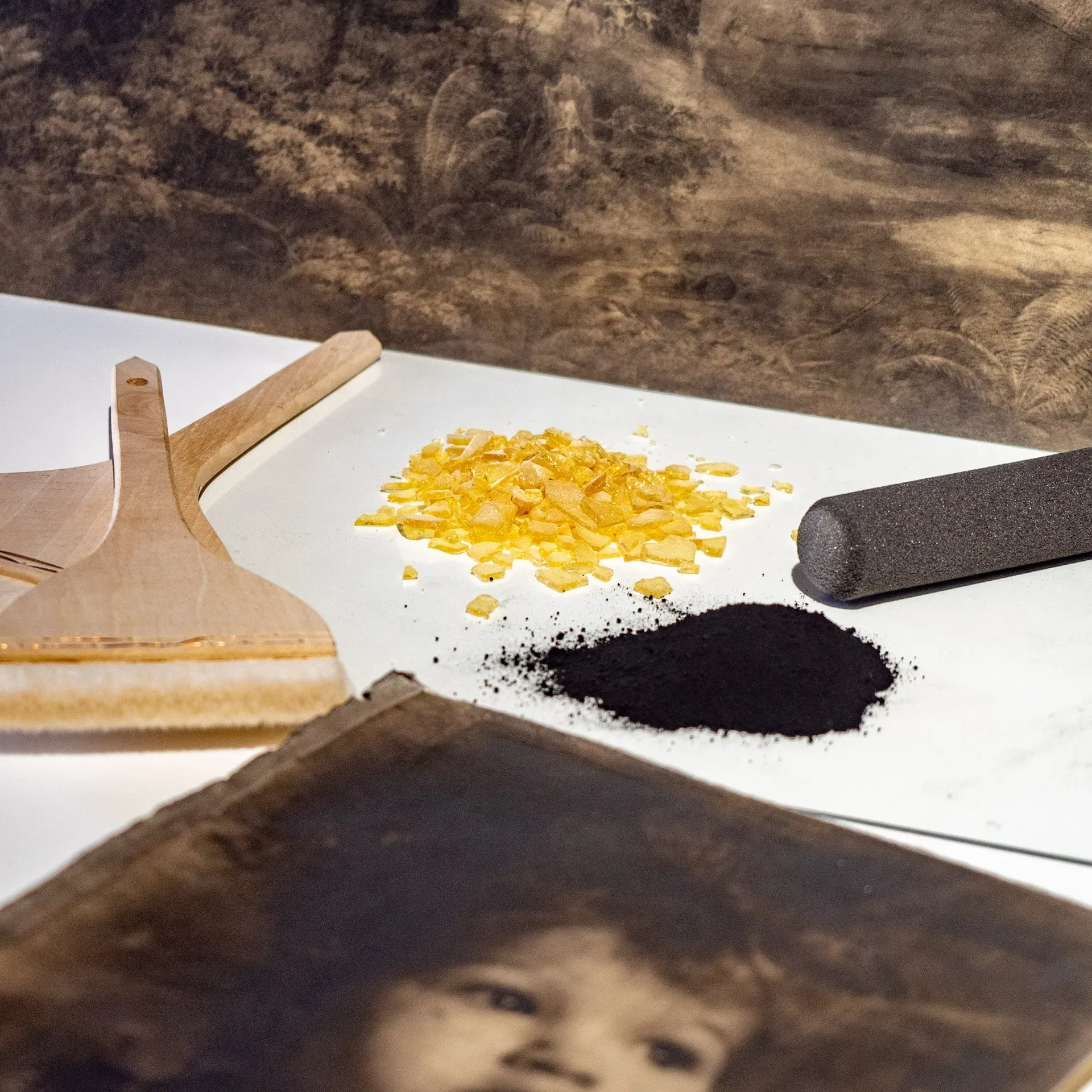
The resinotype is an alternative photographic process invented in the 19th century, belonging to the family of dusting-on processes. Its principle relies on the property of certain resins — particularly rosin, derived from pine resin — to become tacky when exposed to ultraviolet light.
The paper is coated with a layer of gelatin mixed with rosin, then sensitised. After exposure under a negative, the exposed areas harden while the unexposed areas remain tacky. A powdered pigment — carbon black, charcoal, natural earths, or ash — is then dusted on, adhering only to the tacky areas and revealing the image.
The ash resinotype is a remarkable variant where burnt matter (wood, plant, or paper ash) is used as the pigment. This technique creates an organic link between the photographic subject and the very material of the print — particularly poignant for documenting post-wildfire landscapes, as in Maxime Riché's Paradise series.
The process has been rediscovered and reformulated by contemporary artists for its ability to produce blacks of unrivalled depth and softness, with a characteristic velvety appearance that earns it the name "Velvet print" at Maison Picturale.
At Maison Picturale
Every resinotype made by Maison Picturale is a unique piece, produced entirely by hand in our Parisian workshop.
The paper used is a 100% cotton satin watercolour stock at 640 g/m², chosen for its ability to retain the gelatin-rosin layer deep within its fibres. The pigment — carbon black for classic Velvet prints, or ash for ash resinotypes — is hand-dusted, giving every piece unique subtle variations.
Our formats range from Coquille (44 × 56 cm) to the monumental Univers (100 × 140 cm). The chemistry used is entirely reformulated by Picturale to be non-toxic and workshop-safe without specialised equipment.
You can send us your own image — photograph, illustration, or drawing — and we will transpose it into a resinotype to your specifications. The result is a work at the crossroads of photography and charcoal drawing.
Example results
24 results for this process
Sizes & Pricing
Coquille
44 × 56 cm
Jésus
56 × 76 cm
Grand Aigle
76 × 112 cm
Univers
100 × 140 cm
Practise at home
Make your own Velvet (Resinotype) prints at home
The S medium, the VP N°03 sensitiser and a pair of pigments — one warm black, one cool — for velvety blacks.
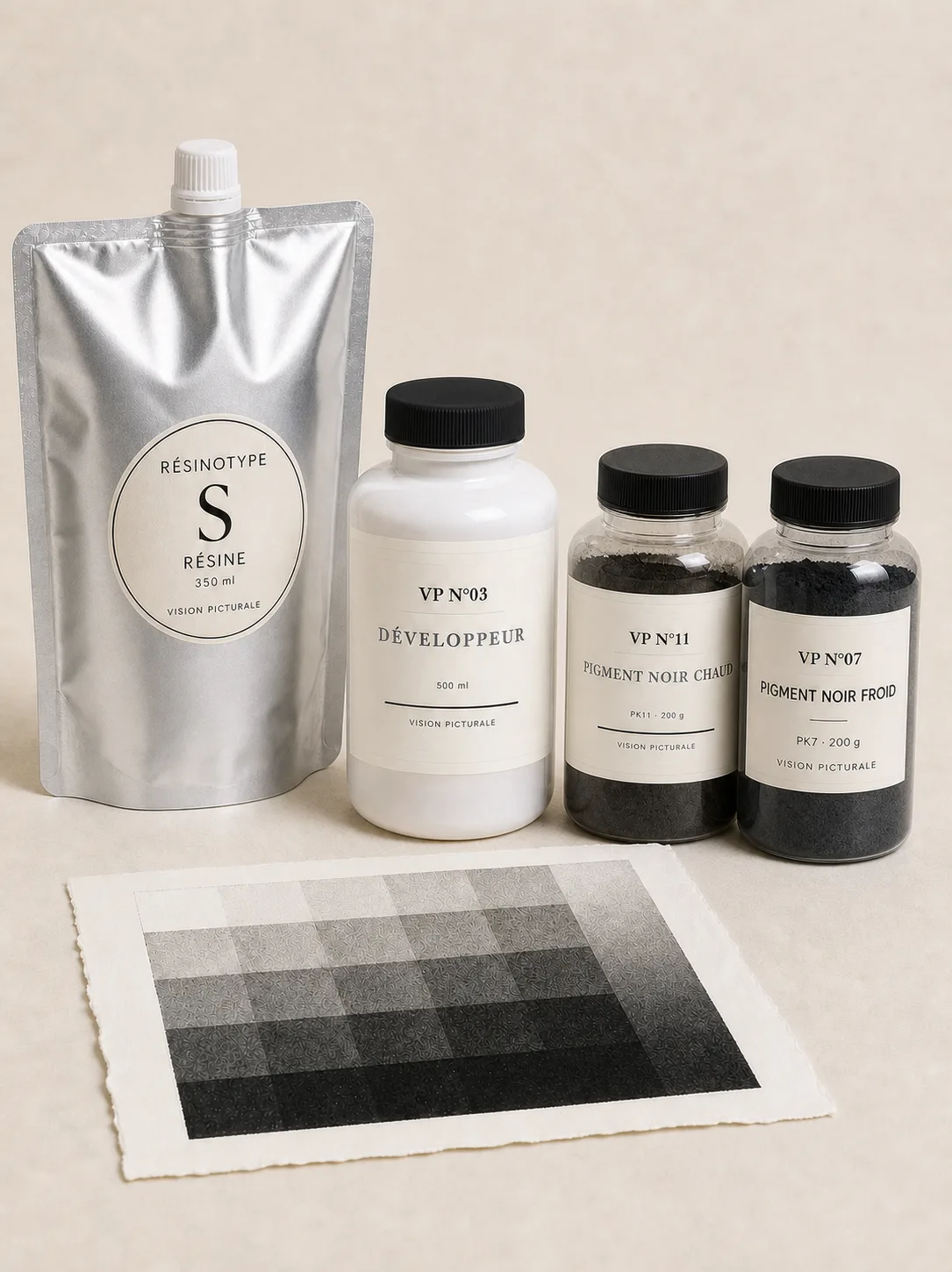
Coffret Résinotype — Velours Minéral
Reproducibility
Calibrate your Velvet (Resinotype)
HD test chart → scan → .acv curve in 3 steps. Calibration Flow generates the exact correction for your process.
Calibrate this processFrequently asked questions
Where does the resinotype come from, and who practises its best-known variants today?
The resinotype derives from the oil process invented in 1904 by G.E.H. Rawlins in Great Britain, which exploits the photochemical sensitivity of dichromated gelatin and its differential affinity for oily pigments. The variant in which a powdered pigment is dusted onto sensitised gelatin — called resinotype, or Velvet in the Maison Picturale catalogue — uses rosin (pine resin) as an additional matrix to deepen the matte black. Today the resinotype remains a little-practised author's process: Maison Picturale is one of the very few European studios to print it in a signed edition. The exclusive ash resinotype variant — in which burnt matter (plant, wood or paper ash) replaces industrial pigment — is used by Maison Picturale for photographer Maxime Riché's Paradise series, in homage to the Californian landscapes devastated by wildfire.
How does Maison Picturale make a Velvet resinotype?
At Maison Picturale, the Velvet resinotype is printed by hand in the studio at 1 passage Dagorno, Paris 20e, by master printers Tristan Sidem and Raphaël Lebas de Lacour, using Vision Picturale's proprietary reformulation, which eliminates the historical potassium dichromate. The 640 gsm satin cotton paper is gelatin-coated then sensitised, exposed under UV from a calibrated digital negative, then dusted through a sieve with the chosen pigments — lamp black for the classic Velvet, or plant ash for the exclusive ash variant. The gelatin hardened by exposure holds the pigment in proportion to the tonal density. The final print shows the signature velvety matte surface, with a measured dMax of around 1.7. Formats: Coquille, Jésus, Grand Aigle, Univers. Signed and numbered.
How long does a Velvet resinotype last, and how stable is it?
The Velvet resinotype offers archival stability comparable to the best historical pigment processes. Rosin (pine resin) forms a chemically inert natural matrix, and the mineral pigments or plant ashes used are inherently stable materials. The gelatin hardened by exposure forms a resistant physical layer. At Maison Picturale the measured maximum density is around 1.7 dMax — slightly below carbon (2.1), but with a unique velvety feel that absorbs light like crushed velvet. Kept away from direct sunlight, at a controlled humidity of 40-60% and a stable temperature, a Velvet resinotype can cross several centuries without visible alteration. Every print is supplied with a certificate of authenticity detailing the conservation conditions and the pigment composition specific to that print (particularly for the ash variant).
How do I commission a Velvet resinotype?
To commission a Velvet resinotype from Maison Picturale, send your high-resolution file (TIFF or JPEG, 300 dpi minimum) through the contact form, specifying the variant you want — classic Velvet (lamp-black pigment) or ash resinotype (the exclusive variant used for Maxime Riché's Paradise series) — and the format. Our master printers confirm that the file is technically suitable, recommend the format best suited to the subject, and prepare the digital negative calibrated for the resinotype's specific curve. A proof is approved before the final print. The standard lead time is five to seven weeks depending on complexity. Prices start at €200 for the Coquille format (44 × 56 cm) and reach €1,200 for Univers (100 × 140 cm). Every print is signed, numbered and supplied with its certificate of authenticity.
How should a Velvet resinotype be framed?
A Maison Picturale Velvet resinotype has a delicate matte pigment surface that must be protected by professional framing. A framer will use high-grade UV-protective glass (Artglass or Mirogard) and an acid-free conservation mount board thick enough (4 mm minimum) to prevent any contact between the glass and the velvety surface — such contact would crush the signature pigment grain and cause irreversible transfer. For the large formats (Grand Aigle 76 × 112 cm and Univers 100 × 140 cm) a rigid support panel is necessary. The work should hang away from direct sunlight, from any heat source and from damp environments. Maison Picturale can recommend several partner framers in Paris used to the requirements of matte-grain pigment prints.
What is the difference between commissioning a Velvet resinotype and making one yourself with a kit?
Maison Picturale and Vision Picturale cover two complementary intentions around the resinotype. At Maison Picturale you commission a fine-art print made by hand by the master printers on 640 gsm museum-grade cotton paper, with the signature velvety surface, in a signed and numbered limited edition with a certificate of authenticity — a rare collector's object, archivally stable for several centuries. The ash variant is exclusive to Maison Picturale, made notably for Maxime Riché's Paradise series. With the Vision Picturale resinotype kit you practise the process yourself, from the non-toxic reformulated chemistry shared by both brands, on more affordable papers, with your own image — a making experience, not a collector's work. The proprietary chemical recipes are the same on both sides. NOEME Picturale Academy offers online courses for going further.
Why is Maison Picturale's Velvet resinotype non-toxic?
Since the early twentieth century the historical resinotype has used potassium dichromate to sensitise the gelatin — a hexavalent chromium salt classified as a Group 1 carcinogen by the International Agency for Research on Cancer (IARC), toxic by inhalation and skin contact. Maison Picturale has removed this toxic salt entirely by using only Vision Picturale's proprietary reformulation (a confidential recipe), which achieves the same photochemical cross-linking of the gelatin with no dichromate and no chromium at all. The rosin (pine resin) and the mineral pigments or plant ashes used are natural materials, free of petroleum solvents and of toxic fumes. The result: the resinotype's signature velvety surface and 1.7 dMax are preserved without compromise, while the studio operates without carcinogenic-fume extraction and without health risk to the master printers.
See also
Related processes
Practised by
- Maxime Riché
Photographer and artist-researcher
Learn this process
Resinotype course — master Velvet prints and ash resinotypesRESINOTYPE — CHARCOAL EFFECT WITH VELVETY HIGHLIGHTS
About the process
The resinotype (resinotypy, or Velvet print) is related to the oil process: the image is revealed by dusting pigment — carbon black, ash or pine resin — onto a sensitised gelatin layer that has been more or less modified by the action of light. The ash resinotype is a variant where burnt matter is incorporated directly into the print.
The resinotype offers a unique silky texture that absorbs pigment in a way that creates blacks of exceptional depth. Rosin (pine resin) is at the heart of the process, giving the print its characteristic velvety appearance. Ideal for portraits and landscapes requiring an intimate atmosphere.
Recommended files: High-definition TIFF or JPEG (300 dpi). We create the digital negative.
Example results
24 results made with this process
View full gallery →Need advice?
Our team can help you choose the right paper, format and finish for your project.
History
The resinotype is an alternative photographic process invented in the 19th century, belonging to the family of dusting-on processes. Its principle relies on the property of certain resins — particularly rosin, derived from pine resin — to become tacky when exposed to ultraviolet light.
The paper is coated with a layer of gelatin mixed with rosin, then sensitised. After exposure under a negative, the exposed areas harden while the unexposed areas remain tacky. A powdered pigment — carbon black, charcoal, natural earths, or ash — is then dusted on, adhering only to the tacky areas and revealing the image.
The ash resinotype is a remarkable variant where burnt matter (wood, plant, or paper ash) is used as the pigment. This technique creates an organic link between the photographic subject and the very material of the print — particularly poignant for documenting post-wildfire landscapes, as in Maxime Riché's Paradise series.
The process has been rediscovered and reformulated by contemporary artists for its ability to produce blacks of unrivalled depth and softness, with a characteristic velvety appearance that earns it the name "Velvet print" at Maison Picturale.
At Maison Picturale
Every resinotype made by Maison Picturale is a unique piece, produced entirely by hand in our Parisian workshop.
The paper used is a 100% cotton satin watercolour stock at 640 g/m², chosen for its ability to retain the gelatin-rosin layer deep within its fibres. The pigment — carbon black for classic Velvet prints, or ash for ash resinotypes — is hand-dusted, giving every piece unique subtle variations.
Our formats range from Coquille (44 × 56 cm) to the monumental Univers (100 × 140 cm). The chemistry used is entirely reformulated by Picturale to be non-toxic and workshop-safe without specialised equipment.
You can send us your own image — photograph, illustration, or drawing — and we will transpose it into a resinotype to your specifications. The result is a work at the crossroads of photography and charcoal drawing.
Frequently asked questions
Where does the resinotype come from, and who practises its best-known variants today?
The resinotype derives from the oil process invented in 1904 by G.E.H. Rawlins in Great Britain, which exploits the photochemical sensitivity of dichromated gelatin and its differential affinity for oily pigments. The variant in which a powdered pigment is dusted onto sensitised gelatin — called resinotype, or Velvet in the Maison Picturale catalogue — uses rosin (pine resin) as an additional matrix to deepen the matte black. Today the resinotype remains a little-practised author's process: Maison Picturale is one of the very few European studios to print it in a signed edition. The exclusive ash resinotype variant — in which burnt matter (plant, wood or paper ash) replaces industrial pigment — is used by Maison Picturale for photographer Maxime Riché's Paradise series, in homage to the Californian landscapes devastated by wildfire.
How does Maison Picturale make a Velvet resinotype?
At Maison Picturale, the Velvet resinotype is printed by hand in the studio at 1 passage Dagorno, Paris 20e, by master printers Tristan Sidem and Raphaël Lebas de Lacour, using Vision Picturale's proprietary reformulation, which eliminates the historical potassium dichromate. The 640 gsm satin cotton paper is gelatin-coated then sensitised, exposed under UV from a calibrated digital negative, then dusted through a sieve with the chosen pigments — lamp black for the classic Velvet, or plant ash for the exclusive ash variant. The gelatin hardened by exposure holds the pigment in proportion to the tonal density. The final print shows the signature velvety matte surface, with a measured dMax of around 1.7. Formats: Coquille, Jésus, Grand Aigle, Univers. Signed and numbered.
How long does a Velvet resinotype last, and how stable is it?
The Velvet resinotype offers archival stability comparable to the best historical pigment processes. Rosin (pine resin) forms a chemically inert natural matrix, and the mineral pigments or plant ashes used are inherently stable materials. The gelatin hardened by exposure forms a resistant physical layer. At Maison Picturale the measured maximum density is around 1.7 dMax — slightly below carbon (2.1), but with a unique velvety feel that absorbs light like crushed velvet. Kept away from direct sunlight, at a controlled humidity of 40-60% and a stable temperature, a Velvet resinotype can cross several centuries without visible alteration. Every print is supplied with a certificate of authenticity detailing the conservation conditions and the pigment composition specific to that print (particularly for the ash variant).
How do I commission a Velvet resinotype?
To commission a Velvet resinotype from Maison Picturale, send your high-resolution file (TIFF or JPEG, 300 dpi minimum) through the contact form, specifying the variant you want — classic Velvet (lamp-black pigment) or ash resinotype (the exclusive variant used for Maxime Riché's Paradise series) — and the format. Our master printers confirm that the file is technically suitable, recommend the format best suited to the subject, and prepare the digital negative calibrated for the resinotype's specific curve. A proof is approved before the final print. The standard lead time is five to seven weeks depending on complexity. Prices start at €200 for the Coquille format (44 × 56 cm) and reach €1,200 for Univers (100 × 140 cm). Every print is signed, numbered and supplied with its certificate of authenticity.
How should a Velvet resinotype be framed?
A Maison Picturale Velvet resinotype has a delicate matte pigment surface that must be protected by professional framing. A framer will use high-grade UV-protective glass (Artglass or Mirogard) and an acid-free conservation mount board thick enough (4 mm minimum) to prevent any contact between the glass and the velvety surface — such contact would crush the signature pigment grain and cause irreversible transfer. For the large formats (Grand Aigle 76 × 112 cm and Univers 100 × 140 cm) a rigid support panel is necessary. The work should hang away from direct sunlight, from any heat source and from damp environments. Maison Picturale can recommend several partner framers in Paris used to the requirements of matte-grain pigment prints.
What is the difference between commissioning a Velvet resinotype and making one yourself with a kit?
Maison Picturale and Vision Picturale cover two complementary intentions around the resinotype. At Maison Picturale you commission a fine-art print made by hand by the master printers on 640 gsm museum-grade cotton paper, with the signature velvety surface, in a signed and numbered limited edition with a certificate of authenticity — a rare collector's object, archivally stable for several centuries. The ash variant is exclusive to Maison Picturale, made notably for Maxime Riché's Paradise series. With the Vision Picturale resinotype kit you practise the process yourself, from the non-toxic reformulated chemistry shared by both brands, on more affordable papers, with your own image — a making experience, not a collector's work. The proprietary chemical recipes are the same on both sides. NOEME Picturale Academy offers online courses for going further.
Why is Maison Picturale's Velvet resinotype non-toxic?
Since the early twentieth century the historical resinotype has used potassium dichromate to sensitise the gelatin — a hexavalent chromium salt classified as a Group 1 carcinogen by the International Agency for Research on Cancer (IARC), toxic by inhalation and skin contact. Maison Picturale has removed this toxic salt entirely by using only Vision Picturale's proprietary reformulation (a confidential recipe), which achieves the same photochemical cross-linking of the gelatin with no dichromate and no chromium at all. The rosin (pine resin) and the mineral pigments or plant ashes used are natural materials, free of petroleum solvents and of toxic fumes. The result: the resinotype's signature velvety surface and 1.7 dMax are preserved without compromise, while the studio operates without carcinogenic-fume extraction and without health risk to the master printers.
See also
Related processes
Practised by
- Maxime Riché
Photographer and artist-researcher
Learn this process
Resinotype course — master Velvet prints and ash resinotypesPractise at home
Make your own Velvet (Resinotype) prints at home
The S medium, the VP N°03 sensitiser and a pair of pigments — one warm black, one cool — for velvety blacks.
Discover the Coffret Résinotype — Velours MinéralReproducibility
Calibrate your Velvet (Resinotype)
HD test chart → scan → .acv curve in 3 steps. Calibration Flow generates the exact correction for your process.
Calibrate this processVelvet (Resinotype)
From €200