THE OIL-INK PRINT: VELVETY, INTENSE & UNALTERABLE
About the process
Bromoil is a hybrid process where a silver print is chemically treated then hand-inked with greasy inks. Each brush stroke is a unique gesture, giving an incomparable pictorial character to the photographic image.
History
Bromoil was born in London in 1907 at the instigation of C. Welborne Piper, who formalised a process for turning a gelatin-silver print into a matrix that could be inked by hand. E.J. Wall consolidated the technique in his reference work The Bromoil Process, making it one of the technical standards of the Anglo-Saxon Pictorialist movement.
French Pictorialists adopted bromoil immediately for its closeness to oil painting. Robert Demachy, the tutelary figure of French Pictorialism, produced several series now held at the Musée d'Orsay. The Royal Photographic Society Collection in London holds the major prints of the English school — evidence of the continuous dialogue between photography and the graphic arts at the turn of the twentieth century.
Technically, the process starts from a silver print that is bleached and then re-inked by hand with Charbonnel intaglio ink, applied with a foam roller. Each tonal zone takes up ink according to the differential swelling of the gelatin, exactly as a lithographic matrix does. The printer's gesture determines the final rendering entirely.
After several decades of eclipse, bromoil was revived in the 1990s by British and North American studios, notably around the Bostick & Sullivan workshop circuit. Contemporary photographers such as David Lewis and Gene Laughter published manuals that relaunched a demanding practice, giving the photographic print back an openly painterly materiality.
Maison Picturale works within this French Pictorialist tradition while benefiting from the chemistry reformulated by our sister brand Vision Picturale, which has removed copper dichromate from the historical bleaching bath. The Paris 20e studio thus carries on Demachy's gesture with contemporary safety.
At Maison Picturale
Every bromoil print made at the studio at 1 passage Dagorno is a unique piece, inked by hand by our master printers. Because the process remains editable for several hours while the roller work goes on, two prints from the same negative are never alike: gesture, pressure and ink distribution sign each copy irreducibly.
We work exclusively on 640 gsm 100% cotton satin watercolour paper, chosen for its ability to withstand the swelling of the gelatin without distortion, and for the velvety depth it gives to intaglio black. This conservation-grade paper gives the inked work a stability spanning several centuries.
The formats available for bromoil are Jésus (56 × 76 cm) and Grand Aigle (76 × 112 cm) — the scales that reveal the process's characteristic ink grain and the richness of its tonal transitions. Smaller formats would flatten the painterly matter that is precisely what makes the process valuable.
For a commissioned print, you can send us your own high-resolution file through the contact form. Our printers then prepare a digital negative calibrated for the specific contrast bromoil requires, and produce your print according to the rendering you want — more graphic or more painterly, depending on your project.
Example results
24 results for this process
Sizes & Pricing
Coquille
44 × 56 cm
Jésus
56 × 76 cm
Grand Aigle
76 × 112 cm
Univers
100 × 140 cm
Practise at home
Make your own Bromoil prints at home
The Resinotype S medium, the VP N°03 sensitiser, a Charbonnel pigment tube and a Bromoil registration chart.
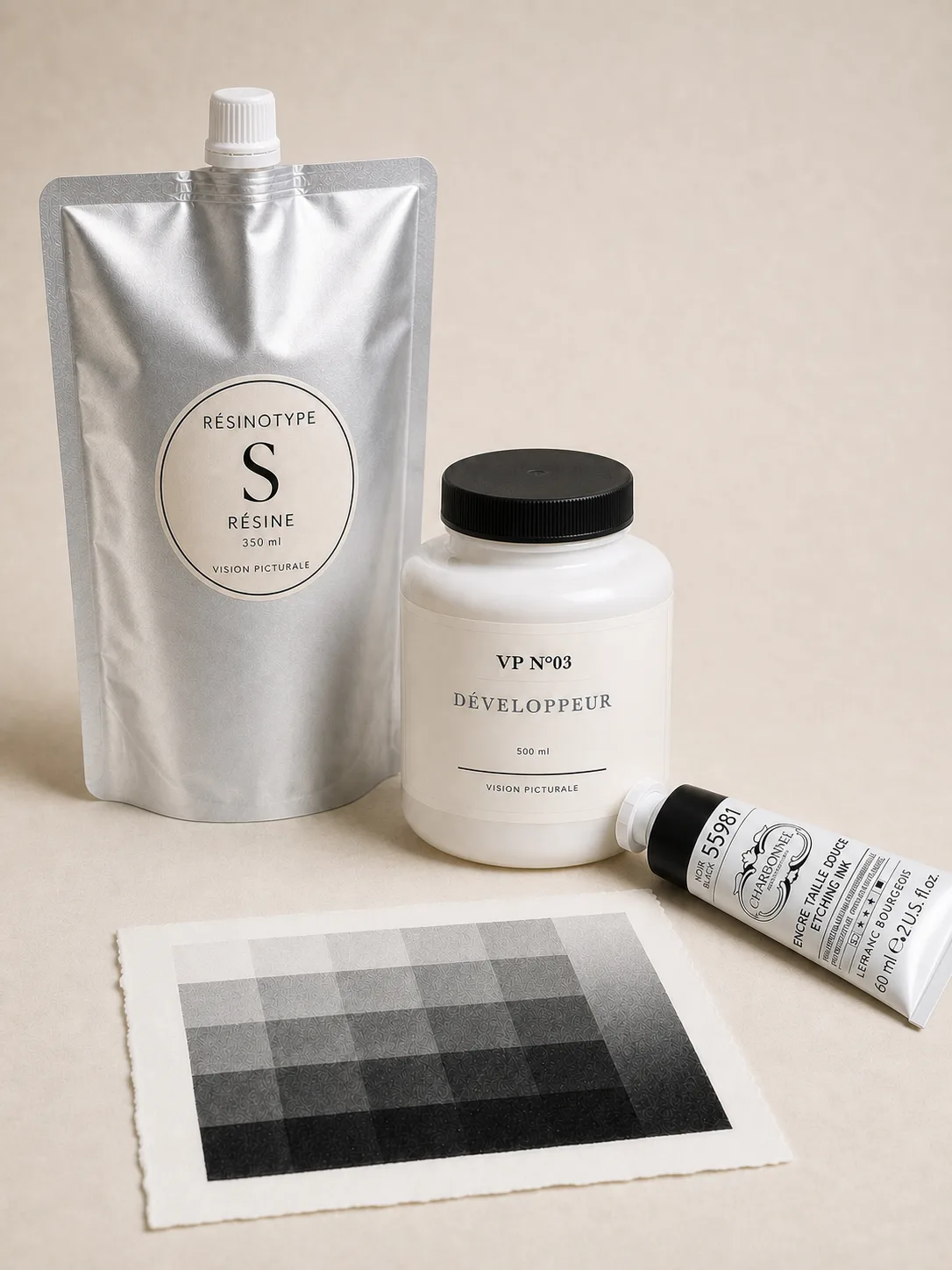
Coffret Bromoil — Huile Vivante
Reproducibility
Calibrate your Bromoil
HD test chart → scan → .acv curve in 3 steps. Calibration Flow generates the exact correction for your process.
Calibrate this processFrequently asked questions
Who invented bromoil, and where are the earliest prints held?
Bromoil was invented in London in 1907 by C. Welborne Piper, a technician attached to the Royal Photographic Society, who published the detailed protocol in the British Journal of Photography. The technique was then theorised by E.J. Wall in his reference manual The Bromoil Process (1908), and adopted and elevated in France by Robert Demachy and the Photo-Club de Paris. The principle: a gelatin-silver print is bleached, swollen in water, then inked by hand with a foam roller using a greasy lithographic ink — each print becoming unique through the printer's gesture. Robert Demachy's historical prints from the 1910s are today held at the Musée d'Orsay, in the Royal Photographic Society Collection in Bradford, and at the Metropolitan Museum of Art. Bromoil separates Pictorialist photography from automated photography more radically than any other process.
How does Maison Picturale make a bromoil print?
At Maison Picturale, bromoil is printed by hand in the studio at 1 passage Dagorno, Paris 20e, by master printers Tristan Sidem and Raphaël Lebas de Lacour, using Vision Picturale's proprietary reformulation, which eliminates the historical copper-dichromate bleaching bath. The 640 gsm cotton paper is printed as a gelatin-silver image, bleached, swollen in water, then inked with a foam roller using a Charbonnel lithographic (intaglio) ink — a fine-art printing ink based on vegetable oil — applied by successive dabbing. Pigment density depends solely on the inking gesture, which is what makes every bromoil print unique. Available in deep black, warm sepia or midnight blue, in Coquille, Jésus, Grand Aigle and Univers formats. Signed, numbered limited edition.
How long does a bromoil print last, and how stable is it?
Bromoil offers exceptional archival stability, greater than that of a traditional fibre-based silver print. The Charbonnel intaglio ink used is a fine-art printing ink designed for conservation across centuries — the same ink used for museum engravings, made from vegetable oils (linseed, walnut) and stable mineral pigments. Robert Demachy's bromoil prints from the 1910s, held at the Musée d'Orsay and in the Royal Photographic Society Collection in Bradford, still show their original density and matter more than 110 years on. The hardened gelatin and the silver matrix form a physically stable structure. Kept away from direct sunlight and from a damp environment, a Maison Picturale bromoil will cross several centuries without significant alteration. A conservation certificate is supplied.
How do I commission a bromoil print?
To commission a bromoil print from Maison Picturale, send your high-resolution file (ideally 16-bit TIFF, or maximum-quality JPEG, 300 dpi minimum) through the contact form, specifying the rendering you want — deep black, warm sepia or midnight blue — and the format. Our master printers confirm that the file is technically suitable — bromoil calls for a very specific tonal curve, compressing the highlights and strengthening the mid-shadows — and prepare the calibrated digital negative. A proof is approved before the final print. The standard lead time is five to seven weeks, as the inking gesture is long and painstaking. Prices start at €200 for the Coquille format (44 × 56 cm) and reach €1,200 for Univers (100 × 140 cm). Every print is signed, numbered and supplied with its certificate of authenticity.
How should a bromoil print be framed?
A Maison Picturale bromoil is framed like any work on conservation paper. Foam-roller inking leaves matter that is visible in raking light — the process's signature — and it must be protected by float mounting, with no direct contact between the glass and the inked surface. Maison Picturale recommends high-grade UV-protective glass (Artglass or Mirogard), a 100% cotton pH-8 neutral conservation mount board, and hinging with Japanese paper along the top edge only. For the large formats (Grand Aigle 76 × 112 cm and Univers 100 × 140 cm) a rigid support panel is necessary. The studio works with several professional Parisian framers who specialise in alternative-process photographic works; their details are given when the print is handed over.
What is the difference between commissioning a bromoil print and making one yourself with a kit?
Maison Picturale and Vision Picturale cover two complementary intentions around bromoil. At Maison Picturale you commission a fine-art print made by hand by the master printers on 640 gsm museum-grade cotton paper, with the signature inking gesture, in a signed and numbered limited edition with a certificate of authenticity — a Pictorialist collector's object, archivally stable for more than a century. With the Vision Picturale bromoil kit you practise the process yourself, from the non-toxic reformulated chemistry shared by both brands, on more affordable papers, with your own image and your own inking gesture — a Pictorialist making experience, not a collector's work. The proprietary chemical recipes are the same on both sides: Maison Picturale prints only with the Vision Picturale formulation, free of copper dichromate. NOEME Picturale Academy offers online courses for going further.
Why is Maison Picturale's bromoil non-toxic?
Since 1907, historical bromoil has used a copper-dichromate bleaching bath (a hexavalent chromium salt), classified as a Group 1 carcinogen by the International Agency for Research on Cancer (IARC) — toxic by inhalation and skin contact, and requiring full protective equipment in traditional studios (P3 mask, nitrile gloves, forced ventilation, regulated waste disposal). Maison Picturale has removed this toxic bath entirely by using only Vision Picturale's proprietary reformulation (a confidential recipe), which achieves the same differential swelling of the gelatin with no dichromate and no chromium at all. The Charbonnel ink used is a lithographic ink based on vegetable oils (linseed, walnut), with no petroleum solvent. The result: the authentic Pictorialist signature — inking gesture, matter visible in raking light — is preserved without compromise, while the studio operates without any carcinogenic-fume extraction.
See also
Related processes
Pictorialist masters
- Robert Demachy
1859-1936
- Heinrich Kühn
1866-1944
THE OIL-INK PRINT: VELVETY, INTENSE & UNALTERABLE
About the process
Bromoil (or oleobromide, oleotype) is a process from the early days of photography. The softness and painterly rendering of the prints are typical of this genre and have recently led fine-art photographers to use this method again.
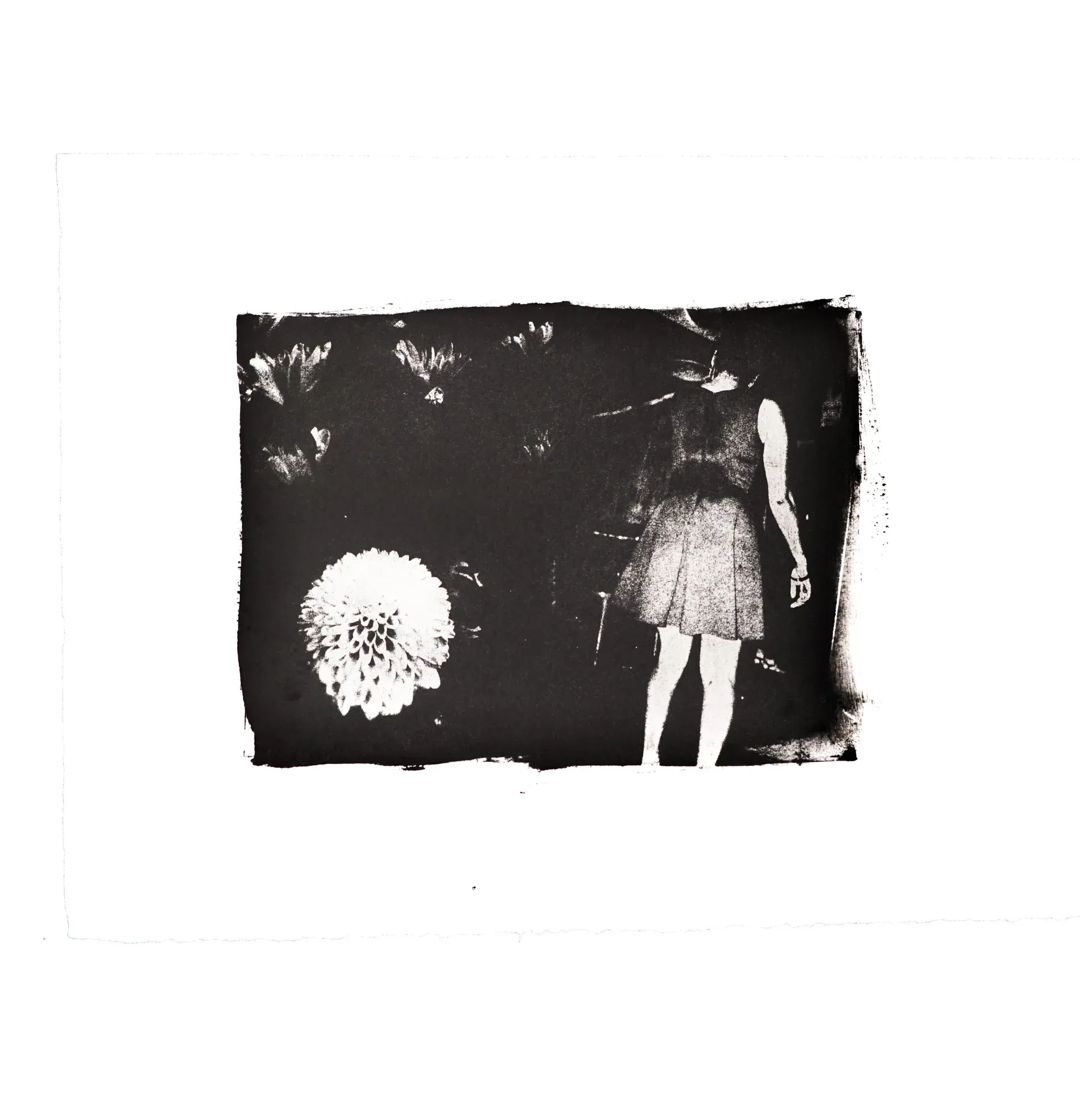
Bromoil is a hybrid process where a silver print is chemically treated then hand-inked with greasy inks. Each brush stroke is a unique gesture, giving an incomparable pictorial character to the photographic image.
Recommended files: High-definition TIFF or JPEG (300 dpi). We create the digital negative.
Example results
24 results made with this process
View full gallery →Need advice?
Our team can help you choose the right paper, format and finish for your project.
History
Bromoil was born in London in 1907 at the instigation of C. Welborne Piper, who formalised a process for turning a gelatin-silver print into a matrix that could be inked by hand. E.J. Wall consolidated the technique in his reference work The Bromoil Process, making it one of the technical standards of the Anglo-Saxon Pictorialist movement.
French Pictorialists adopted bromoil immediately for its closeness to oil painting. Robert Demachy, the tutelary figure of French Pictorialism, produced several series now held at the Musée d'Orsay. The Royal Photographic Society Collection in London holds the major prints of the English school — evidence of the continuous dialogue between photography and the graphic arts at the turn of the twentieth century.
Technically, the process starts from a silver print that is bleached and then re-inked by hand with Charbonnel intaglio ink, applied with a foam roller. Each tonal zone takes up ink according to the differential swelling of the gelatin, exactly as a lithographic matrix does. The printer's gesture determines the final rendering entirely.
After several decades of eclipse, bromoil was revived in the 1990s by British and North American studios, notably around the Bostick & Sullivan workshop circuit. Contemporary photographers such as David Lewis and Gene Laughter published manuals that relaunched a demanding practice, giving the photographic print back an openly painterly materiality.
Maison Picturale works within this French Pictorialist tradition while benefiting from the chemistry reformulated by our sister brand Vision Picturale, which has removed copper dichromate from the historical bleaching bath. The Paris 20e studio thus carries on Demachy's gesture with contemporary safety.
At Maison Picturale
Every bromoil print made at the studio at 1 passage Dagorno is a unique piece, inked by hand by our master printers. Because the process remains editable for several hours while the roller work goes on, two prints from the same negative are never alike: gesture, pressure and ink distribution sign each copy irreducibly.
We work exclusively on 640 gsm 100% cotton satin watercolour paper, chosen for its ability to withstand the swelling of the gelatin without distortion, and for the velvety depth it gives to intaglio black. This conservation-grade paper gives the inked work a stability spanning several centuries.
The formats available for bromoil are Jésus (56 × 76 cm) and Grand Aigle (76 × 112 cm) — the scales that reveal the process's characteristic ink grain and the richness of its tonal transitions. Smaller formats would flatten the painterly matter that is precisely what makes the process valuable.
For a commissioned print, you can send us your own high-resolution file through the contact form. Our printers then prepare a digital negative calibrated for the specific contrast bromoil requires, and produce your print according to the rendering you want — more graphic or more painterly, depending on your project.
Frequently asked questions
Who invented bromoil, and where are the earliest prints held?
Bromoil was invented in London in 1907 by C. Welborne Piper, a technician attached to the Royal Photographic Society, who published the detailed protocol in the British Journal of Photography. The technique was then theorised by E.J. Wall in his reference manual The Bromoil Process (1908), and adopted and elevated in France by Robert Demachy and the Photo-Club de Paris. The principle: a gelatin-silver print is bleached, swollen in water, then inked by hand with a foam roller using a greasy lithographic ink — each print becoming unique through the printer's gesture. Robert Demachy's historical prints from the 1910s are today held at the Musée d'Orsay, in the Royal Photographic Society Collection in Bradford, and at the Metropolitan Museum of Art. Bromoil separates Pictorialist photography from automated photography more radically than any other process.
How does Maison Picturale make a bromoil print?
At Maison Picturale, bromoil is printed by hand in the studio at 1 passage Dagorno, Paris 20e, by master printers Tristan Sidem and Raphaël Lebas de Lacour, using Vision Picturale's proprietary reformulation, which eliminates the historical copper-dichromate bleaching bath. The 640 gsm cotton paper is printed as a gelatin-silver image, bleached, swollen in water, then inked with a foam roller using a Charbonnel lithographic (intaglio) ink — a fine-art printing ink based on vegetable oil — applied by successive dabbing. Pigment density depends solely on the inking gesture, which is what makes every bromoil print unique. Available in deep black, warm sepia or midnight blue, in Coquille, Jésus, Grand Aigle and Univers formats. Signed, numbered limited edition.
How long does a bromoil print last, and how stable is it?
Bromoil offers exceptional archival stability, greater than that of a traditional fibre-based silver print. The Charbonnel intaglio ink used is a fine-art printing ink designed for conservation across centuries — the same ink used for museum engravings, made from vegetable oils (linseed, walnut) and stable mineral pigments. Robert Demachy's bromoil prints from the 1910s, held at the Musée d'Orsay and in the Royal Photographic Society Collection in Bradford, still show their original density and matter more than 110 years on. The hardened gelatin and the silver matrix form a physically stable structure. Kept away from direct sunlight and from a damp environment, a Maison Picturale bromoil will cross several centuries without significant alteration. A conservation certificate is supplied.
How do I commission a bromoil print?
To commission a bromoil print from Maison Picturale, send your high-resolution file (ideally 16-bit TIFF, or maximum-quality JPEG, 300 dpi minimum) through the contact form, specifying the rendering you want — deep black, warm sepia or midnight blue — and the format. Our master printers confirm that the file is technically suitable — bromoil calls for a very specific tonal curve, compressing the highlights and strengthening the mid-shadows — and prepare the calibrated digital negative. A proof is approved before the final print. The standard lead time is five to seven weeks, as the inking gesture is long and painstaking. Prices start at €200 for the Coquille format (44 × 56 cm) and reach €1,200 for Univers (100 × 140 cm). Every print is signed, numbered and supplied with its certificate of authenticity.
How should a bromoil print be framed?
A Maison Picturale bromoil is framed like any work on conservation paper. Foam-roller inking leaves matter that is visible in raking light — the process's signature — and it must be protected by float mounting, with no direct contact between the glass and the inked surface. Maison Picturale recommends high-grade UV-protective glass (Artglass or Mirogard), a 100% cotton pH-8 neutral conservation mount board, and hinging with Japanese paper along the top edge only. For the large formats (Grand Aigle 76 × 112 cm and Univers 100 × 140 cm) a rigid support panel is necessary. The studio works with several professional Parisian framers who specialise in alternative-process photographic works; their details are given when the print is handed over.
What is the difference between commissioning a bromoil print and making one yourself with a kit?
Maison Picturale and Vision Picturale cover two complementary intentions around bromoil. At Maison Picturale you commission a fine-art print made by hand by the master printers on 640 gsm museum-grade cotton paper, with the signature inking gesture, in a signed and numbered limited edition with a certificate of authenticity — a Pictorialist collector's object, archivally stable for more than a century. With the Vision Picturale bromoil kit you practise the process yourself, from the non-toxic reformulated chemistry shared by both brands, on more affordable papers, with your own image and your own inking gesture — a Pictorialist making experience, not a collector's work. The proprietary chemical recipes are the same on both sides: Maison Picturale prints only with the Vision Picturale formulation, free of copper dichromate. NOEME Picturale Academy offers online courses for going further.
Why is Maison Picturale's bromoil non-toxic?
Since 1907, historical bromoil has used a copper-dichromate bleaching bath (a hexavalent chromium salt), classified as a Group 1 carcinogen by the International Agency for Research on Cancer (IARC) — toxic by inhalation and skin contact, and requiring full protective equipment in traditional studios (P3 mask, nitrile gloves, forced ventilation, regulated waste disposal). Maison Picturale has removed this toxic bath entirely by using only Vision Picturale's proprietary reformulation (a confidential recipe), which achieves the same differential swelling of the gelatin with no dichromate and no chromium at all. The Charbonnel ink used is a lithographic ink based on vegetable oils (linseed, walnut), with no petroleum solvent. The result: the authentic Pictorialist signature — inking gesture, matter visible in raking light — is preserved without compromise, while the studio operates without any carcinogenic-fume extraction.
See also
Related processes
Practise at home
Make your own Bromoil prints at home
The Resinotype S medium, the VP N°03 sensitiser, a Charbonnel pigment tube and a Bromoil registration chart.
Discover the Coffret Bromoil — Huile VivanteReproducibility
Calibrate your Bromoil
HD test chart → scan → .acv curve in 3 steps. Calibration Flow generates the exact correction for your process.
Calibrate this processBromoil
From €200