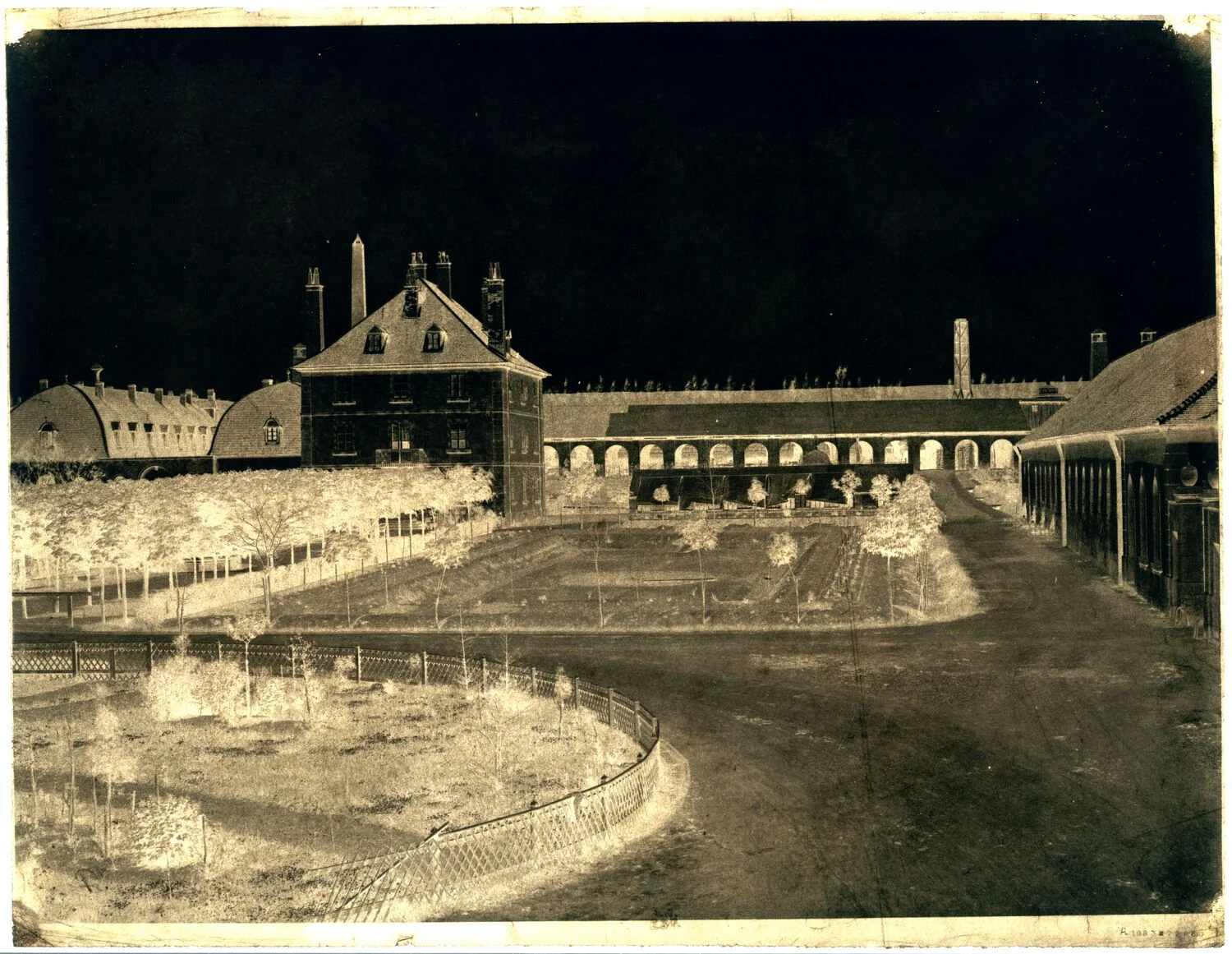
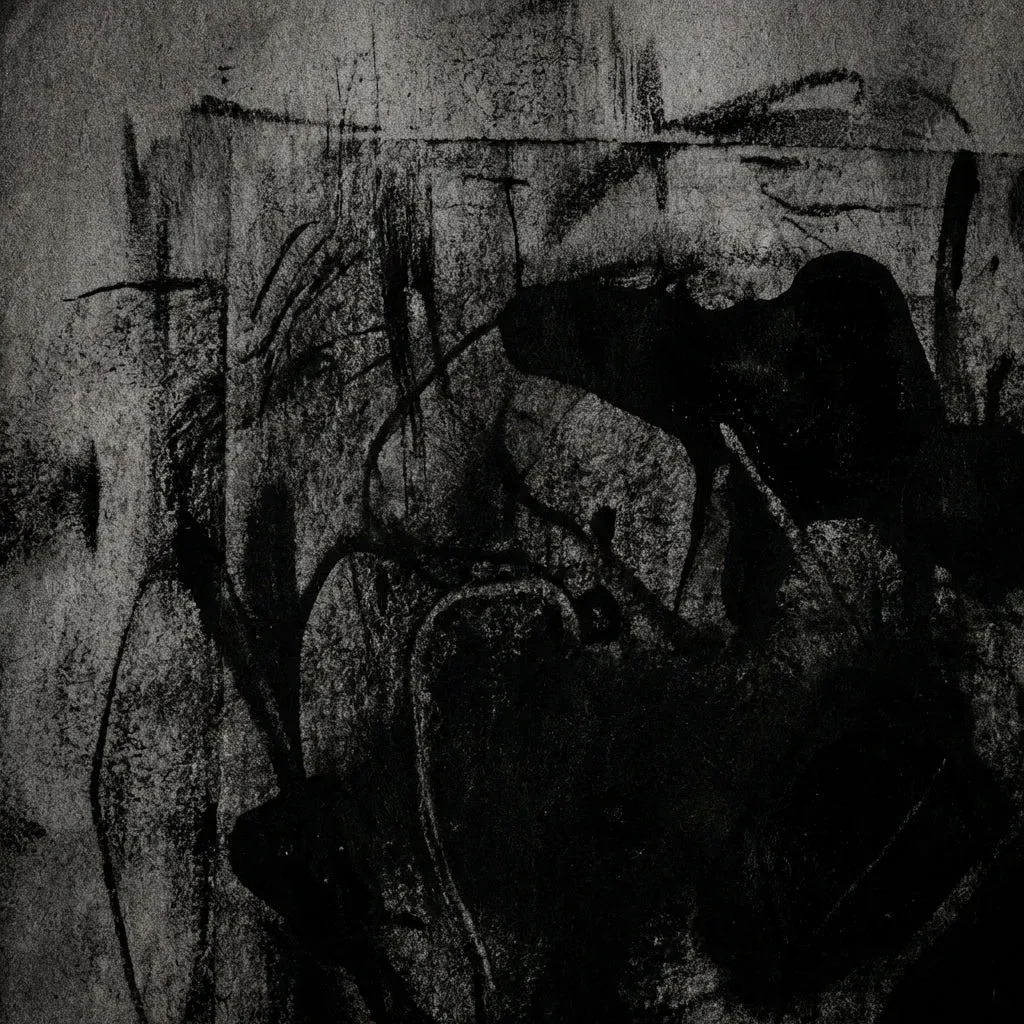
Image: the public-domain reference file. Your print is a hand-made interpretation of it, produced at the studio in Sanguine Aquaprint — its matter and tonality are its own.
Alphonse Poitevin · c. 1855
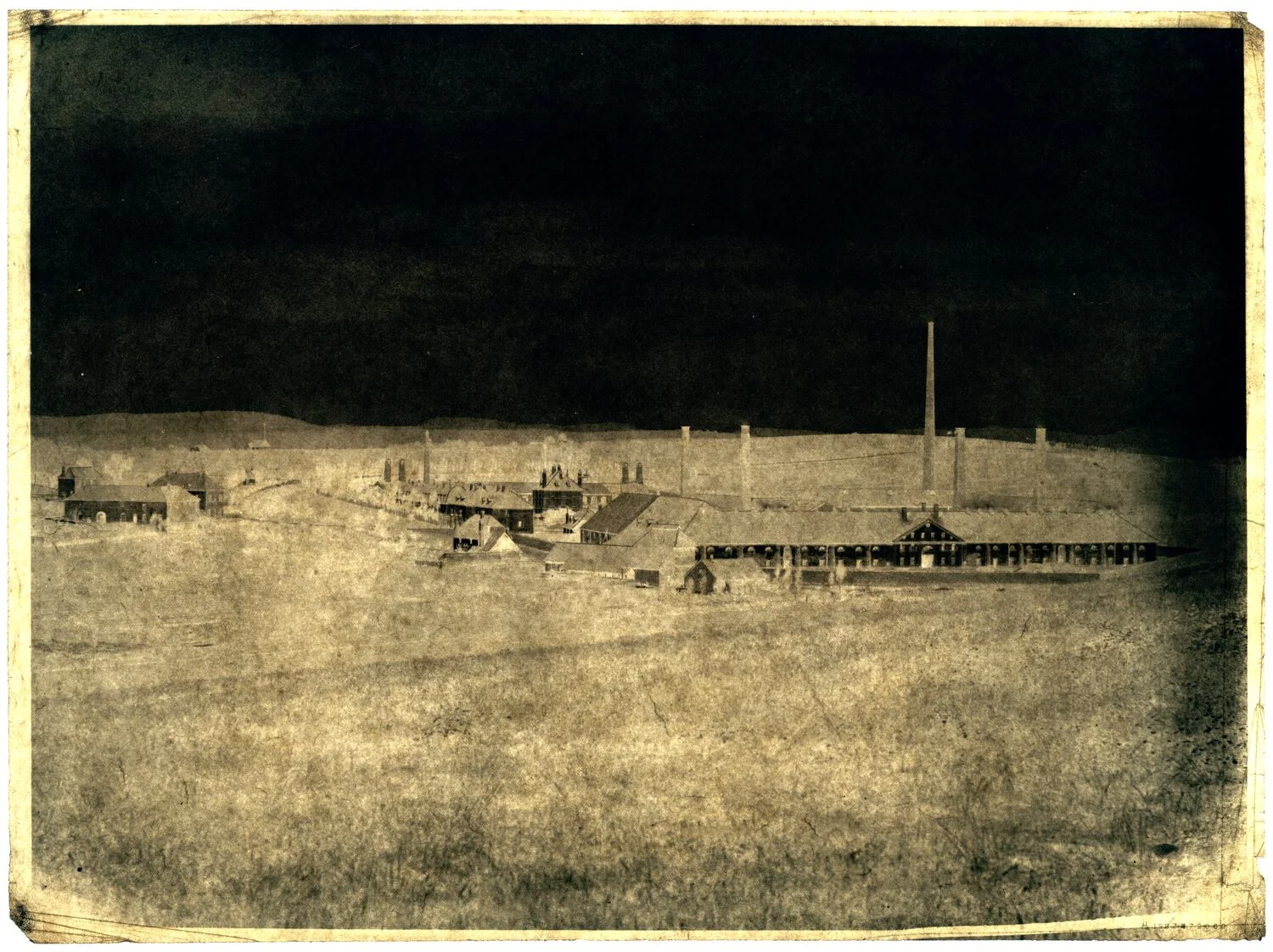
Courtyard of the Gouhenans Salt Works
- Year
- c. 1855
- Original process
- Photographic negative (Poitevin process)
- Held at
- Bibliothèque nationale de France
Key facts
- Edition
- Signed and numbered limited edition
- Authenticity
- Official certificate of authenticity
- Chemistry
- Non-toxic process (Vision Picturale recipes)
- Year
- c. 1855
- Original held at
- Bibliothèque nationale de France
- Public domain
- Since 1953 (CPI L.123-1)
- Printer
- Maison Picturale — Paris 20e studio
- Lead time
- Hand-made · 3 to 5 weeks
Maison Picturale reinterpretation in carbon transfer
About this work
Documentary view of the courtyard of the Gouhenans salt works in Haute-Saône, where Louis-Alphonse Poitevin (1819-1882) served as engineering director from 1851 to 1855 — the very years preceding the three patents (gum bichromate, carbon process, photolithography) he filed in 1855 and that would found the entire family of pigment-based photographic processes. Poitevin's industrial trajectory ran in parallel to his photographic research: trained at the École Centrale des Arts et Manufactures (Paris, class of 1843), he directed in succession the salt works of Dieuze, Montmorot and Gouhenans, then the Ahun-les-Mines and Folembray glassworks, before retiring to Conflans-sur-Anille (Sarthe) where he served as mayor from 1871 to 1878. This plate is therefore a rare biographical document, capturing the workplace where the chemist-engineer matured the colloid sensitisation experiments that culminated in his 1855 inventions, awarded with the Duc de Luynes Prize by the Société française de photographie in 1862. The Gouhenans complex itself was a major industrial site of mid-19th-century eastern France, exploiting salt from deep brine wells under the technical reorganisation that Poitevin oversaw, and is today held at the Bibliothèque nationale de France (Gallica). The image stands as a rare convergence of his industrial and photographic careers — a witness of working architecture and worker presence at a moment when documentary photography of industry was still a marginal genre in 1850s France. At Maison Picturale, this register of industrial documentation can be reinterpreted as a carbon transfer print in the Noir Musée range (pigmented gelatin in deep blacks) or in the multi-pigment Couleur Profonde palette.
Reference file : Gallica BnF (Public Domain)
Procédé Transposition
Print like Alphonse Poitevin today — without the toxics.
Each Maison Picturale print is a material reinterpretation of the image. Three readings of the same work — the original, its closest transposition, and a creative transposition into another procédé.
Multi-tone carbon transfer — the most permanent material in all of photography. Contemporary reinvention of the 1855 Poitevin procédé.
MP procédé — reformulated non-toxic chemistry, signed by Tristan Sidem and Raphaël Lebas de Lacour.
View the procédéOr print it yourself
The chemistry of this process, reformulated non-toxic, is available as a kit from Vision Picturale — the house’s studio brand. Your image, your hands, the same chemistry as our printers.
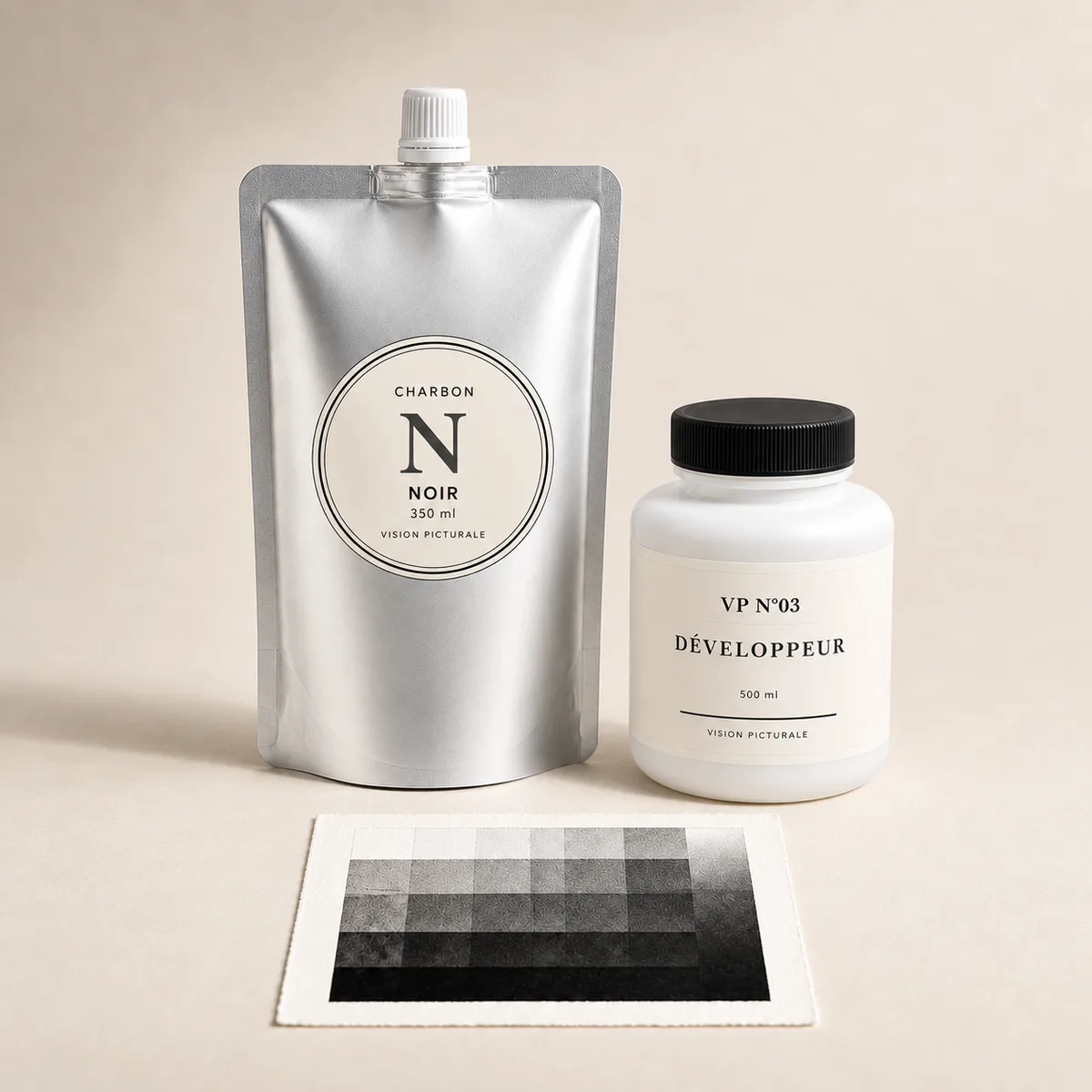
Coffret Charbon Mono — Noir Musée
History of the process
The carbon process was invented in 1864 by Joseph Wilson Swan, the British chemist and inventor also known for his work on the incandescent lamp. He presented it to the Royal Photographic Society in London that same year, patented as the Carbon Process. The principle: a pigmented gelatin hardened by UV exposure through a negative, then transferred onto a final paper.
Carbon very quickly became the reference process for serious photographic publishers. The Lumière brothers' heliographic works in Lyon, the Autotype Company in London and the Braun firm in Dornach made it their industrial process for reproducing artworks for museums. Late nineteenth-century carbon prints held at the Musée d'Orsay, at George Eastman House in Rochester and at the Metropolitan Museum of Art still show their maximum density intact today.
Our approach
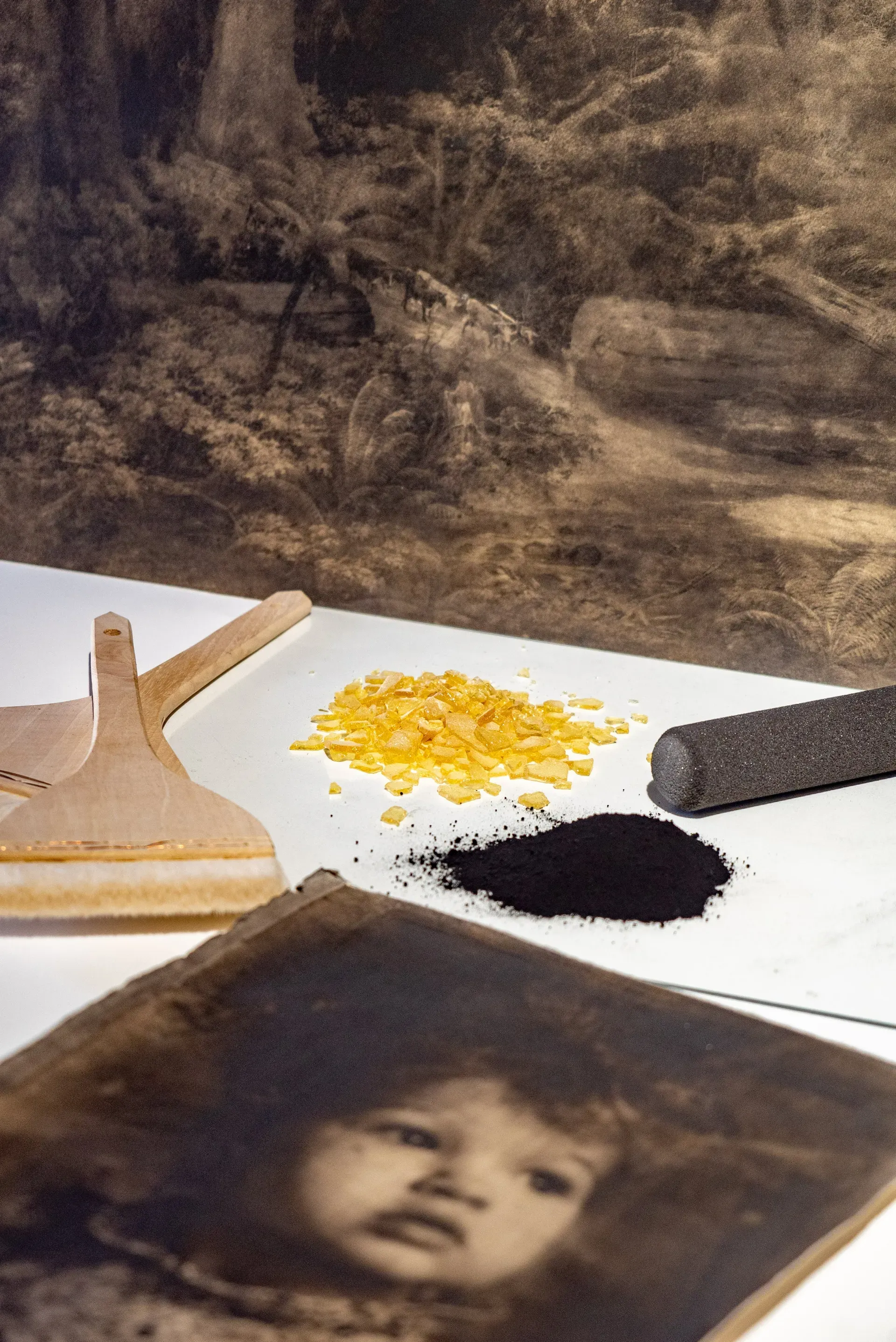
A Maison Picturale carbon print is a unique piece made by hand by the master printers of the studio at 1 passage Dagorno, Tristan Sidem and Raphaël Lebas de Lacour. Each carbon print takes several days of work: preparing the pigmented gelatin, UV exposure, transfer onto the final paper, controlled drying. It is a strictly museum-grade process, intended for serious collectors and institutions.
Our 640 gsm 100% cotton satin watercolour paper suits carbon particularly well: its weight supports the transfer of pigmented gelatin without distortion, and its satin surface fully reveals the slight low relief that signs the process in raking light. This conservation paper, free of optical brighteners, guarantees the work's permanence across centuries.
Inside our studio
1 Passage Dagorno, Paris 20e. Each print is hand-crafted by Tristan Sidem and Raphaël Lebas de Lacour, using Vision Picturale's reformulated non-toxic chemistry. Limited edition, signed and numbered.
Commission this print
- Hand-printed and signed by Tristan Sidem & Raphaël Lebas de Lacour
- Reformulated non-toxic chemistry (Vision Picturale recipes)
- Limited edition, numbered, certificate of authenticity
- 1 Passage Dagorno studio, Paris 20e
- Delivery 3 to 5 weeks · ships worldwide from France
Formats and prices
- ProcédéSanguine Aquaprint
- Coquille44 × 56 cm200 €
- Jésus56 × 76 cm400 €
The Carbon transfer process is not yet offered at the studio: this print is made in Sanguine Aquaprint, the non-toxic watercolour gum.
Firm prices: they follow from the procédé and the paper format, as on our Process pages. 100% cotton paper, 640 gsm, deckled edges. Which formats are offered depends on the resolution of the reference file we hold for this work.
Contemporary print after a work in the public domain (CPI L.123-1, 70 years post-mortem). Hand-crafted reinterpretation by Maison Picturale's master printers — this is not an original vintage by the master. The mention 'after [Master]' is systematic on the print and on the certificate of authenticity.