INSPIRED BY THE THREE-CRAYON DRAWING TECHNIQUE
About the process
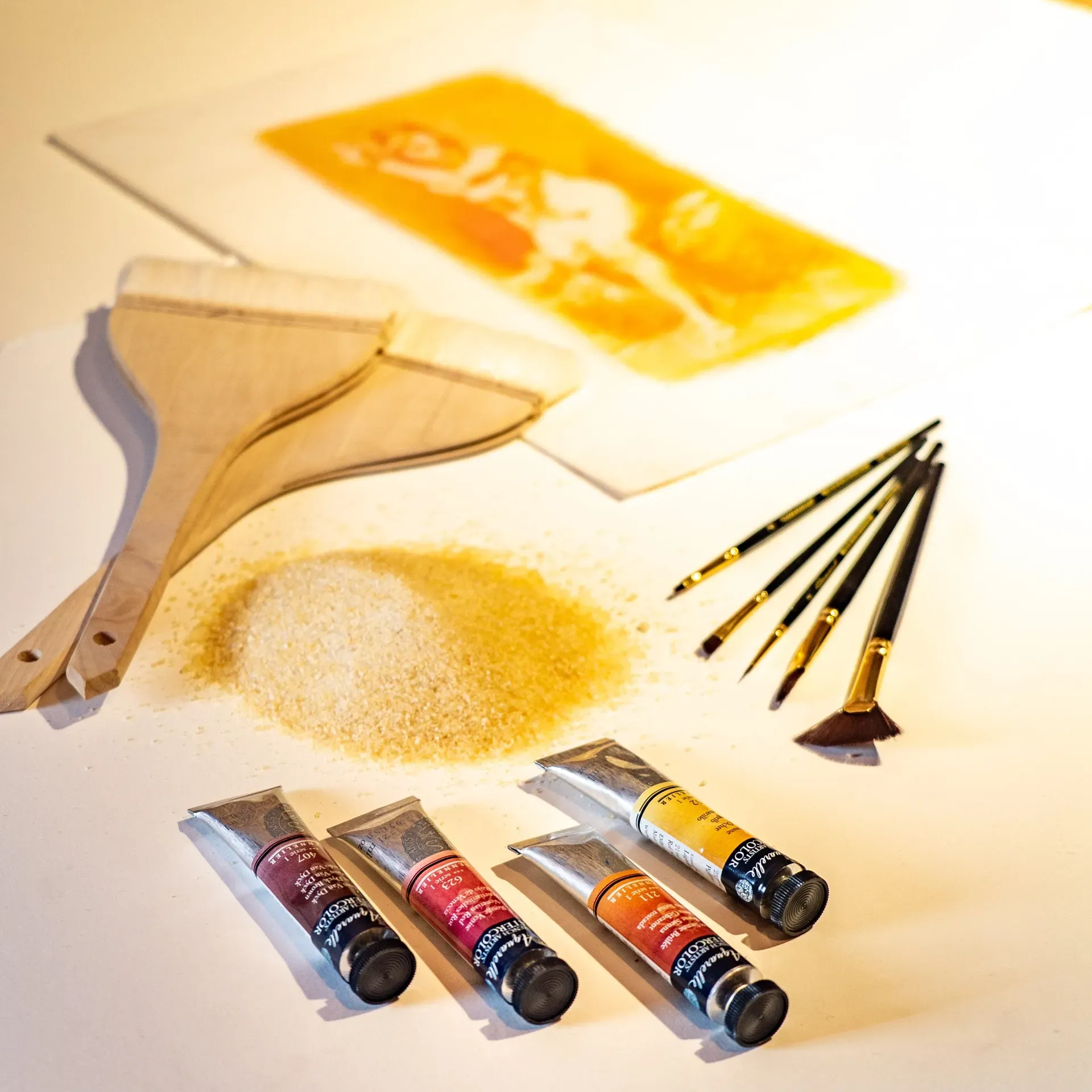
Sanguine gum offers a rendering close to Old Master drawings, with warm tones ranging from brick red to burnt sienna. Each pigment layer is applied and exposed individually, allowing fine control of intensity.
History
Maison Picturale's photographic sanguine is a single-pigment variant of the classic gum print, developed within the graphic tradition of the French Beaux-Arts. It uses a single pure sienna earth pigment laid onto sensitised gum arabic, in direct reference to the red-chalk preparatory drawings that Leonardo da Vinci, Michelangelo and Raphael made on tinted paper during the Italian Renaissance.
Sanguine drawings hold a central place in the history of Western draughtsmanship. The Louvre holds Leonardo's preparatory studies for The Last Supper and the Mona Lisa; the department of drawings and prints at the Metropolitan Museum holds Michelangelo's red chalks for the Sistine Chapel; and the Albertina in Vienna holds the most complete Raphael group in the world. This graphic tradition founds the visual identity of the photographic process.
Technically, Maison Picturale's photographic sanguine proceeds by laying gum arabic pigmented with sienna earth onto cotton paper, sensitising, exposing under UV, and washing out in tepid water. Two or three successive layers are superimposed to reach the intended tonal density, in an approach close to classic gum bichromate but deliberately limited to a single warm red-brown pigment.
The process belongs to the graphic path of French Pictorialism, a different tradition from four-colour gum bichromate. Robert Demachy, Constant Puyo and the French school of the early twentieth century already favoured earthy tonalities and drawing-like renderings, in reaction to the over-documentary sharpness of silver. Photographic sanguine continues that path today.
Maison Picturale offers sanguine in the catalogue as a continuation of this Beaux-Arts tradition. The chemistry has been reformulated by our sister brand Vision Picturale to remove the historical dichromate, while preserving the authentic single-pigment sienna rendering.
At Maison Picturale
Every sanguine print made at the studio at 1 passage Dagorno is a unique piece standing on the border between drawing and photography. The brush marks left when the pigmented gum arabic is laid down are deliberately left visible, in the graphic tradition of Renaissance drawing that this process explicitly claims. It is this studio gesture that sets each print apart.
Our 640 gsm 100% cotton satin watercolour paper suits sanguine particularly well: its weight supports the multiple gum layers without distortion, and its satin surface fully reveals the brush matter and the characteristic warm sienna tonality. The final rendering recalls the old masters' sanguines on tinted paper.
The formats available for sanguine are Coquille (44 × 56 cm) and Jésus (56 × 76 cm) — scales at which the brush matter and the pigment grain remain fully legible. Sanguine suits portraits, anatomical studies, nudes and intimate scenes particularly well, directly in line with the graphic subjects treated in red chalk since the Renaissance.
For a commissioned print, you can send us your high-resolution file through the contact form. Our printers prepare a digital negative calibrated for the specific tonal curve of single-pigment sanguine, and may suggest a preliminary discussion about the choice of image, since certain compositions lend themselves particularly well to this Renaissance-line signature.
Example results
52 results for this process
Sizes & Pricing
Coquille
44 × 56 cm
Jésus
56 × 76 cm
Grand Aigle
76 × 112 cm
Univers
100 × 140 cm
Practise at home
Make your own Sanguine prints at home
Three sanguine pouches (yellow, earth, red), the VP N°03 sensitiser and a registration chart — sanguine shares the Aquaprint base.
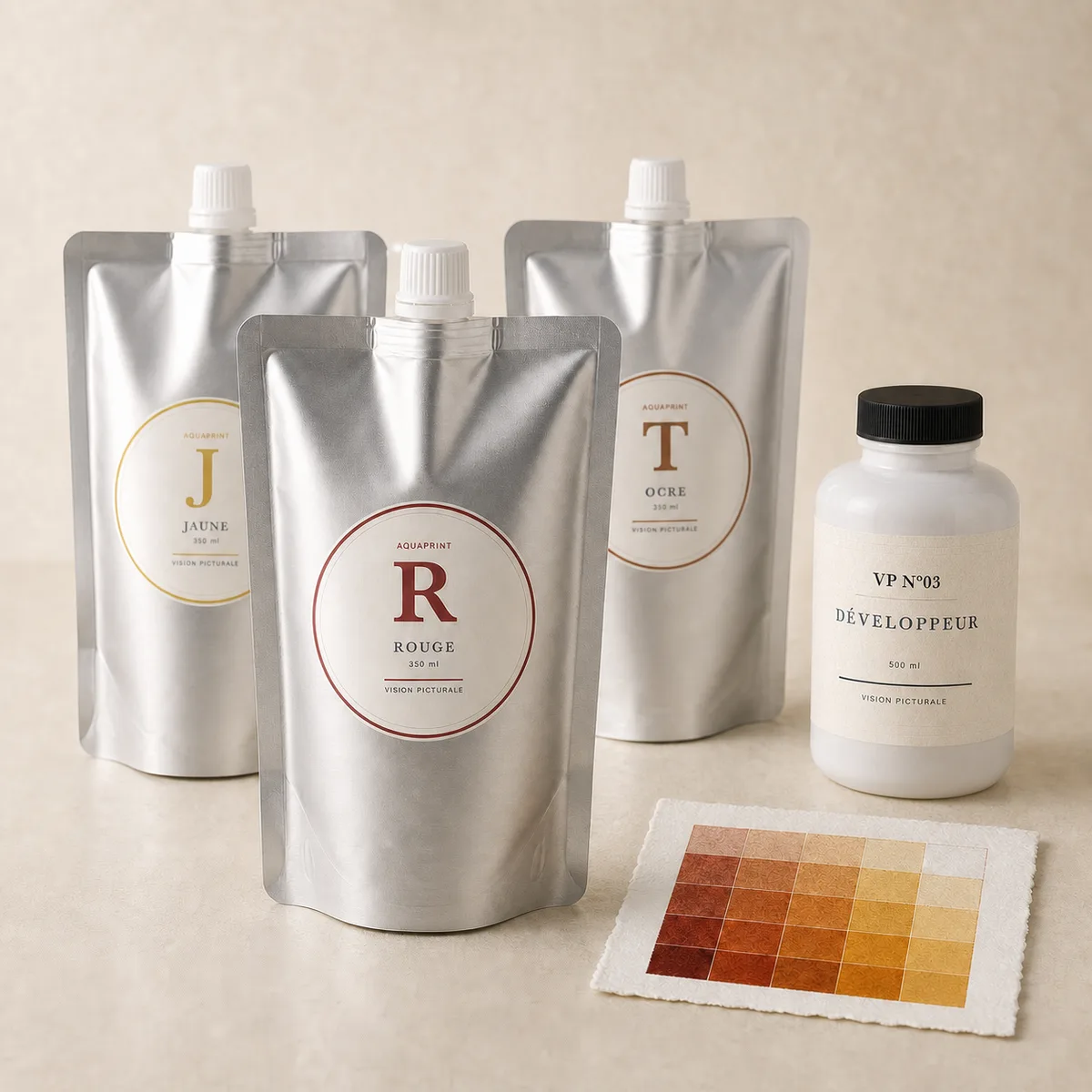
Coffret Aquaprint Sanguine
Reproducibility
Calibrate your Sanguine
HD test chart → scan → .acv curve in 3 steps. Calibration Flow generates the exact correction for your process.
Calibrate this processFrequently asked questions
Where does photographic sanguine come from, and which graphic tradition does it belong to?
Photographic sanguine, as practised at Maison Picturale, is a single-pigment variant of gum bichromate — the process invented in 1855 by the French chemist Alphonse Poitevin — printed in sienna earth as a direct homage to the graphic tradition of the Italian Renaissance. The sanguine drawings (natural red chalk rich in iron oxides) of Leonardo da Vinci, Michelangelo and Raphael, made across the fifteenth and sixteenth centuries, fixed the visual identity of this earthy pigment for five centuries: a warm red-brown with a dry grain. The historical sanguines are held in the Cabinet des Dessins at the Louvre, at the Casa Buonarroti in Florence, at the Albertina in Vienna and in the department of drawings and prints at the Metropolitan Museum of Art. Maison Picturale is one of the only European studios to offer this photographic variant in a signed edition.
How does Maison Picturale make a photographic sanguine?
At Maison Picturale, photographic sanguine is printed by hand in the studio at 1 passage Dagorno, Paris 20e, by master printers Tristan Sidem and Raphaël Lebas de Lacour, using Vision Picturale's proprietary reformulation, which removes historical potassium dichromate entirely. The 640 gsm satin cotton paper is sensitised, exposed under UV from a digital negative calibrated for the specific tonal curve, then loaded with pure sienna earth pigment (artists' grade, ASTM I rated) brushed on in two or three successive layers. The single pigment allows a dense matter and a continuous warm red-brown gradation with a dry grain, consistent with the tradition of Renaissance red chalk. Available formats: Coquille (44 × 56 cm) and Jésus (56 × 76 cm). Signed and numbered limited edition.
How long does a sanguine print last, and how stable is it?
Photographic sanguine offers exceptional archival permanence, inherited directly from the Renaissance painting tradition. Sienna earth — a natural mineral pigment whose stability has been documented since antiquity, used in Roman frescoes and medieval altarpieces — is physically incorporated into the gum arabic hardened on the cotton paper. The sanguines of Leonardo da Vinci and Michelangelo held at the Louvre, the Albertina in Vienna and the Metropolitan Museum, dating from the fifteenth and sixteenth centuries, testify to the multi-century permanence of earth pigments on cotton paper after more than 500 years. At Maison Picturale, every sanguine print is supplied with a certificate of authenticity detailing the conservation conditions: moderate lighting, 40-60% relative humidity, a stable temperature around 20 °C, away from direct sunlight.
How do I commission a sanguine print?
To commission a sanguine print from Maison Picturale, send your high-resolution file (TIFF or JPEG, 300 dpi minimum) through the contact form, specifying the format you want. Since sanguine is a warm single-pigment process with a strongly marked signature, our master printers advise on the fit between image and process: portraits, anatomical studies, nudes, intimate scenes and predominantly graphic compositions lend themselves particularly well to this Renaissance-line signature. The digital negative is calibrated specifically for the sanguine curve. A proof is approved before the final print. The standard lead time is five to seven weeks for two or three successive layers. Prices start at €200 for the Coquille format (44 × 56 cm) and reach €1,200 for Univers (100 × 140 cm). Every print is signed, numbered and supplied with its certificate of authenticity.
How should a sanguine print be framed?
A Maison Picturale sanguine print is framed in the tradition of old-master drawings, as a work on conservation paper. A professional framer will use high-grade UV-protective glass (Artglass or Mirogard) to protect the sienna pigment and the cotton paper, a 100% cotton pH-8 neutral conservation mount board tinted slightly ecru or cream (in reference to Renaissance tinted papers), and float mounting with Japanese paper hinges along the top edge only. The surface pigment matter that signs the process must be protected by a standoff of at least 3-4 mm between the glass and the print. The work should be lit in soft, diffuse light. Maison Picturale can recommend several partner framers in Paris who specialise in drawings and works on paper.
What is the difference between commissioning a photographic sanguine and making one yourself with a kit?
Maison Picturale and Vision Picturale cover two complementary intentions around sanguine. At Maison Picturale you commission a fine-art print made by hand by the master printers on 640 gsm museum-grade cotton paper, with the Renaissance-line signature, in a signed and numbered limited edition with a certificate of authenticity — a rare collector's object, archivally stable for several centuries. With Vision Picturale's Aquaprint gum bichromate kit you can practise the sanguine variant yourself, using sienna earth pigment on the non-toxic reformulated chemistry shared by both brands, on more affordable papers, with your own image — a Pictorialist practice, not a collector's work. The proprietary chemical recipes are the same on both sides: free of dichromate. NOEME Picturale Academy offers online courses for going further.
Why is Maison Picturale's sanguine non-toxic?
Because photographic sanguine is a single-pigment variant of gum bichromate, it historically uses the same potassium-dichromate sensitiser — a hexavalent chromium salt classified as a Group 1 carcinogen by the International Agency for Research on Cancer (IARC), extremely toxic by inhalation and skin contact. Maison Picturale has removed this toxic salt entirely by using only Vision Picturale's proprietary reformulation (a confidential recipe), which achieves the same photochemical cross-linking of the gum arabic with no dichromate and no chromium at all. Sienna earth itself is a natural mineral pigment with no toxicity, used in painting since antiquity. The result: the authentic Renaissance-line signature — warm pigment matter, dry grain, continuous gradation — is preserved without compromise, while the studio operates without carcinogenic-fume extraction.
See also
Related processes
INSPIRED BY THE THREE-CRAYON DRAWING TECHNIQUE
About the process
Sanguine is a family of red earth-coloured pigments. Sanguine also comes in orange, ochre, brown and beige.
Sanguine gum offers a rendering close to Old Master drawings, with warm tones ranging from brick red to burnt sienna. Each pigment layer is applied and exposed individually, allowing fine control of intensity.
Recommended files: High-definition TIFF or JPEG (300 dpi). We create the digital negative.
Example results
52 results made with this process
View full gallery →Need advice?
Our team can help you choose the right paper, format and finish for your project.
History
Maison Picturale's photographic sanguine is a single-pigment variant of the classic gum print, developed within the graphic tradition of the French Beaux-Arts. It uses a single pure sienna earth pigment laid onto sensitised gum arabic, in direct reference to the red-chalk preparatory drawings that Leonardo da Vinci, Michelangelo and Raphael made on tinted paper during the Italian Renaissance.
Sanguine drawings hold a central place in the history of Western draughtsmanship. The Louvre holds Leonardo's preparatory studies for The Last Supper and the Mona Lisa; the department of drawings and prints at the Metropolitan Museum holds Michelangelo's red chalks for the Sistine Chapel; and the Albertina in Vienna holds the most complete Raphael group in the world. This graphic tradition founds the visual identity of the photographic process.
Technically, Maison Picturale's photographic sanguine proceeds by laying gum arabic pigmented with sienna earth onto cotton paper, sensitising, exposing under UV, and washing out in tepid water. Two or three successive layers are superimposed to reach the intended tonal density, in an approach close to classic gum bichromate but deliberately limited to a single warm red-brown pigment.
The process belongs to the graphic path of French Pictorialism, a different tradition from four-colour gum bichromate. Robert Demachy, Constant Puyo and the French school of the early twentieth century already favoured earthy tonalities and drawing-like renderings, in reaction to the over-documentary sharpness of silver. Photographic sanguine continues that path today.
Maison Picturale offers sanguine in the catalogue as a continuation of this Beaux-Arts tradition. The chemistry has been reformulated by our sister brand Vision Picturale to remove the historical dichromate, while preserving the authentic single-pigment sienna rendering.
At Maison Picturale
Every sanguine print made at the studio at 1 passage Dagorno is a unique piece standing on the border between drawing and photography. The brush marks left when the pigmented gum arabic is laid down are deliberately left visible, in the graphic tradition of Renaissance drawing that this process explicitly claims. It is this studio gesture that sets each print apart.
Our 640 gsm 100% cotton satin watercolour paper suits sanguine particularly well: its weight supports the multiple gum layers without distortion, and its satin surface fully reveals the brush matter and the characteristic warm sienna tonality. The final rendering recalls the old masters' sanguines on tinted paper.
The formats available for sanguine are Coquille (44 × 56 cm) and Jésus (56 × 76 cm) — scales at which the brush matter and the pigment grain remain fully legible. Sanguine suits portraits, anatomical studies, nudes and intimate scenes particularly well, directly in line with the graphic subjects treated in red chalk since the Renaissance.
For a commissioned print, you can send us your high-resolution file through the contact form. Our printers prepare a digital negative calibrated for the specific tonal curve of single-pigment sanguine, and may suggest a preliminary discussion about the choice of image, since certain compositions lend themselves particularly well to this Renaissance-line signature.
Frequently asked questions
Where does photographic sanguine come from, and which graphic tradition does it belong to?
Photographic sanguine, as practised at Maison Picturale, is a single-pigment variant of gum bichromate — the process invented in 1855 by the French chemist Alphonse Poitevin — printed in sienna earth as a direct homage to the graphic tradition of the Italian Renaissance. The sanguine drawings (natural red chalk rich in iron oxides) of Leonardo da Vinci, Michelangelo and Raphael, made across the fifteenth and sixteenth centuries, fixed the visual identity of this earthy pigment for five centuries: a warm red-brown with a dry grain. The historical sanguines are held in the Cabinet des Dessins at the Louvre, at the Casa Buonarroti in Florence, at the Albertina in Vienna and in the department of drawings and prints at the Metropolitan Museum of Art. Maison Picturale is one of the only European studios to offer this photographic variant in a signed edition.
How does Maison Picturale make a photographic sanguine?
At Maison Picturale, photographic sanguine is printed by hand in the studio at 1 passage Dagorno, Paris 20e, by master printers Tristan Sidem and Raphaël Lebas de Lacour, using Vision Picturale's proprietary reformulation, which removes historical potassium dichromate entirely. The 640 gsm satin cotton paper is sensitised, exposed under UV from a digital negative calibrated for the specific tonal curve, then loaded with pure sienna earth pigment (artists' grade, ASTM I rated) brushed on in two or three successive layers. The single pigment allows a dense matter and a continuous warm red-brown gradation with a dry grain, consistent with the tradition of Renaissance red chalk. Available formats: Coquille (44 × 56 cm) and Jésus (56 × 76 cm). Signed and numbered limited edition.
How long does a sanguine print last, and how stable is it?
Photographic sanguine offers exceptional archival permanence, inherited directly from the Renaissance painting tradition. Sienna earth — a natural mineral pigment whose stability has been documented since antiquity, used in Roman frescoes and medieval altarpieces — is physically incorporated into the gum arabic hardened on the cotton paper. The sanguines of Leonardo da Vinci and Michelangelo held at the Louvre, the Albertina in Vienna and the Metropolitan Museum, dating from the fifteenth and sixteenth centuries, testify to the multi-century permanence of earth pigments on cotton paper after more than 500 years. At Maison Picturale, every sanguine print is supplied with a certificate of authenticity detailing the conservation conditions: moderate lighting, 40-60% relative humidity, a stable temperature around 20 °C, away from direct sunlight.
How do I commission a sanguine print?
To commission a sanguine print from Maison Picturale, send your high-resolution file (TIFF or JPEG, 300 dpi minimum) through the contact form, specifying the format you want. Since sanguine is a warm single-pigment process with a strongly marked signature, our master printers advise on the fit between image and process: portraits, anatomical studies, nudes, intimate scenes and predominantly graphic compositions lend themselves particularly well to this Renaissance-line signature. The digital negative is calibrated specifically for the sanguine curve. A proof is approved before the final print. The standard lead time is five to seven weeks for two or three successive layers. Prices start at €200 for the Coquille format (44 × 56 cm) and reach €1,200 for Univers (100 × 140 cm). Every print is signed, numbered and supplied with its certificate of authenticity.
How should a sanguine print be framed?
A Maison Picturale sanguine print is framed in the tradition of old-master drawings, as a work on conservation paper. A professional framer will use high-grade UV-protective glass (Artglass or Mirogard) to protect the sienna pigment and the cotton paper, a 100% cotton pH-8 neutral conservation mount board tinted slightly ecru or cream (in reference to Renaissance tinted papers), and float mounting with Japanese paper hinges along the top edge only. The surface pigment matter that signs the process must be protected by a standoff of at least 3-4 mm between the glass and the print. The work should be lit in soft, diffuse light. Maison Picturale can recommend several partner framers in Paris who specialise in drawings and works on paper.
What is the difference between commissioning a photographic sanguine and making one yourself with a kit?
Maison Picturale and Vision Picturale cover two complementary intentions around sanguine. At Maison Picturale you commission a fine-art print made by hand by the master printers on 640 gsm museum-grade cotton paper, with the Renaissance-line signature, in a signed and numbered limited edition with a certificate of authenticity — a rare collector's object, archivally stable for several centuries. With Vision Picturale's Aquaprint gum bichromate kit you can practise the sanguine variant yourself, using sienna earth pigment on the non-toxic reformulated chemistry shared by both brands, on more affordable papers, with your own image — a Pictorialist practice, not a collector's work. The proprietary chemical recipes are the same on both sides: free of dichromate. NOEME Picturale Academy offers online courses for going further.
Why is Maison Picturale's sanguine non-toxic?
Because photographic sanguine is a single-pigment variant of gum bichromate, it historically uses the same potassium-dichromate sensitiser — a hexavalent chromium salt classified as a Group 1 carcinogen by the International Agency for Research on Cancer (IARC), extremely toxic by inhalation and skin contact. Maison Picturale has removed this toxic salt entirely by using only Vision Picturale's proprietary reformulation (a confidential recipe), which achieves the same photochemical cross-linking of the gum arabic with no dichromate and no chromium at all. Sienna earth itself is a natural mineral pigment with no toxicity, used in painting since antiquity. The result: the authentic Renaissance-line signature — warm pigment matter, dry grain, continuous gradation — is preserved without compromise, while the studio operates without carcinogenic-fume extraction.
See also
Related processes
Practise at home
Make your own Sanguine prints at home
Three sanguine pouches (yellow, earth, red), the VP N°03 sensitiser and a registration chart — sanguine shares the Aquaprint base.
Discover the Coffret Aquaprint SanguineReproducibility
Calibrate your Sanguine
HD test chart → scan → .acv curve in 3 steps. Calibration Flow generates the exact correction for your process.
Calibrate this processSanguine
From €200