Nicéphore Niépce
Library

1765-1833 · French

Nicéphore Niépce

Nicéphore Niépce (1765-1833) is the French inventor of heliography, the process behind View from the Window at Le Gras (1827), the oldest surviving photograph taken with a camera. Bitumen of Judea hardened by light on a pewter plate: photography began as a hand-made process.

Public domain since 1904 · CPI L.123-1

Held at

  • Harry Ransom Center, University of Texas at Austin (View from the Window at Le Gras)
  • Bibliothèque nationale de France (Le Cheval et son conducteur, 1825)
  • Victoria and Albert Museum, Royal Photographic Society collection (Le Cardinal d'Amboise, 1826)
  • Musée Nicéphore Niépce, Chalon-sur-Saône (plates of Le Cardinal d'Amboise)

Reference writings

  • Notice sur l'héliographie (1829, published in Daguerre's manual of 1839)

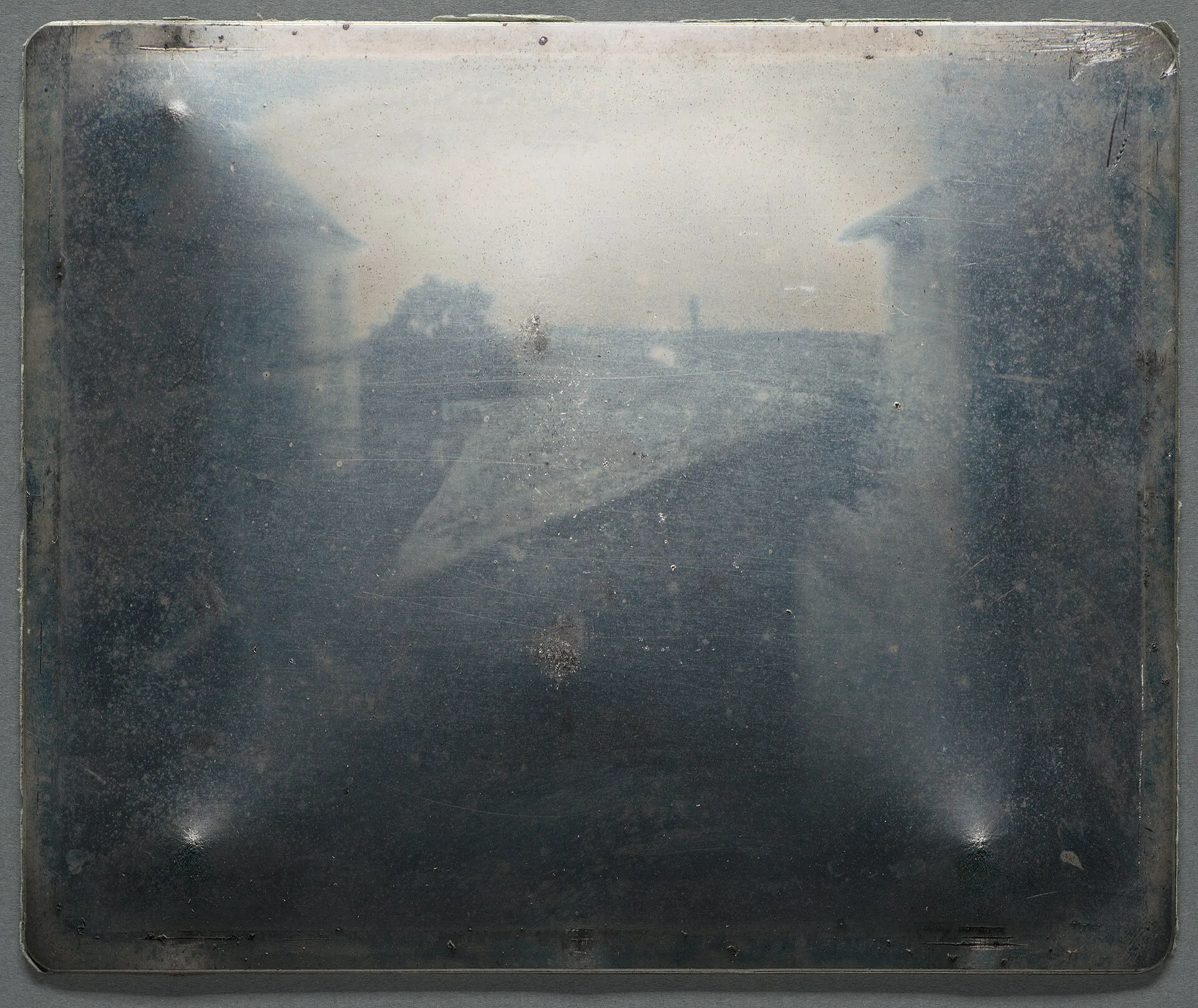
Joseph Nicéphore Niépce was born in Chalon-sur-Saône on 7 March 1765 and died on 5 July 1833 in Saint-Loup-de-Varennes, where his estate of Le Gras stood. An inventor of many things, he spent the 1810s and 1820s trying to fix the image formed inside a camera obscura. He succeeded with an unexpected material: bitumen of Judea, a natural asphalt that hardens in light. Dissolved in oil of lavender and spread on a plate, it hardens wherever light strikes; a bath of oil of lavender and white petroleum then dissolves the parts that stayed soft, and the image appears. Niépce called the process heliography, 'sun writing'. He first used it to copy engravings: once etched with acid, the plate could be inked and printed like an engraving. Le Cheval et son conducteur (1825, Bibliothèque nationale de France) is a paper print made that way; Le Cardinal d'Amboise (1826) survives as plates. He then placed a plate in the camera obscura, in front of a window of his house at Le Gras. View from the Window at Le Gras, dated 1827 by the Harry Ransom Center in Austin, which holds it, is the oldest surviving photograph taken with a camera. The exposure lasted several days according to the Ransom Center, several hours according to the BnF: the question remains open. In December 1829 Niépce went into partnership with Louis Daguerre; he died in 1833, six years before Daguerre presented the daguerreotype. The French bicentenary of photography (2026-2027) takes as its reference date the making of View from the Window at Le Gras, in the spring of 1827. The principle of heliography — light hardens a layer, a bath removes the rest — is the one found again, with gelatine and pigment, in carbon and gum printing. At Maison Picturale, the process closest to heliography is carbon printing, in non-toxic chemistry; we do not work with bitumen, which requires solvents.

Essential works

A curated selection of public-domain works by Nicéphore Niépce, reinterpretable as contemporary prints by Maison Picturale's master printers. Each artwork page details the original process and its atelier equivalent.

Print after — systematic mention on the certificate of authenticity.

View from the Window at Le Gras — Nicéphore Niépce

1827 · Heliograph (bitumen of Judea on pewter)

View from the Window at Le Gras

View from the Window at Le Gras is the oldest surviving photograph taken with a camera, and the only point de vue by Nicéphore Niépce known to survive. Niépce coated a polished pewter plate with bitumen of Judea dissolved in oil of lavender, placed it in a camera obscura in front of a window of his house at Le Gras, in Saint-Loup-de-Varennes, and left it to the light. The Harry Ransom Center, which holds the plate, dates it to 1827 and speaks of an exposure of several days; the BnF writes 'about 1826-1827' and an exposure of several hours. The French bicentenary of photography takes the spring of 1827 as its reference date. On the plate (16.7 × 20.3 cm) appear the courtyard, the outbuildings and the trees of the estate. Niépce gave it to Francis Bauer in London in 1827; the historian Helmut Gernsheim found it in England in 1952, and the Ransom Center acquired it with the Gernsheim Collection in 1963 (inventory 964:0000:0001). For the bicentenary it is lent to the Musée Nicéphore Niépce in Chalon-sur-Saône, on view from 26 April 2027 in the exhibition L'empreinte d'Hélios (20 March – 20 June 2027) — the first time it is shown in France. The image here is the Ransom Center's 2020 photograph of the plate, not the version retouched in 1952. Its closest equivalent at Maison Picturale is carbon printing, in non-toxic chemistry: the same principle, light hardens a layer and a bath removes the rest.

Original held at : Harry Ransom Center, University of Texas at Austin

Reference file source : Harry Ransom Center, University of Texas at Austin — photographie 2020, domaine public (via Wikimedia Commons)
A Horse and His Rider — Nicéphore Niépce

1825 · Heliographic engraving, paper print (after an engraving by Dirk Stoop)

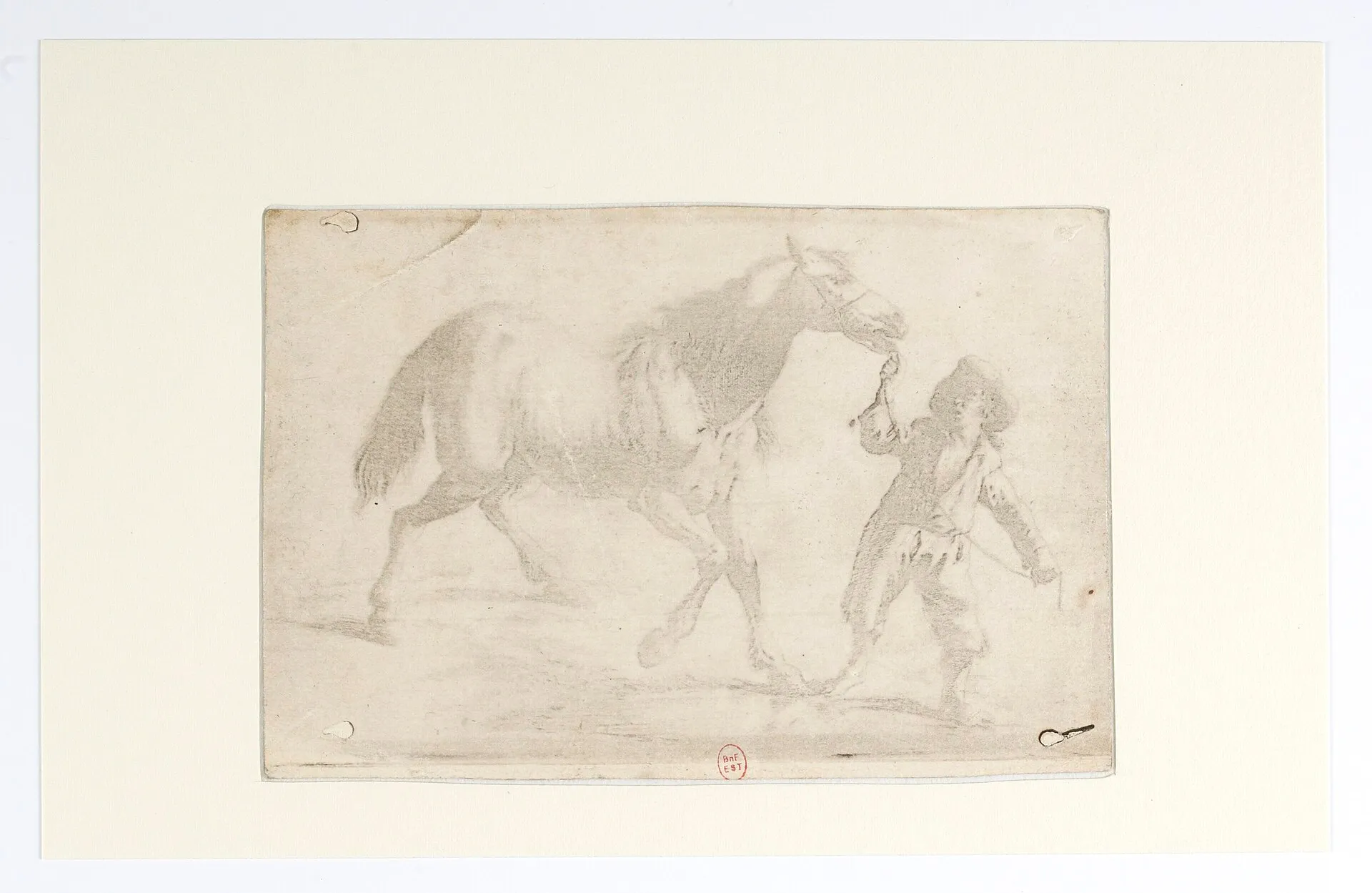
A Horse and His Rider

Le Cheval et son conducteur is a paper print of 1825 made by Nicéphore Niépce from a plate engraved by light. Niépce made a seventeenth-century engraving by the Dutch artist Dirk Stoop translucent and laid it on a plate coated with bitumen of Judea: light passed through the paper where it was blank and hardened the bitumen beneath, while the lines of the drawing kept it soft. Once the soft parts were dissolved, the bare metal was etched with acid, then inked and printed like an ordinary engraving. The image is therefore not a view of the world but a copy obtained by light — the first use Niépce found for heliography, two years before View from the Window at Le Gras. The print (14.7 × 10 cm) comes from the André Jammes collection and is held by the Bibliothèque nationale de France, department of Prints and Photography (RESERVE BOITE FOL-Z-14 (22,A)). Its closest equivalent at Maison Picturale is carbon printing, in non-toxic chemistry, which keeps the fineness of the engraved line.

Original held at : Bibliothèque nationale de France

Reference file source : Bibliothèque nationale de France (Gallica btv1b8593611k), domaine public

The documented corpus

The rest of Nicéphore Niépce's public-domain corpus: plates kept in our editorial archives. Reproducible on request, without dedicated editorial study.

1 archived plate

Le Cardinal d'Amboise — Nicéphore Niépce

1826

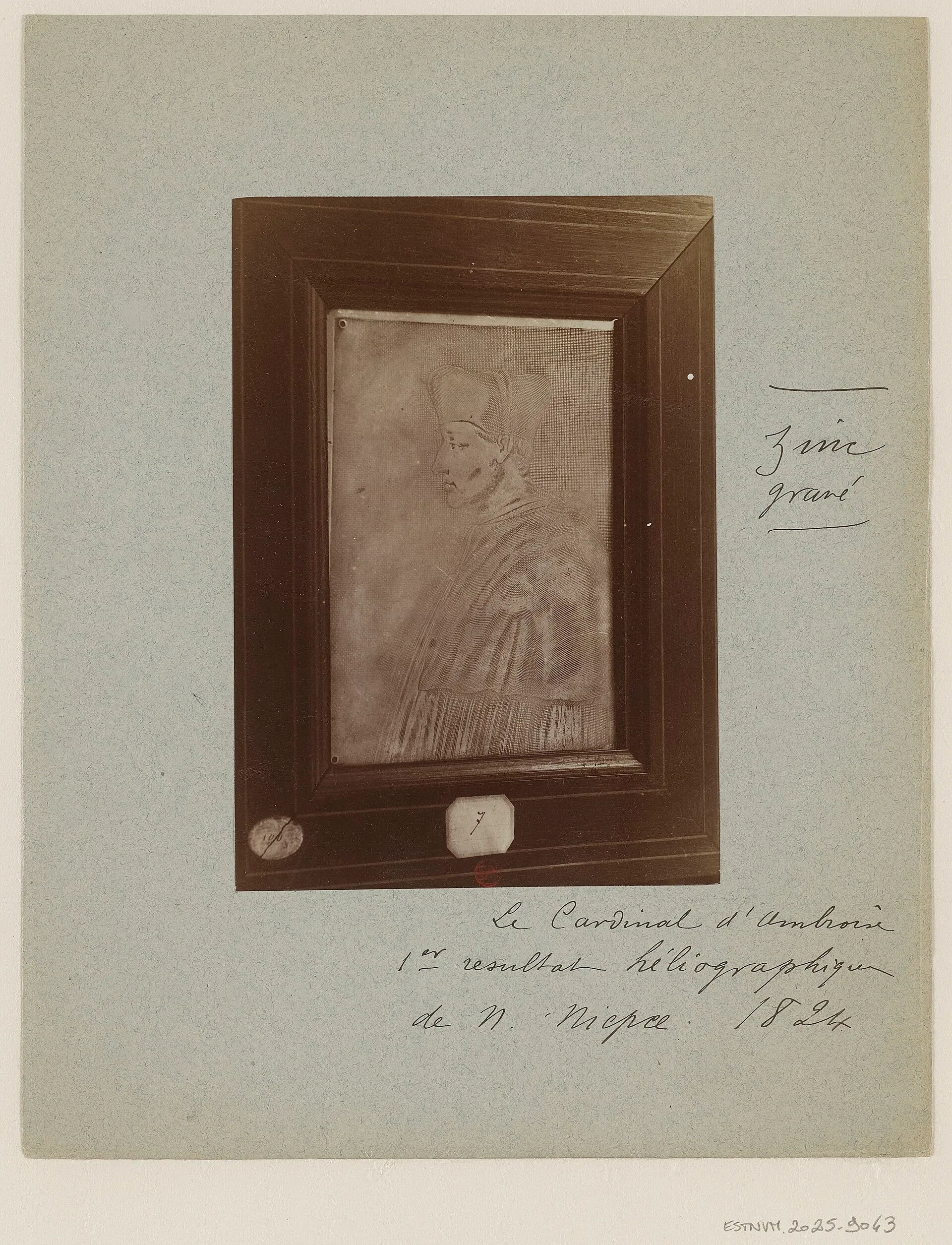
Le Cardinal d'Amboise

Heliographic engraving plate (after an engraving by Isaac Briot), photographed in the 19th century

Commission a print after Nicéphore Niépce

Maison Picturale produces on commission contemporary prints after works by Nicéphore Niépce that have entered the public domain. Hand-printed by master printers Tristan Sidem and Raphaël Lebas de Lacour on 640 gsm cotton paper, signed and numbered in limited edition, with a certificate of authenticity explicitly mentioning the "after" nature of the reinterpretation.

Start a commission