THE SEPIA PRINT, ELEGANT & QUINTESSENTIALLY AUTHENTIC
About the process
The Van Dyke process uses iron and silver salts to produce an image with warm brown tones. Simple and elegant, it offers a classic rendering reminiscent of the earliest photographs.
History
The Van Dyke Brown process was developed in 1889 by the English chemists T. Phipson and W.W.J. Nicol, who formalised a formula based on silver salts and iron sulphate producing a characteristic warm brown monochrome print. The process takes its name from the Flemish painter Anthony van Dyck (1599-1641), whose signature warm browns in his English aristocratic portraits became a reference in Western painting.
Van Dyke Brown belongs to the family of iron-silver processes, alongside the kallitype and the argentotype. It quickly became popular among early twentieth-century Pictorialists as an economical alternative to the platinotype, whose noble-metal costs put it beyond amateurs' reach. The Royal Photographic Society in London holds several Pictorialist Van Dyke series dating from the 1900s to the 1920s.
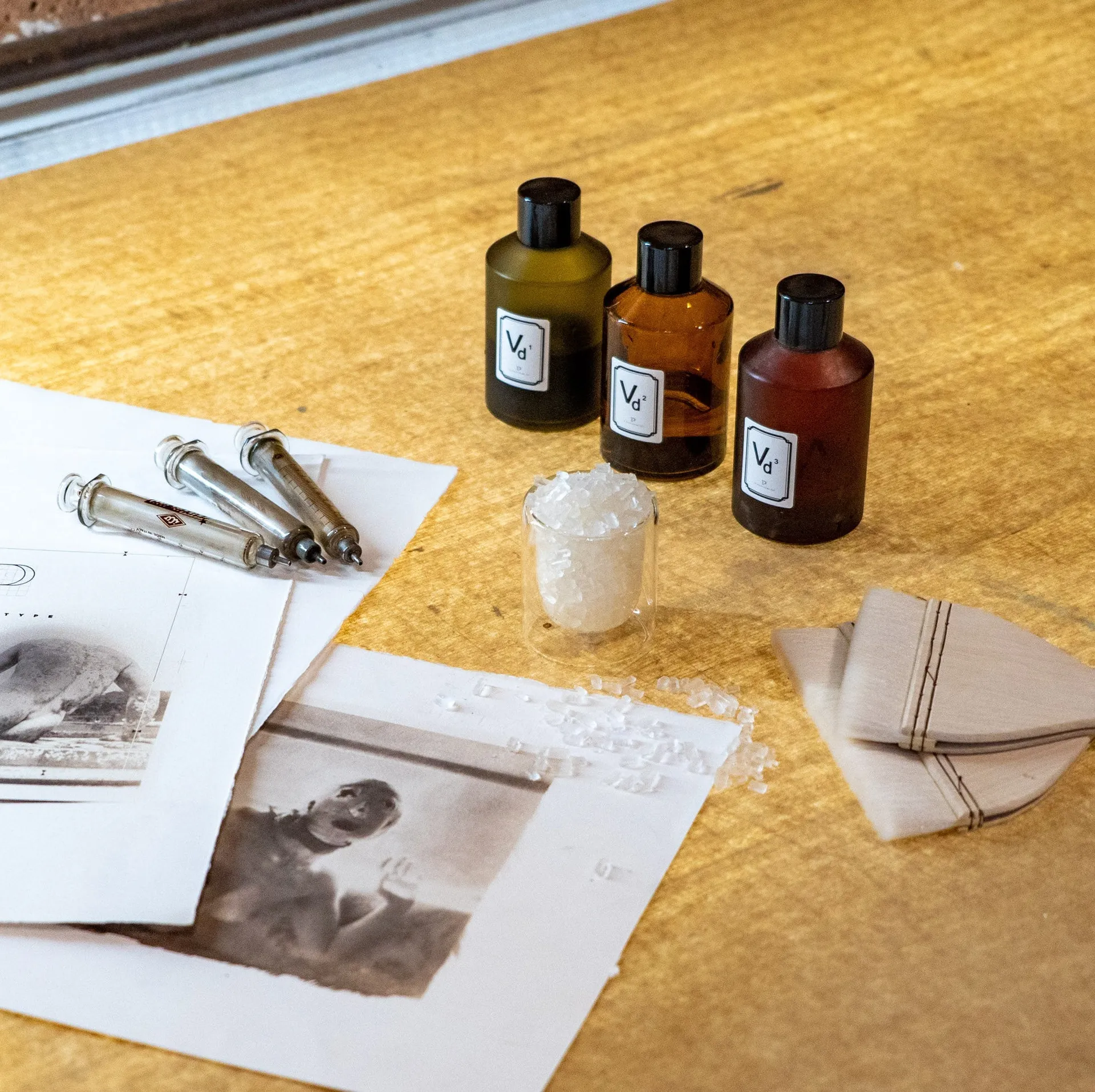
Technically, the cotton paper is brush sensitised with a solution combining silver nitrate, tartaric acid and ferric ammonium citrate, exposed to UV by contact through a negative at final size, then developed simply in water — which makes it one of the most accessible alternative processes. The final tonality is a deep warm brown recalling Flemish painting, sitting between the coolness of the cyanotype and the density of carbon.
Van Dyke has enjoyed a continuous contemporary revival since the 1970s, driven notably by the Bostick & Sullivan studios in the United States and a broad international network of practitioners. The process remains prized for portraiture and architecture, where its warm, nostalgic tonality recalls the travel photographs of the turn of the twentieth century — the golden age of amateur alternative printing.
Maison Picturale offers Van Dyke Brown in the catalogue as a continuation of our warm monochrome range. The chemistry has been reformulated by our sister brand Vision Picturale for safe studio use, while preserving the authentic warm brown tonality that signs the historical process.
At Maison Picturale
Every Van Dyke Brown print made at the studio at 1 passage Dagorno is a unique piece, brush sensitised by our printers. The brush marks from sensitising are deliberately left visible in the margins — the artisanal signature of the process, and what sets each print apart from a mechanical reproduction. The warm, nostalgic brown tonality recalls the van Dyck portraits from which the process takes its name.
Our 640 gsm 100% cotton satin watercolour paper suits Van Dyke particularly well: its pure cotton fibre, free of optical brighteners, lets the silver and iron salts embed deeply and develop their characteristic warm brown tonality. The satin surface fully reveals the process's warm tonal range, with no stray reflection and no excessive absorption.
The formats available for Van Dyke are Jésus (56 × 76 cm) and Grand Aigle (76 × 112 cm). As this is a direct-contact process, each format requires a digital negative at the exact dimensions of the final print, prepared by our printers. Van Dyke suits portraits, architecture and atmospheric landscapes particularly well, where its warm tonality strengthens the timeless dimension of the subject.
For a commissioned print, send us your high-resolution file through the contact form. Our printers prepare a digital negative calibrated for Van Dyke's specific tonal curve, which requires strengthened highlights to preserve the subtlety of the light browns. You approve a test print before the final one. Lead time: two to four weeks.
Sizes & Pricing
Coquille
44 × 56 cm
Jésus
56 × 76 cm
Grand Aigle
76 × 112 cm
Univers
100 × 140 cm
Reproducibility
Calibrate your Silver Sepia
HD test chart → scan → .acv curve in 3 steps. Calibration Flow generates the exact correction for your process.
Calibrate this processFrequently asked questions
Who invented Van Dyke Brown, and where does its name come from?
Van Dyke Brown is an iron-silver process published in 1889 by the British chemists T.E. Phipson and W.W. Nicol, who formalised the protocol in the British Journal of Photography. The process owes its name to the Flemish painter Anthony van Dyck (1599-1641), official portraitist to Charles I of England, known for the deep, nuanced warm browns of his aristocratic portraits — browns visible today at the National Gallery in London, at the Louvre, in the British Royal Collection and at the Rijksmuseum in Amsterdam. When Phipson and Nicol formalised their process, the name Van Dyke Brown naturally attached itself to this characteristic brown-sepia tonality, in the Anglo-Saxon tradition of borrowing pigment names from the old masters. Van Dyke long served as an economical alternative to platinum-palladium, whose warm tonality it imitates while remaining two to three times cheaper to produce.
How does Maison Picturale make a Van Dyke Brown print?
At Maison Picturale, Van Dyke Brown is printed by hand in the studio at 1 passage Dagorno, Paris 20e, by master printers Tristan Sidem and Raphaël Lebas de Lacour, using the process's historical chemistry — silver nitrate, ferric ammonium citrate, tartaric acid — which has not been reformulated, because the salts involved are of low acute toxicity under professional conditions of use. The 640 gsm satin cotton paper is brush sensitised, exposed under UV in direct contact with a digital negative calibrated for the specific tonal curve, then fixed, washed and systematically toned in gold or selenium to museum archival standard. The final print shows a deep, nuanced warm brown in the painterly tradition of van Dyck. Coquille to Univers formats, signed and numbered limited edition, with a certificate of authenticity.
How long does a Van Dyke Brown print last, and how stable is it?
Van Dyke Brown offers archival stability across centuries, provided it is correctly toned and kept in standard conditions. Pictorialist Van Dyke prints from the 1900s to the 1920s, held in the Royal Photographic Society Collection in Bradford and at the George Eastman Museum in Rochester, still show their characteristic warm brown tonality more than a century on. The process is less stable than platinum-palladium or carbon, but its permanence remains firmly multi-century once the print is fixed, washed and toned in gold or selenium to museum conservation standard — Maison Picturale applies these archival protocols systematically. Prolonged exposure to direct sunlight should be avoided, as with any silver-salt print. Every print is supplied with a certificate of authenticity detailing the conservation conditions and the type of toning applied.
How do I commission a Van Dyke Brown print?
To commission a Van Dyke Brown print from Maison Picturale, send your high-resolution file (ideally 16-bit TIFF, 360 dpi minimum for Grand Aigle) through the contact form, specifying the toning you want (gold toning for the warmest hue and maximum stability, or selenium toning) and the format. As Van Dyke is a direct-contact process, our master printers prepare a digital negative at the exact dimensions of the print, calibrated for the specific tonal curve. Van Dyke lends itself particularly well to portraits, historical architecture and atmospheric landscapes. A proof is approved before the final print. The standard lead time is four to six weeks including toning. Prices start at €100 for the Coquille format (44 × 56 cm) and reach €600 for Univers (100 × 140 cm). Signed and numbered.
How should a Van Dyke Brown print be framed?
A Maison Picturale Van Dyke Brown print is framed under the conservation conditions used for silver-salt photographic works on cotton paper. A professional framer will use high-grade UV-protective glass (Artglass or Mirogard) to slow the slow oxidation of the silver salts — protection that matters particularly for iron-silver processes, which remain sensitive to direct UV light — a 100% cotton pH-8 neutral conservation mount board, and float mounting with Japanese paper hinges along the top edge only. Prolonged exposure to direct sunlight must be avoided absolutely. For the large formats a rigid support panel is recommended. The studio works with several professional Parisian framers who specialise in alternative-process photographic works; their details are given when the print is handed over.
What is the difference between commissioning a Van Dyke Brown print and making one yourself with a kit?
Maison Picturale and Vision Picturale cover two complementary intentions around Van Dyke Brown. At Maison Picturale you commission a fine-art print made by hand by the master printers on 640 gsm museum-grade cotton paper, toned in gold or selenium to archival standard, in a signed and numbered limited edition with a certificate of authenticity — a collector's object with the signature van Dyck brown tonality, archivally stable for more than a century. With Vision Picturale's Van Dyke Brown kit you practise the process yourself, from the historical chemistry (the salts involved being of low toxicity under normal conditions), on more affordable papers, with your own image — a making experience, not a collector's work. NOEME Picturale Academy offers online courses for going further, notably on calibrating and toning Van Dyke.
Is Maison Picturale's Van Dyke Brown non-toxic?
Unlike Maison Picturale's other processes (cyanotype, gum bichromate, carbon, bromoil, resinotype, sanguine, gumoil), whose chemistry has been reformulated by Vision Picturale to eliminate carcinogenic potassium dichromate, Van Dyke Brown is printed with its original historical chemistry — silver nitrate, ferric ammonium citrate and tartaric acid. This exception is justified by the nature of the materials: these salts are of low acute toxicity and are not classified as carcinogenic or mutagenic by the IARC under professional conditions of use. Silver nitrate nonetheless calls for careful handling — nitrile gloves to avoid skin staining and sensitisation, safety goggles, dedicated local ventilation — protocols followed systematically at the Paris 20e studio. Van Dyke remains one of the most accessible and safest alternative processes to practise, with no dichromate and no costly noble metals.
See also
Related processes
THE SEPIA PRINT, ELEGANT & QUINTESSENTIALLY AUTHENTIC
About the process
The Van Dyke is an alternative process for producing photographic prints using silver salt. It owes its name to the similarity with Van Dyck brown paint.
The Van Dyke process uses iron and silver salts to produce an image with warm brown tones. Simple and elegant, it offers a classic rendering reminiscent of the earliest photographs.
Recommended files: High-definition TIFF or JPEG (300 dpi). We create the digital negative.
Need advice?
Our team can help you choose the right paper, format and finish for your project.
History
The Van Dyke Brown process was developed in 1889 by the English chemists T. Phipson and W.W.J. Nicol, who formalised a formula based on silver salts and iron sulphate producing a characteristic warm brown monochrome print. The process takes its name from the Flemish painter Anthony van Dyck (1599-1641), whose signature warm browns in his English aristocratic portraits became a reference in Western painting.
Van Dyke Brown belongs to the family of iron-silver processes, alongside the kallitype and the argentotype. It quickly became popular among early twentieth-century Pictorialists as an economical alternative to the platinotype, whose noble-metal costs put it beyond amateurs' reach. The Royal Photographic Society in London holds several Pictorialist Van Dyke series dating from the 1900s to the 1920s.
Technically, the cotton paper is brush sensitised with a solution combining silver nitrate, tartaric acid and ferric ammonium citrate, exposed to UV by contact through a negative at final size, then developed simply in water — which makes it one of the most accessible alternative processes. The final tonality is a deep warm brown recalling Flemish painting, sitting between the coolness of the cyanotype and the density of carbon.
Van Dyke has enjoyed a continuous contemporary revival since the 1970s, driven notably by the Bostick & Sullivan studios in the United States and a broad international network of practitioners. The process remains prized for portraiture and architecture, where its warm, nostalgic tonality recalls the travel photographs of the turn of the twentieth century — the golden age of amateur alternative printing.
Maison Picturale offers Van Dyke Brown in the catalogue as a continuation of our warm monochrome range. The chemistry has been reformulated by our sister brand Vision Picturale for safe studio use, while preserving the authentic warm brown tonality that signs the historical process.
At Maison Picturale
Every Van Dyke Brown print made at the studio at 1 passage Dagorno is a unique piece, brush sensitised by our printers. The brush marks from sensitising are deliberately left visible in the margins — the artisanal signature of the process, and what sets each print apart from a mechanical reproduction. The warm, nostalgic brown tonality recalls the van Dyck portraits from which the process takes its name.
Our 640 gsm 100% cotton satin watercolour paper suits Van Dyke particularly well: its pure cotton fibre, free of optical brighteners, lets the silver and iron salts embed deeply and develop their characteristic warm brown tonality. The satin surface fully reveals the process's warm tonal range, with no stray reflection and no excessive absorption.
The formats available for Van Dyke are Jésus (56 × 76 cm) and Grand Aigle (76 × 112 cm). As this is a direct-contact process, each format requires a digital negative at the exact dimensions of the final print, prepared by our printers. Van Dyke suits portraits, architecture and atmospheric landscapes particularly well, where its warm tonality strengthens the timeless dimension of the subject.
For a commissioned print, send us your high-resolution file through the contact form. Our printers prepare a digital negative calibrated for Van Dyke's specific tonal curve, which requires strengthened highlights to preserve the subtlety of the light browns. You approve a test print before the final one. Lead time: two to four weeks.
Frequently asked questions
Who invented Van Dyke Brown, and where does its name come from?
Van Dyke Brown is an iron-silver process published in 1889 by the British chemists T.E. Phipson and W.W. Nicol, who formalised the protocol in the British Journal of Photography. The process owes its name to the Flemish painter Anthony van Dyck (1599-1641), official portraitist to Charles I of England, known for the deep, nuanced warm browns of his aristocratic portraits — browns visible today at the National Gallery in London, at the Louvre, in the British Royal Collection and at the Rijksmuseum in Amsterdam. When Phipson and Nicol formalised their process, the name Van Dyke Brown naturally attached itself to this characteristic brown-sepia tonality, in the Anglo-Saxon tradition of borrowing pigment names from the old masters. Van Dyke long served as an economical alternative to platinum-palladium, whose warm tonality it imitates while remaining two to three times cheaper to produce.
How does Maison Picturale make a Van Dyke Brown print?
At Maison Picturale, Van Dyke Brown is printed by hand in the studio at 1 passage Dagorno, Paris 20e, by master printers Tristan Sidem and Raphaël Lebas de Lacour, using the process's historical chemistry — silver nitrate, ferric ammonium citrate, tartaric acid — which has not been reformulated, because the salts involved are of low acute toxicity under professional conditions of use. The 640 gsm satin cotton paper is brush sensitised, exposed under UV in direct contact with a digital negative calibrated for the specific tonal curve, then fixed, washed and systematically toned in gold or selenium to museum archival standard. The final print shows a deep, nuanced warm brown in the painterly tradition of van Dyck. Coquille to Univers formats, signed and numbered limited edition, with a certificate of authenticity.
How long does a Van Dyke Brown print last, and how stable is it?
Van Dyke Brown offers archival stability across centuries, provided it is correctly toned and kept in standard conditions. Pictorialist Van Dyke prints from the 1900s to the 1920s, held in the Royal Photographic Society Collection in Bradford and at the George Eastman Museum in Rochester, still show their characteristic warm brown tonality more than a century on. The process is less stable than platinum-palladium or carbon, but its permanence remains firmly multi-century once the print is fixed, washed and toned in gold or selenium to museum conservation standard — Maison Picturale applies these archival protocols systematically. Prolonged exposure to direct sunlight should be avoided, as with any silver-salt print. Every print is supplied with a certificate of authenticity detailing the conservation conditions and the type of toning applied.
How do I commission a Van Dyke Brown print?
To commission a Van Dyke Brown print from Maison Picturale, send your high-resolution file (ideally 16-bit TIFF, 360 dpi minimum for Grand Aigle) through the contact form, specifying the toning you want (gold toning for the warmest hue and maximum stability, or selenium toning) and the format. As Van Dyke is a direct-contact process, our master printers prepare a digital negative at the exact dimensions of the print, calibrated for the specific tonal curve. Van Dyke lends itself particularly well to portraits, historical architecture and atmospheric landscapes. A proof is approved before the final print. The standard lead time is four to six weeks including toning. Prices start at €100 for the Coquille format (44 × 56 cm) and reach €600 for Univers (100 × 140 cm). Signed and numbered.
How should a Van Dyke Brown print be framed?
A Maison Picturale Van Dyke Brown print is framed under the conservation conditions used for silver-salt photographic works on cotton paper. A professional framer will use high-grade UV-protective glass (Artglass or Mirogard) to slow the slow oxidation of the silver salts — protection that matters particularly for iron-silver processes, which remain sensitive to direct UV light — a 100% cotton pH-8 neutral conservation mount board, and float mounting with Japanese paper hinges along the top edge only. Prolonged exposure to direct sunlight must be avoided absolutely. For the large formats a rigid support panel is recommended. The studio works with several professional Parisian framers who specialise in alternative-process photographic works; their details are given when the print is handed over.
What is the difference between commissioning a Van Dyke Brown print and making one yourself with a kit?
Maison Picturale and Vision Picturale cover two complementary intentions around Van Dyke Brown. At Maison Picturale you commission a fine-art print made by hand by the master printers on 640 gsm museum-grade cotton paper, toned in gold or selenium to archival standard, in a signed and numbered limited edition with a certificate of authenticity — a collector's object with the signature van Dyck brown tonality, archivally stable for more than a century. With Vision Picturale's Van Dyke Brown kit you practise the process yourself, from the historical chemistry (the salts involved being of low toxicity under normal conditions), on more affordable papers, with your own image — a making experience, not a collector's work. NOEME Picturale Academy offers online courses for going further, notably on calibrating and toning Van Dyke.
Is Maison Picturale's Van Dyke Brown non-toxic?
Unlike Maison Picturale's other processes (cyanotype, gum bichromate, carbon, bromoil, resinotype, sanguine, gumoil), whose chemistry has been reformulated by Vision Picturale to eliminate carcinogenic potassium dichromate, Van Dyke Brown is printed with its original historical chemistry — silver nitrate, ferric ammonium citrate and tartaric acid. This exception is justified by the nature of the materials: these salts are of low acute toxicity and are not classified as carcinogenic or mutagenic by the IARC under professional conditions of use. Silver nitrate nonetheless calls for careful handling — nitrile gloves to avoid skin staining and sensitisation, safety goggles, dedicated local ventilation — protocols followed systematically at the Paris 20e studio. Van Dyke remains one of the most accessible and safest alternative processes to practise, with no dichromate and no costly noble metals.
See also
Related processes
Reproducibility
Calibrate your Silver Sepia
HD test chart → scan → .acv curve in 3 steps. Calibration Flow generates the exact correction for your process.
Calibrate this processSilver Sepia
From €100