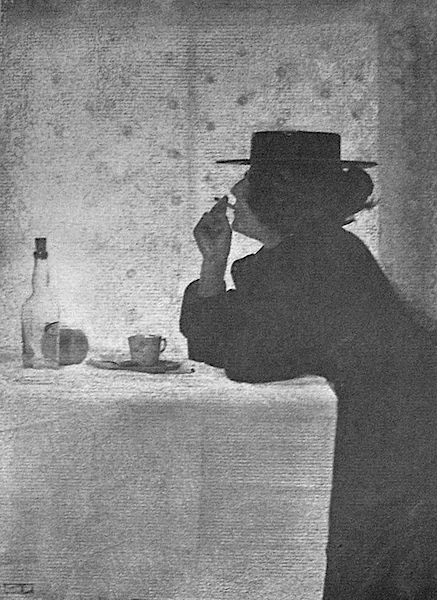
Image: the public-domain reference file. Your print is a hand-made interpretation of it, produced at the studio in Watercolour gum print — its matter and tonality are its own.
Robert Demachy · 1902
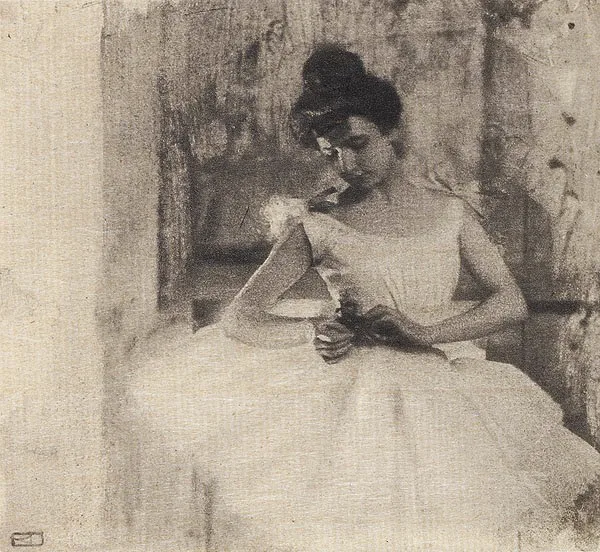
Cigarette Girl — A Poster Design
- Year
- 1902
- Original process
- Gum bichromate
- Held at
- Camera Notes (Photo-Secession)
Key facts
- Edition
- Signed and numbered limited edition
- Authenticity
- Official certificate of authenticity
- Chemistry
- Non-toxic process (Vision Picturale recipes)
- Year
- 1902
- Original held at
- Camera Notes (Photo-Secession)
- Public domain
- Since 2007 (CPI L.123-1)
- Printer
- Maison Picturale — Paris 20e studio
- Lead time
- Hand-made · 3 to 5 weeks
Maison Picturale reinterpretation in watercolour gum print
About this work
Genre portrait of a young woman smoking, conceived as a poster design — a modern Belle Époque subject treated in the pigmentary vocabulary of pictorialism. Published as a plate of Camera Notes vol. 6 n° 1 (July 1902), Alfred Stieglitz's pre-Camera Work journal of the Photo-Secession. By 1902 Demachy was the most influential pictorialist in continental Europe — co-founder with Maurice Bucquet of the Photo-Club de Paris (whose first Salon de Paris had opened in 1894), elected to the British Linked Ring in 1895, and a regular literary contributor whose proximity to the Alphonse Daudet circle anchored his photography in the salon culture of Paris. The poster format is significant: it places photography in dialogue with the lithographic affiche of Toulouse-Lautrec and Chéret, asserting that the gum bichromate print could do, in pigment and manual labour, what the chromolithographic press did mechanically. The smoking female figure is itself a Belle Époque emblem — by 1902 the cigarette had become an iconographic signal of the modern woman, treated by Manet, Degas and the affichistes — and Demachy reclaims it for pictorial photography. Technically the print is gum bichromate: gum arabic charged with watercolour pigment, sensitised with potassium bichromate, exposed under the negative and brushed selectively under tepid water — the figure of the smoking woman is sculpted into matter, the cigarette smoke modelled as a pigmentary cloud rather than captured by the lens. At Maison Picturale, this kind of Belle Époque genre piece is re-transposed in non-toxic gum bichromate following the chemistry reformulated by Vision Picturale, on 640 g/m² cotton paper — the master's pigment, without the bichromate hazard.
Reference file : Robert Demachy, Camera Notes 1902 — Public Domain / Wikimedia Commons
Procédé Transposition
Print like Robert Demachy today — without the toxics.
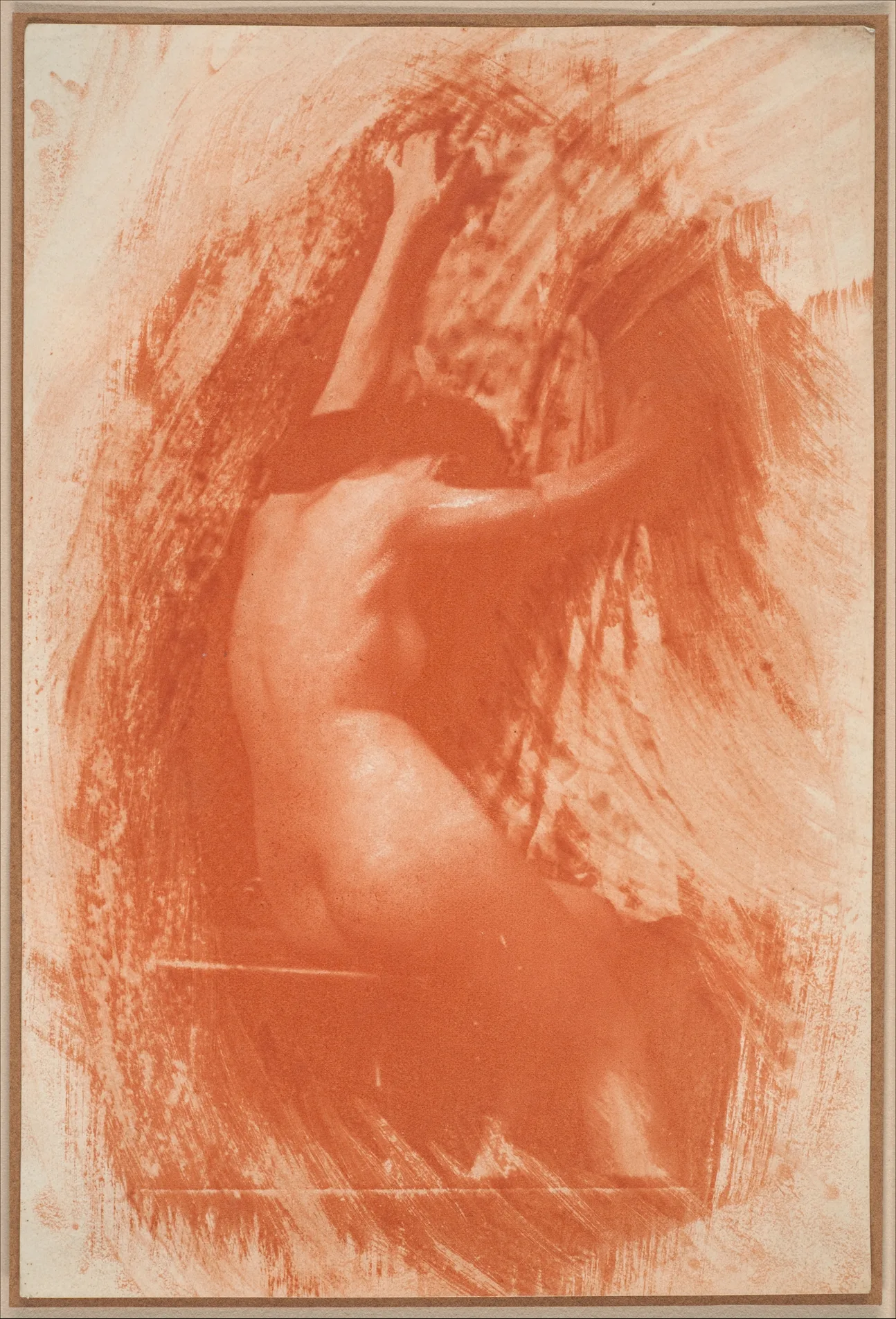
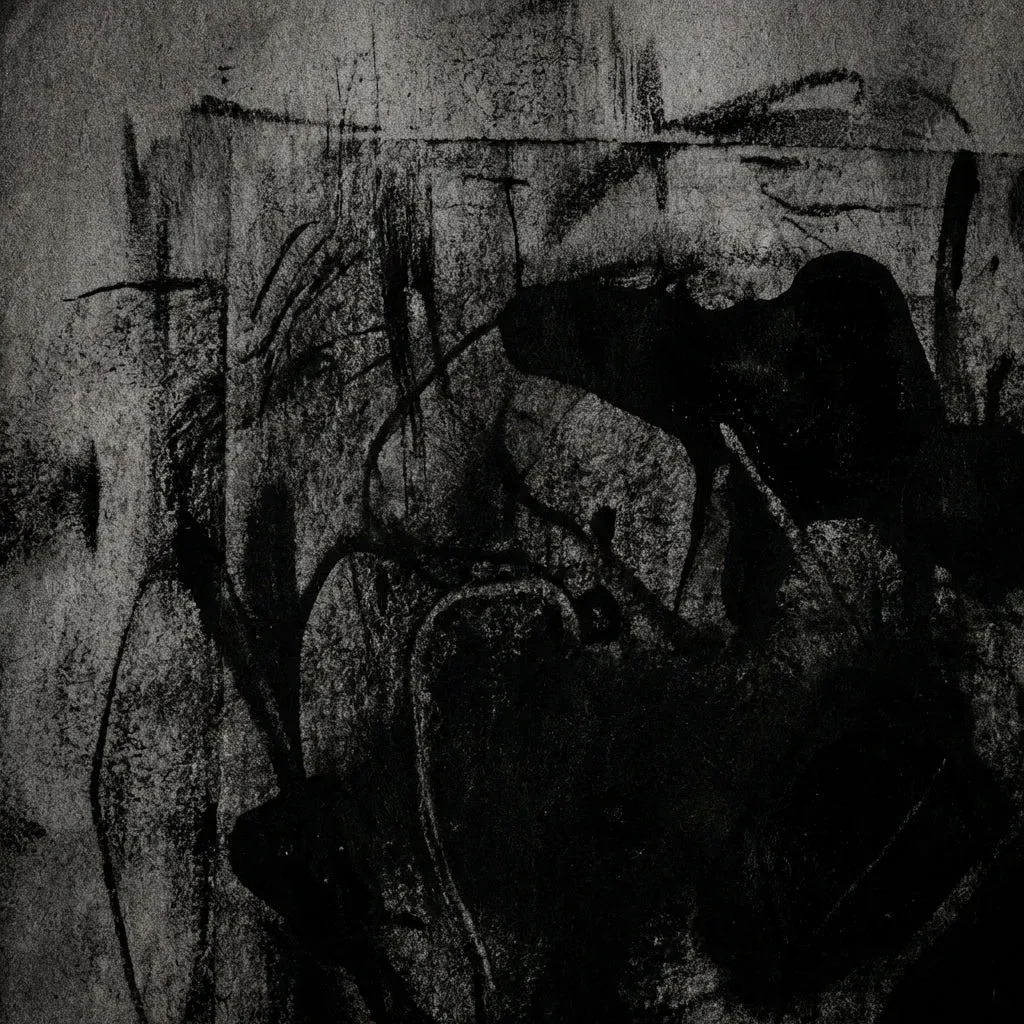
Each Maison Picturale print is a material reinterpretation of the image. Three readings of the same work — the original, its closest transposition, and a creative transposition into another procédé.
Multi-layer watercolour gum, heir to gum bichromate. Each pigment laid separately — VP reformulated recipe, no chromium VI.
MP procédé — reformulated non-toxic chemistry, signed by Tristan Sidem and Raphaël Lebas de Lacour.
View the procédéOr print it yourself
The chemistry of this process, reformulated non-toxic, is available as a kit from Vision Picturale — the house’s studio brand. Your image, your hands, the same chemistry as our printers.
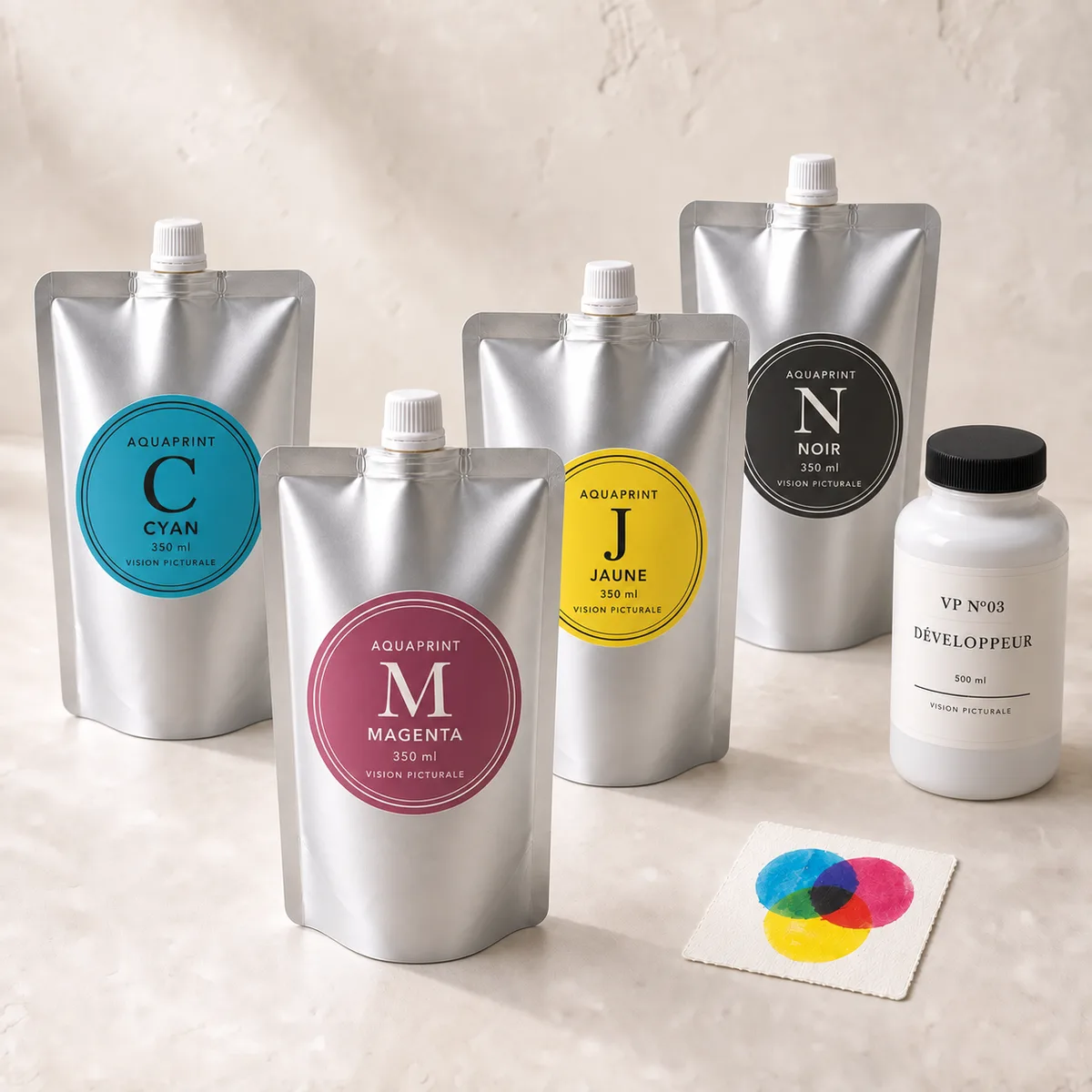
Coffret Aquaprint CMJN — Couleur Aquarelle
History of the process
Watercolour gum (gumprint, gum bichromate print) is one of the most versatile and oldest photographic processes. Its principle was discovered by Mungo Ponton in 1839, who observed that paper soaked in potassium bichromate hardened under light. It was Alphonse Poitevin who, in 1855, had the idea of mixing watercolour pigment with sensitised gum arabic: by exposing this layer under a negative, the exposed areas harden and retain the pigment while unexposed areas dissolve during washing.
The gumprint enjoyed its golden age between 1890 and 1920, within the Pictorialist movement. Photographers such as Robert Demachy, Edward Steichen, and Gertrude Käsebier used it to create images halfway between photography and painting, asserting photography as a fine art in its own right. Each colour layer is applied, sensitised, and exposed individually — a four-colour print therefore requires a minimum of four passes.
Our approach
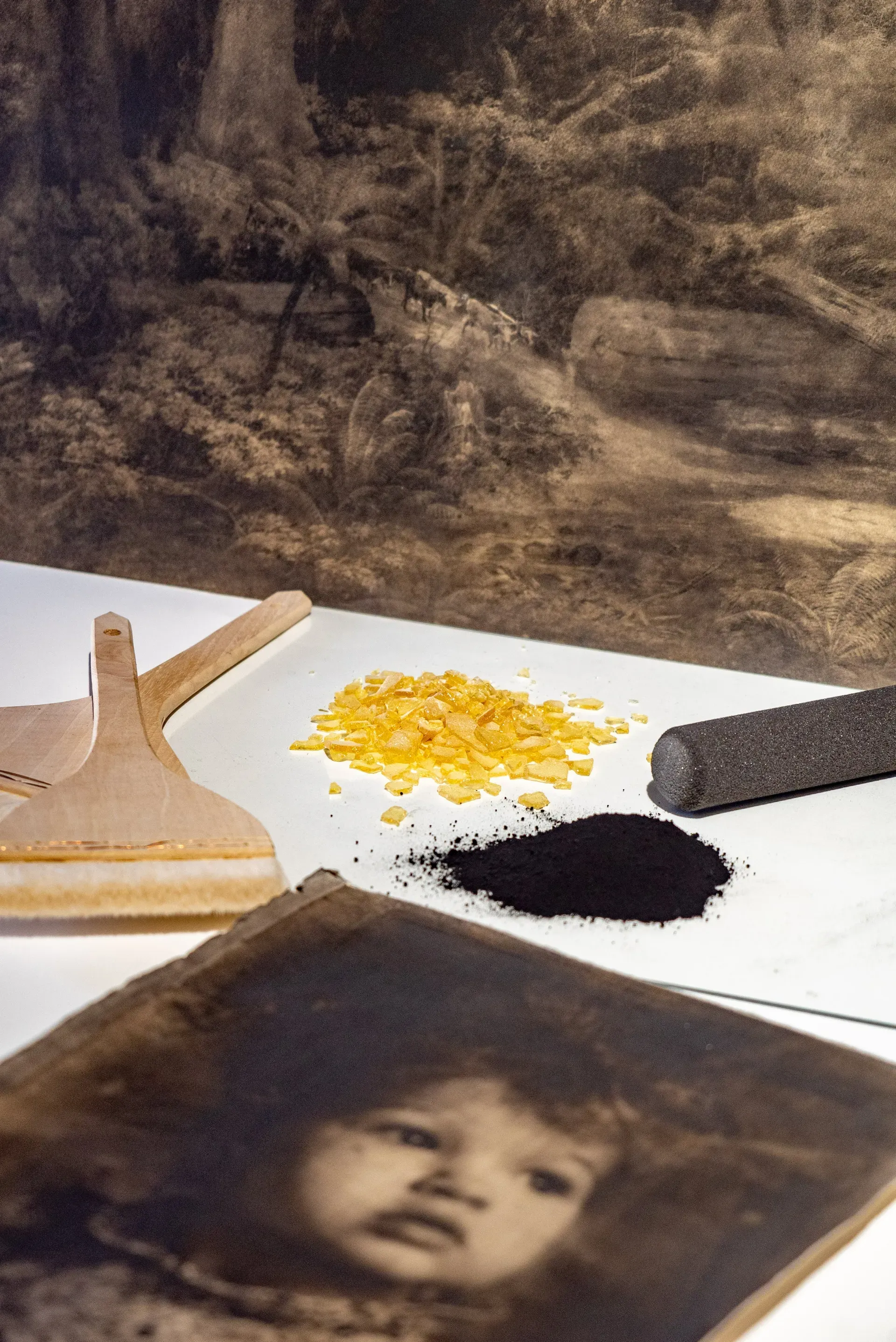
The gumprint made by Maison Picturale is an entirely handmade print where each colour layer is a unique pictorial gesture.
We work on 100% cotton satin watercolour paper at 640 g/m², capable of withstanding multiple watercolour passes without warping. In four-colour mode, each print requires four successive layers — cyan, magenta, yellow, and black — each individually sensitised, exposed, and developed. The result is an image with vibrant colours and a grain impossible to achieve with digital printing.
Inside our studio
1 Passage Dagorno, Paris 20e. Each print is hand-crafted by Tristan Sidem and Raphaël Lebas de Lacour, using Vision Picturale's reformulated non-toxic chemistry. Limited edition, signed and numbered.
Commission this print
- Hand-printed and signed by Tristan Sidem & Raphaël Lebas de Lacour
- Reformulated non-toxic chemistry (Vision Picturale recipes)
- Limited edition, numbered, certificate of authenticity
- 1 Passage Dagorno studio, Paris 20e
- Delivery 3 to 5 weeks · ships worldwide from France
Formats and prices
- ProcédéWatercolour gum print
- PriceOn request
The reference file we hold for this work is too low-resolution for us to commit to a large-format print. We are looking for a better source: write to us and we will answer on this specific point before any order.
Contemporary print after a work in the public domain (CPI L.123-1, 70 years post-mortem). Hand-crafted reinterpretation by Maison Picturale's master printers — this is not an original vintage by the master. The mention 'after [Master]' is systematic on the print and on the certificate of authenticity.