Clarence H. White
Library

1871-1925 · American

Clarence H. White

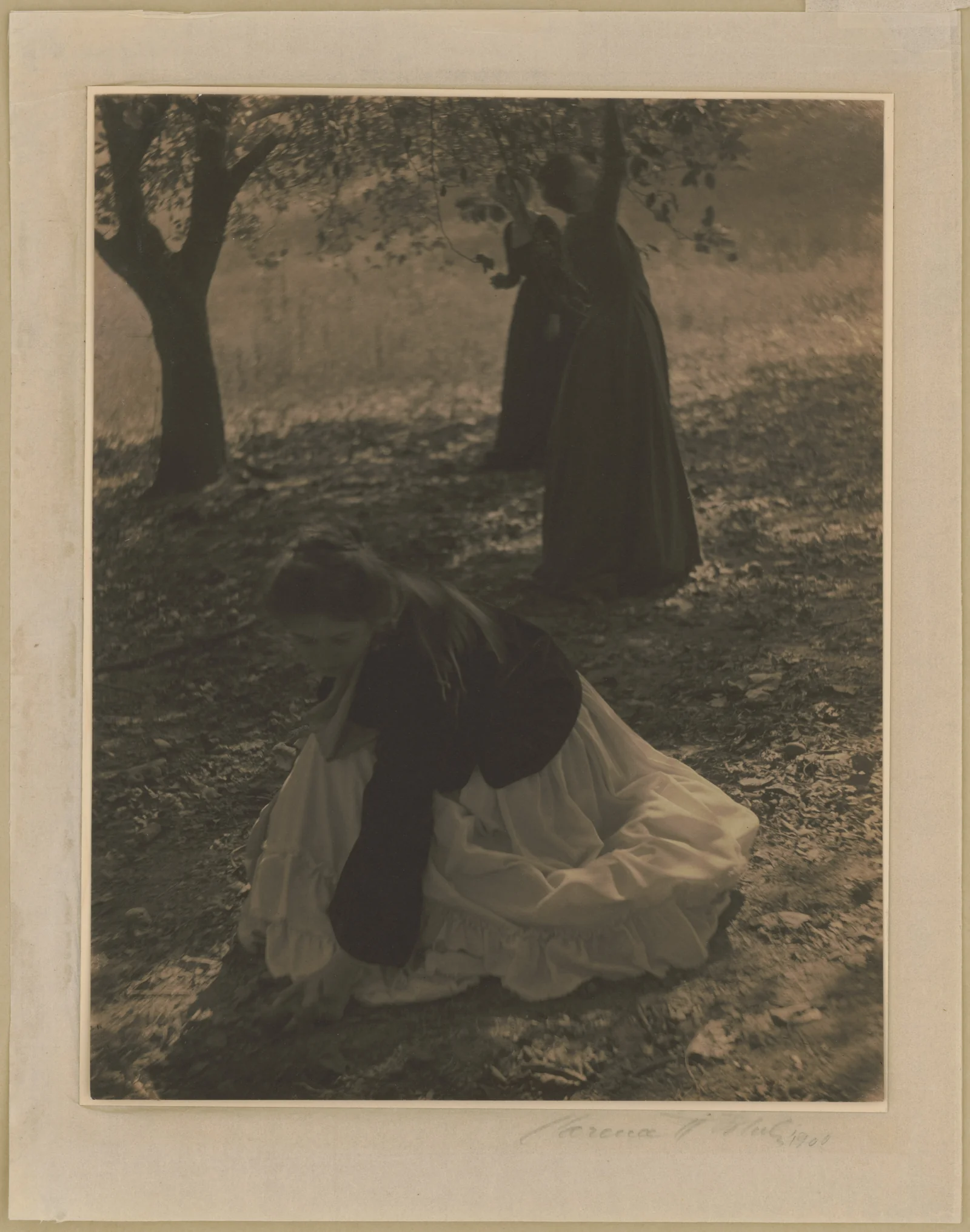
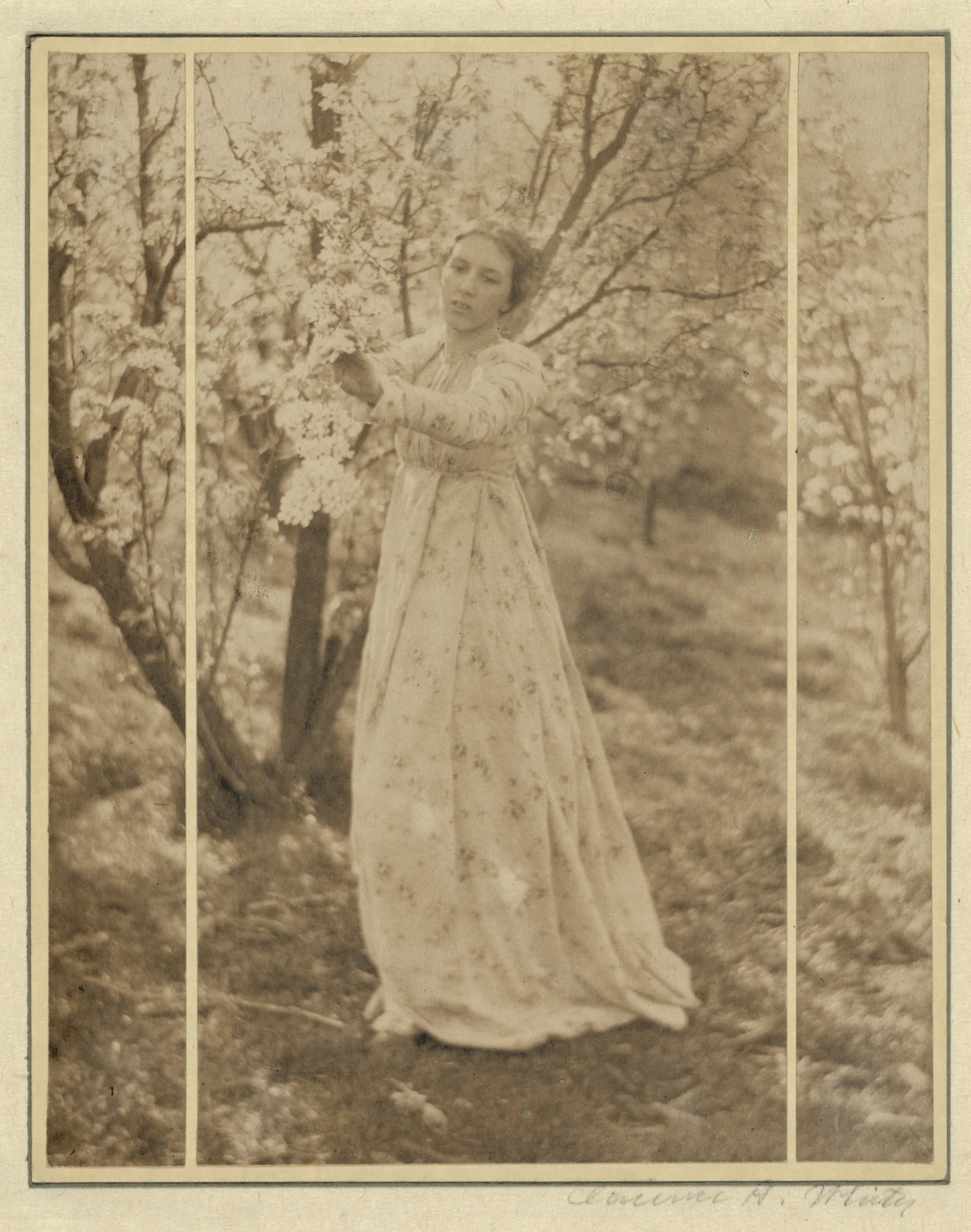
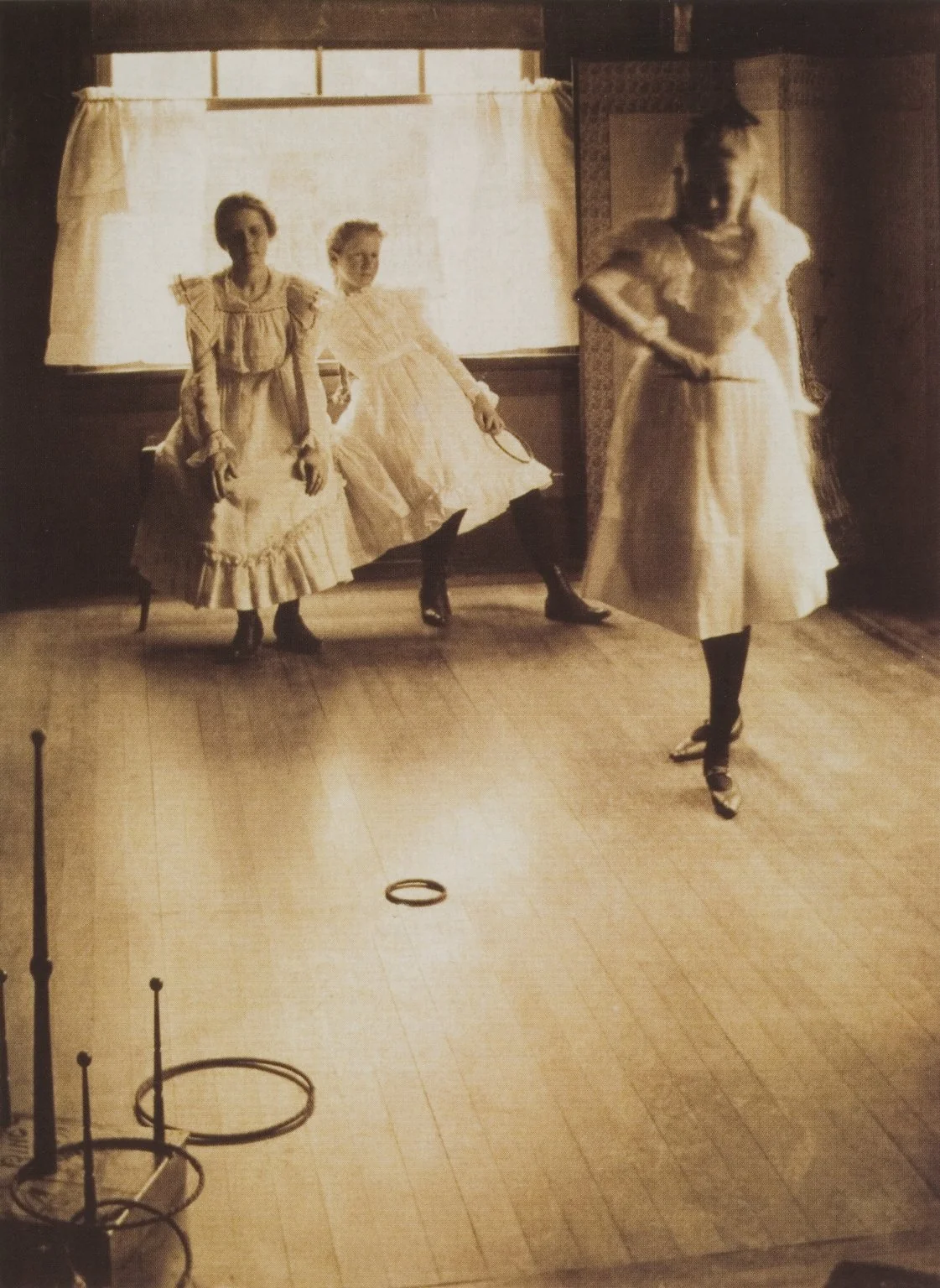
Clarence H. White (1871-1925) is the American pictorialist of intimate domestic light — Morning, The Ring Toss, The Kiss. Self-taught in Newark, Ohio, he became a Photo-Secession founder, co-founded the Pictorial Photographers of America with Gertrude Käsebier, and trained the next generation at the Clarence White School of Photography (1914-1925).

Public domain since 1996 · CPI L.123-1

Held at

  • Metropolitan Museum of Art
  • Princeton University Art Museum
  • Library of Congress
  • National Gallery of Art
  • George Eastman Museum

Born in West Carlisle, Ohio, White worked as a bookkeeper in Newark while teaching himself photography at dawn and dusk — the soft, low-angled light that became his signature. His intimate scenes of his wife Jane and their children, of Letitia Felix and Ada Follett, of children at play (Ring Toss), were exhibited at the Camera Club of New York (1899) and selected by Stieglitz for the Photo-Secession (1902). He moved to New York in 1906 and joined Columbia Teachers College, then founded the Clarence H. White School of Photography in 1914 — through which passed Margaret Bourke-White, Paul Outerbridge, Doris Ulmann, Anton Bruehl, Laura Gilpin, Dorothea Lange, and Karl Struss. In 1916, with Käsebier, he co-founded the Pictorial Photographers of America after the dissolution of the Photo-Secession. He died of a heart attack in Mexico City while leading a student trip. Held at MET, Princeton, LoC, NGA. Public domain since 1996. His platinum and gum-platinum practice is a foundational reference for Maison Picturale.

Essential works

A curated selection of public-domain works by Clarence H. White, reinterpretable as contemporary prints by Maison Picturale's master printers. Each artwork page details the original process and its atelier equivalent.

Print after — systematic mention on the certificate of authenticity.

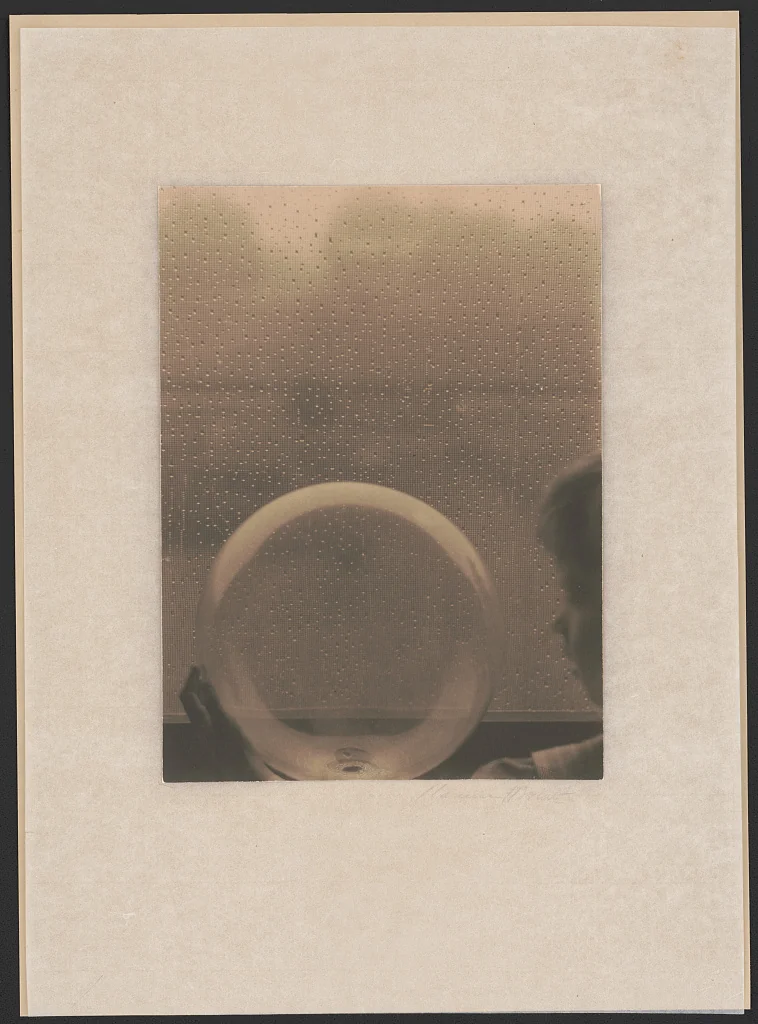
The Bubble — Clarence H. White

1898 · Platinum print

The Bubble

An early canonical work from White's Newark, Ohio period: a young girl absorbed in blowing a soap bubble, the platinum tonal scale rendering domestic intimacy as quiet allegory. Conserved at the Metropolitan Museum of Art (267723), the Museum of Modern Art and Princeton (acc. 42479) — Wikipedia singles it out as one of White's most acclaimed works.

Original held at : Metropolitan Museum of Art (267723) · Museum of Modern Art · Princeton University Art Museum (42479)

Reference file source : MET Open Access (CC0)

Lady in Black with Statuette — Clarence H. White

1908 · Platinum print

Lady in Black with Statuette

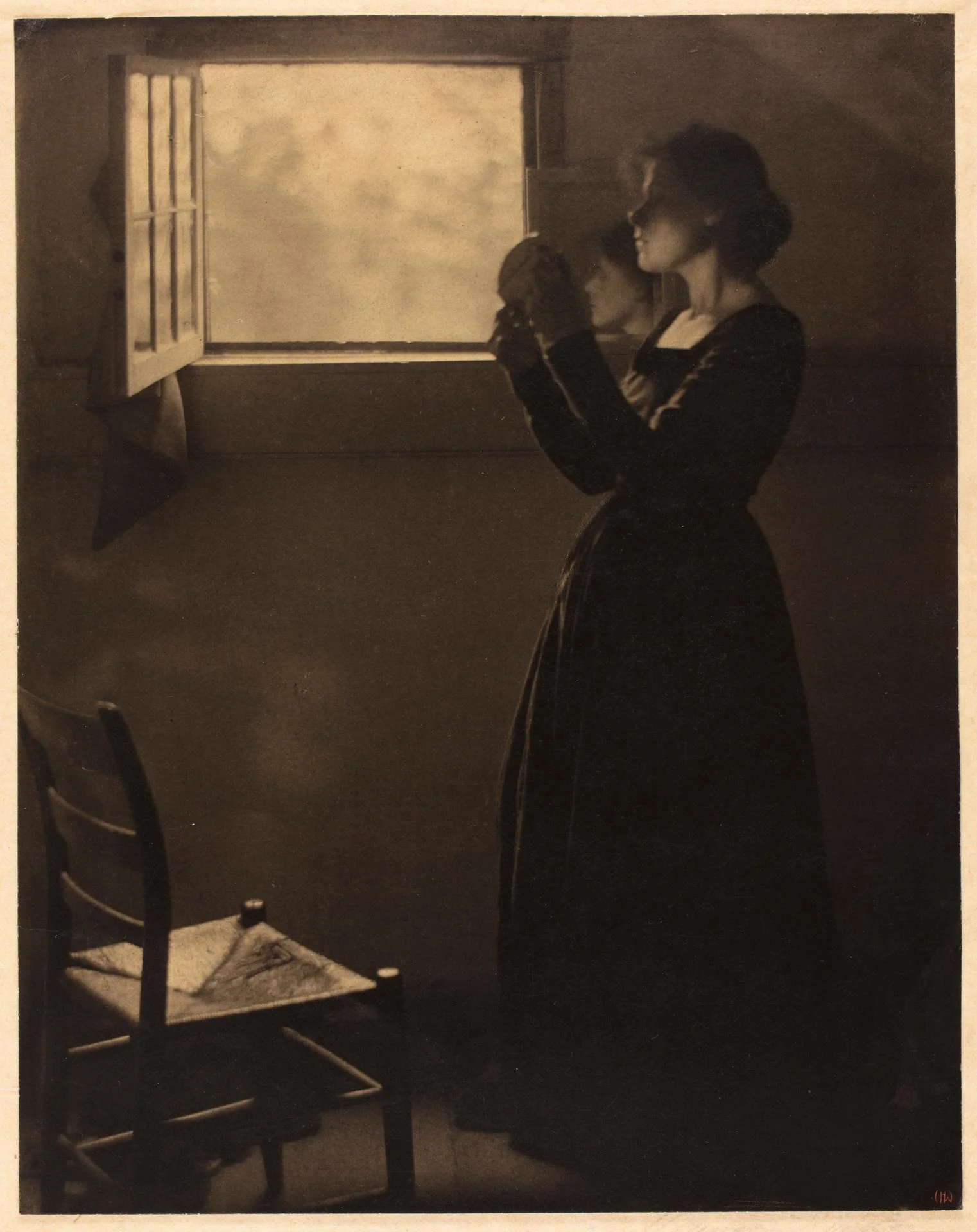
Letitia Felix posed against a Venus de Milo statuette — one of White's major Newark-period portraits, exhibited in Camera Work and acquired by the Philadelphia Museum of Art and the Metropolitan Museum (267711, sometimes catalogued as "Girl in Black with Statuette"). A palladium version is held at Davis/Wellesley. The composition stages domestic pictorialism against canonical sculpture, an allegory of the artist-model relationship.

Original held at : Philadelphia Museum of Art · Metropolitan Museum of Art (267711) · Davis Museum at Wellesley College (palladium version)

Reference file source : MET Open Access (CC0)

The Readers (Letitia Felix and Ada Follett) — Clarence H. White

1897 · Platinum print

The Readers (Letitia Felix and Ada Follett)

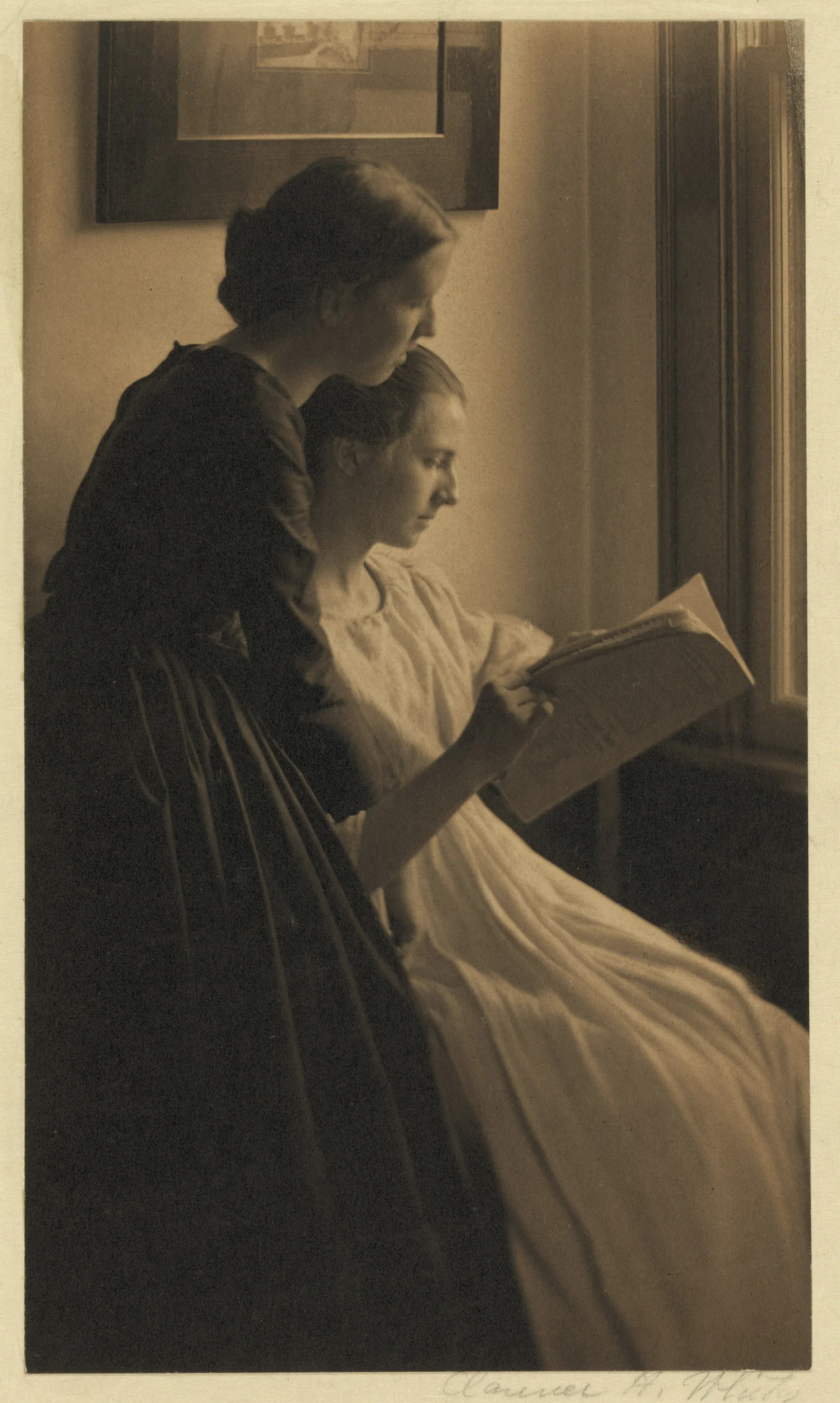
Two young women — Letitia Felix and Ada Follett, White's recurrent Newark, Ohio models — absorbed in reading inside a domestic interior, lit by oblique window light that grazes their hands, faces and printed pages. Made in 1897 during White's bookkeeper years in Newark, the platinum print belongs to the foundational moment of his pictorialism, before his selection by Stieglitz for the Photo-Secession in 1902. The composition is exemplary of White's signature economy: two figures, one light source, a horizontal axis of attention along the book, and a tonal scale that uses the platinum paper's long mid-tones to render fabric, skin and paper in a single continuous register. Where Demachy and Puyo sought painterly intervention, White worked the negative and the natural light, treating the dawn-and-dusk hours of his Newark life as the true material of his practice. The Library of Congress holds the platinum print under LCCN 2003653996 (Library of Congress Prints and Photographs Division, Washington, D.C.), and the image has entered the U.S. public domain since 1996. For Maison Picturale, The Readers is a reference for our platine-palladium workshops in Paris: the print's oblique-light intimism, achieved historically with sensitised platinum-iron paper, is reproducible today on 640 g/m² cotton paper with the non-toxic platine-palladium chemistry reformulated by Vision Picturale — preserving the warm-cool tonal duality of the original without the legacy hazards of historical platinum sensitiser handling. The 1897 dating predates Stieglitz's direct selection of White for the Photo-Secession by five years and confirms The Readers as a foundational document of pre-Secession American pictorialism, alongside The Bubble (1898) and Spring: A Triptych (1898).

Original held at : Library of Congress

Reference file source : Library of Congress (via Wikimedia Commons, public domain)

The Kiss, Terre Haute, Ind. — Clarence H. White

1904 · Platinum print

The Kiss, Terre Haute, Ind.

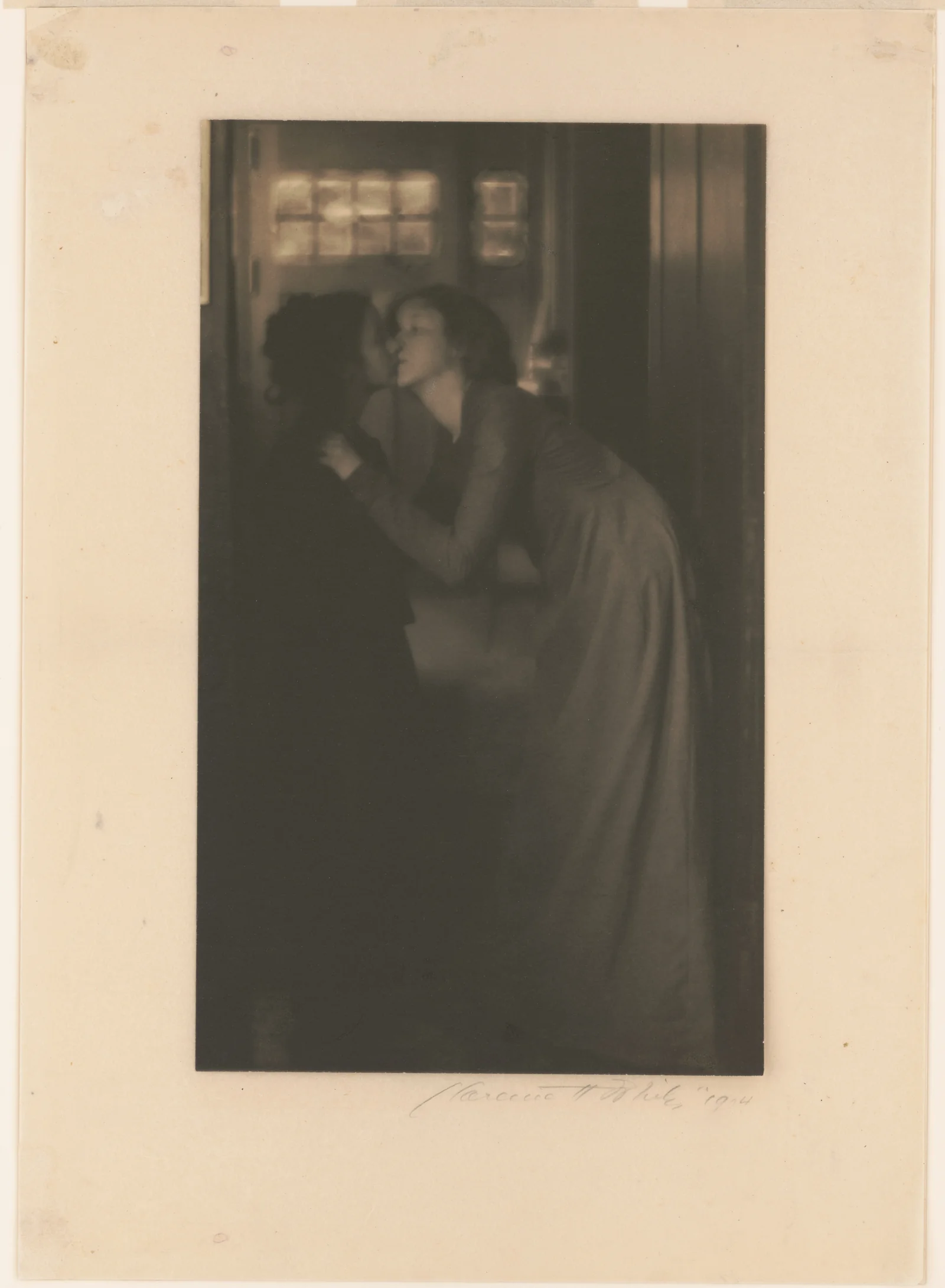
Tender embrace between the Reynolds sisters Jean and Marion — and not a romantic couple, as the image has sometimes been mis-catalogued. Made in Terre Haute, Indiana in 1904, the platinum print stages the two sisters in a quiet horizontal embrace, faces almost touching, the upper body of one against the bent head of the other, in a soft Newark-style interior light. The work is emblematic of White's American pictorialism in its refusal of the staged-couple narrative that filled commercial salon photography of the period: the subject is sororal intimacy, not romance, and the formal restraint of the composition — a single light source, a tight chest-and-shoulders crop, the platinum tonal scale doing the entire dramatic work — anticipates by three decades Cartier-Bresson's economy of the decisive moment of the intimate. The Library of Congress holds the print under LCCN 2005677531 (Library of Congress Prints and Photographs Division, Washington, D.C.), public domain since 1996. For Maison Picturale, The Kiss is a study case for our platine-palladium workshops: the print's bias toward the long mid-tones — where skin, hair and dark fabric overlap in a single tonal envelope — is precisely the register that the platine-palladium MP chemistry reformulated by Vision Picturale preserves on 640 g/m² cotton paper, without the platinum-salt handling hazards of the historical 1904 process. Compared to Käsebier's contemporaneous Mother and Child platinum prints, The Kiss demonstrates White's tighter, more reductive compositional grammar — a quality that Steichen, in his Camera Work essays, identified as the defining mark of the Ohio pictorialist.

Original held at : Library of Congress

Reference file source : Library of Congress (via Wikimedia Commons, public domain)

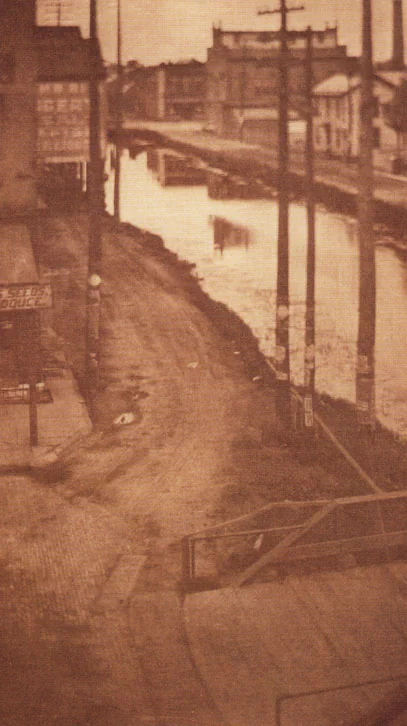
Telegraph Poles — Clarence H. White

1898 · Photogravure (Camera Work No. 3, 1903)

Telegraph Poles

A row of telegraph poles cuts the horizon of a Newark, Ohio field, dividing the landscape into bands of pastoral foreground, technological middle ground and pale sky. The 1898 image is one of White's rare ventures outside intimate domestic genre and into the industrial-pastoral juxtaposition that became a recurring American pictorialist motif — Stieglitz's locomotives, Steichen's Flatiron, White's wired countryside. Stieglitz selected the work for Camera Work No. 3 (July 1903), where it was published as a photogravure on India paper, the printing technique that defined the journal's tonal fidelity. The composition reveals White's compositional intelligence as much as his light: the verticals of the poles, the diagonal of the wires and the horizontal of the field together form a quietly modernist grid that prefigures Paul Strand's 1916 abstractions. The Library of Congress preserves a photogravure of the work, and the Camera Work plate has entered the U.S. public domain since 1996. For Maison Picturale, Telegraph Poles is a reference for our héliogravure workshops in Paris: the Camera Work India-paper photogravure tradition is transposed today through the héliogravure MP — a transposed Poitevin photogravure process developed in collaboration with Vision Picturale's non-toxic reformulation effort, which preserves the ink-on-paper continuous-tone signature of the 1903 plate without the dichromate hazards of the historical bichromated-gelatin photogravure resist. Telegraph Poles is among the earliest American photographic engagements with the industrial-pastoral motif and pre-dates by fifteen years the Precisionist iconography of Charles Sheeler and Charles Demuth — a measure of how early White's compositional modernism arrived.

Original held at : Camera Work No. 3 · Library of Congress

Reference file source : Camera Work / Wikimedia Commons (public domain)

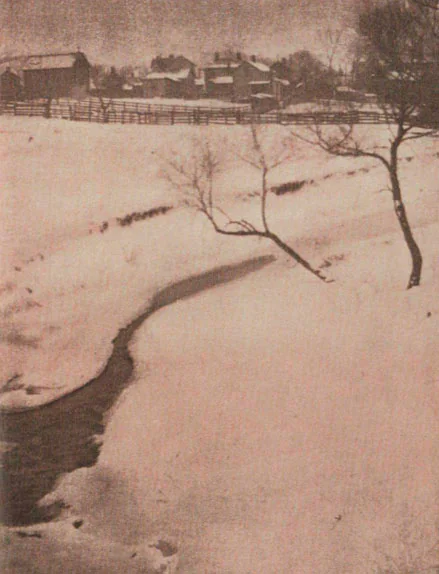
Winter Landscape — Clarence H. White

1903 · Photogravure (Camera Work No. 3, 1903)

Winter Landscape

Minimalist snow-covered field framed by sparse dark verticals — bare tree trunks or fence posts — set against a pale sky that occupies more than half the print. The 1903 image was published as a photogravure in Camera Work No. 3 (July 1903), the same issue as Telegraph Poles, and stands as one of the rare White landscapes that abandons the intimate domestic Newark mode entirely. The composition operates in high-key restraint: the snow is rendered through the photogravure ink as a continuous near-paper tone, the dark verticals as the only graphic punctuation, and the entire print sits in the upper third of the tonal scale where most pictorialists rarely ventured. This is White at his most reductive — the same compositional intelligence that organises his interior scenes by a single light source here organises an outdoor scene by a single tonal envelope. The plate is held in Camera Work No. 3 archive copies at the Library of Congress, the Metropolitan Museum and the Princeton Marquand Library, and has entered the U.S. public domain since 1996. For Maison Picturale, Winter Landscape is a reference for our héliogravure workshops: the high-key continuous-tone signature of the 1903 photogravure — extremely demanding for traditional bichromated-gelatin photogravure — is preserved today through the héliogravure MP, the transposed Poitevin process developed with Vision Picturale's non-toxic chemistry, on 640 g/m² cotton paper. Winter Landscape sits in dialogue with Steichen's contemporaneous The Pond — Moonlight (1904) and with Stieglitz's The Hand of Man (1902), but pushes the tonal envelope further into high-key reductivism than either, a position that makes it the most graphically modernist of White's Camera Work plates.

Original held at : Camera Work No. 3

Reference file source : Camera Work / Wikimedia Commons (public domain)

The Pipes of Pan — Clarence H. White

1905 · Photogravure (Camera Work No. 27, 1909) / Platinum print

The Pipes of Pan

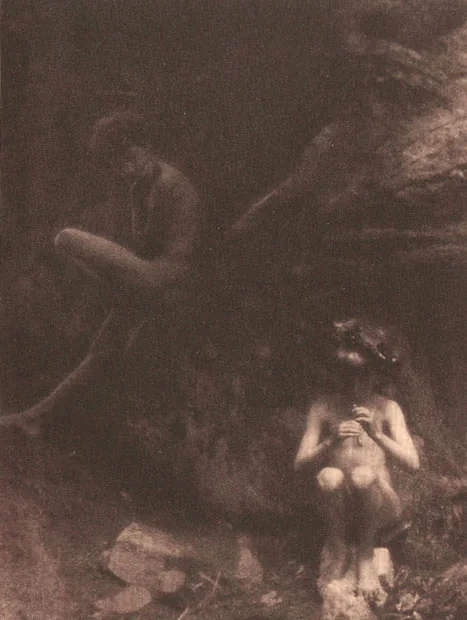
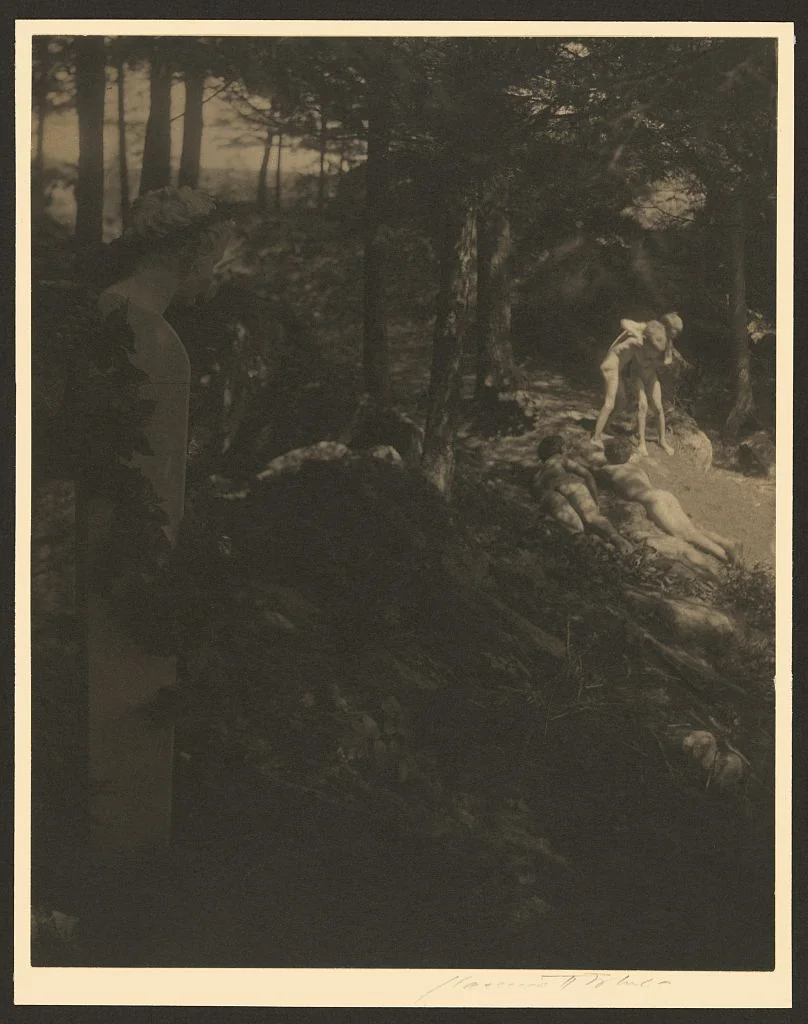
Pastoral-symbolist scene staging White's own two sons — Maynard White and Lewis White, then aged roughly twelve and eight — posed in the Maine woods near Seguinland, the family's summer home. The image is decidedly not a mythological nude, as it has sometimes been mis-described by online catalogues conflating the title with classical pipe-of-Pan iconography: White photographed his clothed children in a forest clearing, one of them holding a wooden flute or pipe, the other reading or listening, in a quiet woodland intimism that belongs squarely to his Newark-and-Maine family-pastoral mode. Stieglitz selected the work for Camera Work No. 27 (July 1909), where it was published as a photogravure; a platinum print version is held at the Library of Congress. The composition is exemplary of White's late-Newark style: dappled light, vertical tree trunks acting as architectural pillars, and the same single-source oblique illumination that defines his domestic interiors transposed outdoors. The Camera Work plate is in the U.S. public domain since 1996. For Maison Picturale, Pipes of Pan is a reference both for our platine-palladium workshops (the platinum print version's tonal scale) and for our héliogravure workshops (the Camera Work photogravure tradition), with the non-toxic chemistry reformulated by Vision Picturale preserving the woodland light envelope on 640 g/m² cotton paper. The Seguinland summer-home period also produced White's later Maine landscapes and the family genre images he continued to make until his death in 1925 — and confirms that the family-pastoral mode was, for White, the throughline of his entire mature practice, not a youthful Newark phase.

Original held at : Camera Work No. 27 · Library of Congress

Reference file source : Camera Work / Wikimedia Commons (public domain)

12 of 16 works

The documented corpus

The rest of Clarence H. White's public-domain corpus: plates kept in our editorial archives. Reproducible on request, without dedicated editorial study.

1 archived plates

Girl with Mirror — Clarence H. White

1912

Girl with Mirror

Palladium print (printed after 1917)

Commission a print after Clarence H. White

Maison Picturale produces on commission contemporary prints after works by Clarence H. White that have entered the public domain. Hand-printed by master printers Tristan Sidem and Raphaël Lebas de Lacour on 640 gsm cotton paper, signed and numbered in limited edition, with a certificate of authenticity explicitly mentioning the "after" nature of the reinterpretation.
Start a commission